10-K: Annual report pursuant to Section 13 and 15(d)
Published on March 2, 2020
UNITED STATES
SECURITIES AND EXCHANGE COMMISSION
Washington, DC 20549
FORM 10-K
ANNUAL REPORT PURSUANT TO SECTION 13 OR 15(d) OF THE SECURITIES EXCHANGE ACT OF 1934 |
|
For the fiscal year ended December 31, 2019
or
TRANSITION REPORT PURSUANT TO SECTION 13 OR 15(d) OF THE SECURITIES EXCHANGE ACT OF 1934 |
|
For the transition period from to
Commission file number 001-09718
THE PNC FINANCIAL SERVICES GROUP, INC .
(Exact name of registrant as specified in its charter)
(State or other jurisdiction of incorporation or organization) |
(I.R.S. Employer Identification No.) |
|||
(Address of principal executive offices, including zip code)
Registrant’s telephone number, including area code - (888 ) 762-2265
Securities registered pursuant to Section 12(b) of the Act:
Title of Each Class |
Trading Symbol(s)
|
Name of Each Exchange
on Which Registered
|
Floating Rate Non-Cumulative Perpetual Preferred Stock, Series P |
||
Non-Cumulative Perpetual Preferred Stock, Series Q |
||
Securities registered pursuant to Section 12(g) of the Act:
$1.80 Cumulative Convertible Preferred Stock - Series B, par value $1.00
Indicate by check mark if the registrant is a well-known seasoned issuer, as defined in Rule 405 of the Securities Act. Yes ☒ No ☐
Indicate by check mark if the registrant is not required to file reports pursuant to Section 13 or Section 15(d) of the Act. Yes ☐ No ☒
Indicate by check mark whether the registrant: (1) has filed all reports required to be filed by Section 13 or 15(d) of the Securities Exchange Act of 1934 during the preceding 12 months (or for such shorter period that the registrant was required to file such reports), and (2) has been subject to such filing requirements for the past 90 days. Yes ☒ No ☐
Indicate by check mark whether the registrant has submitted electronically every Interactive Data File required to be submitted pursuant to Rule 405 of Regulation S-T (§232.405 of this chapter) during the preceding 12 months (or for such shorter period that the registrant was required to submit such
files). Yes ☒ No ☐
Indicate by check mark whether the registrant is a large accelerated filer, an accelerated filer, a non-accelerated filer, a smaller reporting company, or an emerging growth company. See the definitions of “large accelerated filer,” “accelerated filer,” “smaller reporting company,” and "emerging growth company" in Rule 12b-2 of the Exchange Act.
☒ |
Accelerated filer |
☐ |
Emerging growth company |
|||
Non-accelerated filer |
☐ |
Smaller reporting company |
||||
If an emerging growth company, indicate by check mark if the registrant has elected not to use the extended transition period for complying with any new or revised financial accounting standards provided pursuant to Section 13(a) of the Exchange Act. ☐
Indicate by check mark whether the registrant is a shell company (as defined in Rule 12b-2 of the Act). Yes ☐ No ☒
The aggregate market value of the registrant’s outstanding voting common stock held by nonaffiliates on June 30, 2019, determined using the per share closing price on that date on the New York Stock Exchange of $137.28, was approximately $60.9 billion. There is no non-voting common equity of the registrant outstanding.
Number of shares of registrant’s common stock outstanding at February 6, 2020: 428,726,784
DOCUMENTS INCORPORATED BY REFERENCE
Portions of the definitive Proxy Statement of The PNC Financial Services Group, Inc. to be filed pursuant to Regulation 14A for the 2020 annual meeting of shareholders (Proxy Statement) are incorporated by reference into Part III of this Form 10-K.
THE PNC FINANCIAL SERVICES GROUP, INC.
Cross-Reference Index to 2019 Form 10-K
TABLE OF CONTENTS
Page |
||
PART I |
||
Item 1 |
||
Item 1A |
||
Item 1B |
||
Item 2 |
||
Item 3 |
||
Item 4 |
||
PART II |
||
Item 5 |
||
Item 6 |
||
Item 7 |
||
Item 7A |
||
Item 8 |
||
THE PNC FINANCIAL SERVICES GROUP, INC.
Cross-Reference Index to 2019 Form 10-K (continued)
TABLE OF CONTENTS (Continued)
Page |
||
Item 8 |
Financial Statements and Supplementary Data. (continued) |
|
Item 9 |
||
Item 9A |
||
Item 9B |
||
PART III |
||
Item 10 |
||
Item 11 |
||
Item 12 |
||
Item 13 |
||
Item 14 |
||
PART IV |
||
Item 15 |
||
Item 16 |
||
THE PNC FINANCIAL SERVICES GROUP, INC.
Cross-Reference Index to 2019 Form 10-K (continued)
MD&A TABLE REFERENCE
Table |
Description |
Page |
1 |
||
2 |
||
3 |
||
4 |
||
5 |
||
6 |
||
7 |
||
8 |
||
9 |
||
10 |
||
11 |
||
12 |
||
13 |
||
14 |
||
15 |
||
16 |
||
17 |
||
18 |
||
19 |
||
20 |
||
21 |
||
22 |
||
23 |
||
24 |
||
25 |
||
26 |
||
27 |
||
28 |
||
29 |
||
30 |
||
31 |
||
32 |
||
33 |
||
THE PNC FINANCIAL SERVICES GROUP, INC.
Cross-Reference Index to 2019 Form 10-K (continued)
NOTES TO CONSOLIDATED FINANCIAL STATEMENTS TABLE REFERENCE
Table |
Description |
Page |
34 |
||
35 |
||
36 |
||
37 |
||
38 |
||
39 |
||
40 |
||
41 |
||
42 |
||
43 |
||
44 |
||
45 |
||
46 |
||
47 |
||
48 |
||
49 |
||
50 |
||
51 |
||
52 |
||
53 |
||
54 |
||
55 |
||
56 |
||
57 |
||
58 |
||
59 |
||
60 |
||
61 |
||
62 |
||
63 |
||
64 |
||
65 |
||
66 |
||
THE PNC FINANCIAL SERVICES GROUP, INC.
Cross-Reference Index to 2019 Form 10-K (continued)
NOTES TO CONSOLIDATED FINANCIAL STATEMENTS TABLE REFERENCE (Continued)
Table |
Description |
Page |
67 |
||
68 |
||
69 |
||
70 |
||
71 |
||
72 |
||
73 |
||
74 |
||
75 |
||
76 |
||
77 |
||
78 |
||
79 |
||
80 |
||
81 |
||
82 |
||
83 |
||
84 |
||
85 |
||
86 |
||
87 |
||
88 |
||
89 |
||
90 |
||
91 |
||
92 |
||
93 |
||
94 |
||
95 |
||
96 |
||
97 |
||
98 |
||
99 |
||
100 |
||
101 |
||
102 |
||
103 |
||
104 |
||
105 |
||
106 |
|
|
PART I
Forward-Looking Statements: From time to time, The PNC Financial Services Group, Inc. has made and may continue to make written or oral forward-looking statements regarding our outlook for earnings, revenues, expenses, capital and liquidity levels and ratios, asset levels, asset quality, financial position and other matters regarding or affecting us and our future business and operations or the impact of legal, regulatory or supervisory matters on our business operations or performance. This Annual Report on Form 10-K (the Report or Form 10-K) also includes forward-looking statements. With respect to all such forward-looking statements, you should review our Risk Factors discussion in Item 1A, our Risk Management, Critical Accounting Estimates and Judgments, and Cautionary Statement Regarding Forward-Looking Information sections included in Item 7, and Note 19 Legal Proceedings in the Notes To Consolidated Financial Statements included in Item 8 of this Report. See page 79 for a glossary of certain terms used in this Report. In this Report, "PNC", "we", "us", "the Company" or "the Corporation" refers to The PNC Financial Services Group, Inc. and its subsidiaries on a consolidated basis (except when referring to PNC as a public company, its common stock or other securities issued by PNC, which just refer to The PNC Financial Services Group, Inc.). References to The PNC Financial Services Group, Inc. or to any of its subsidiaries are specifically made where applicable.
ITEM 1 – BUSINESS
Business Overview
Headquartered in Pittsburgh, Pennsylvania, we are one of the largest diversified financial services companies in the United States (U.S.). We have businesses engaged in retail banking, including residential mortgage, corporate and institutional banking and asset management, providing many of our products and services nationally. Our retail branch network is located primarily in markets across the Mid-Atlantic, Midwest and Southeast. We also have strategic international offices in four countries outside the U.S. At December 31, 2019, our consolidated total assets, total deposits and total shareholders’ equity were $410.3 billion, $288.5 billion and $49.3 billion, respectively.
We were incorporated under the laws of the Commonwealth of Pennsylvania in 1983 with the consolidation of Pittsburgh National Corporation and Provident National Corporation. Since 1983, we have diversified our geographical presence, business mix and product capabilities through organic growth, strategic bank and non-bank acquisitions and equity investments, and the formation of various non-banking subsidiaries.
Subsidiaries
Our corporate legal structure at December 31, 2019 consisted of one domestic subsidiary bank, including its subsidiaries, and 38 active non-bank subsidiaries, in addition to various affordable housing investments and historic rehabilitation investments. Our bank subsidiary is PNC Bank, National Association (PNC Bank), a national bank headquartered in Pittsburgh, Pennsylvania. For additional information on certain of our subsidiaries, see Exhibit 21 to this Report.
Statistical Disclosure By Bank Holding Companies
The following statistical information is included on the indicated pages of this Report and is incorporated herein by reference:
Form 10-K page |
|
Average Consolidated Balance Sheet And Net Interest Analysis |
172 |
Analysis Of Year-To-Year Changes In Net Interest Income |
173 |
Book Values Of Securities |
42 and 118-120 |
Maturities And Weighted-Average Yield Of Securities |
43 and 120 |
Loan Types |
41-42, 57, 110-111 and 174 |
Selected Loan Maturities And Interest Sensitivity |
175 |
Nonaccrual, Past Due And Restructured Loans And Other Nonperforming Assets |
56-65, 96-100, 109-116 and 175 |
Potential Problem Loans |
56-65 |
Summary Of Loan Loss Experience |
63-65, 117 and 176 |
Allocation Of Allowance For Loan And Lease Losses |
63-65, and 176 |
Average Amount And Average Rate Paid On Deposits |
172 |
Time Deposits Of $100,000 Or More |
177 |
Selected Consolidated Financial Data |
33-35 |
Short-term Borrowings – not included as average balances during 2019, 2018 and 2017 were less than 30% of total shareholders’ equity at the end of each period. |
|
The PNC Financial Services Group, Inc. – 2019 Form 10-K 1
Supervision and Regulation
The PNC Financial Services Group, Inc. is a bank holding company (BHC) registered under the Bank Holding Company Act of 1956 (BHC Act) and a financial holding company under the Gramm-Leach-Bliley Act (GLB Act).
We are subject to numerous governmental regulations, some of which are highlighted below. See Note 18 Regulatory Matters in the Notes To Consolidated Financial Statements in Item 8 of this Report for additional information regarding our regulatory matters. Applicable laws and regulations restrict our permissible activities and investments, impose conditions and requirements on the products and services we offer and the manner in which they are offered and sold, and require compliance with protections for loan, deposit, brokerage, fiduciary, investment management and other customers, among other things. They also restrict our ability to repurchase stock or pay dividends, or to receive dividends from our bank subsidiary, and impose capital adequacy and liquidity requirements. The consequences of noncompliance with these, or other applicable laws or regulations, can include substantial monetary and nonmonetary sanctions.
In addition, we are subject to comprehensive supervision and periodic examination by, among other regulatory bodies, the Board of Governors of the Federal Reserve System (Federal Reserve) and the Office of the Comptroller of the Currency (OCC). These examinations consider not only compliance with applicable laws, regulations and supervisory policies of the agency, but also capital levels, asset quality, risk management effectiveness, the ability and performance of management and the board of directors, the effectiveness of internal controls and internal audit function, earnings, liquidity and various other factors.
The results of examination activity by any of our federal bank regulators potentially can result in the imposition of significant limitations on our activities and growth. These regulatory agencies generally have broad discretion to impose restrictions and limitations on the operations of a regulated entity and take enforcement action, including the imposition of substantial monetary penalties and nonmonetary requirements, against a regulated entity where the relevant agency determines, among other things, that the operations of the regulated entity or any of its subsidiaries fail to comply with applicable law or regulations, are conducted in an unsafe or unsound manner, or represent an unfair or deceptive act or practice. This supervisory framework, including the examination reports and supervisory ratings (which are not publicly available) of the agencies, could materially impact the conduct, growth and profitability of our operations.
The Consumer Financial Protection Bureau (CFPB) is responsible for examining PNC Bank and its affiliates (including PNC) for compliance with most federal consumer financial protection laws, including the laws relating to fair lending and prohibiting unfair, deceptive or abusive acts or practices in connection with the offer, sale or provision of consumer financial products or services, and for enforcing such laws with respect to PNC Bank and its affiliates. The results of the CFPB’s examinations (which are not publicly available) also can result in restrictions or limitations on the operations of a regulated entity as well as enforcement actions against a regulated entity, including the imposition of substantial monetary penalties and nonmonetary requirements.
We also are subject to regulation by the Securities and Exchange Commission (SEC) by virtue of our status as a public company and by the SEC and the Commodity Futures Trading Commission (CFTC) due to the nature of some of our businesses. Our businesses with operations outside the United States also are subject to regulation by appropriate authorities in the foreign jurisdictions in which they do business.
As a regulated financial services firm, our relationships and good standing with regulators are of fundamental importance to the operation and growth of our businesses. The Federal Reserve, OCC, CFPB, SEC, CFTC and other domestic and foreign regulators have broad enforcement powers, and certain of the regulators have the power to approve, deny, or refuse to act upon our applications or notices to conduct new activities, acquire or divest businesses, assets or deposits, expand our operations geographically, or reconfigure existing operations.
Among the areas that have been receiving a high level of regulatory focus are cyber security, compliance with the Bank Secrecy Act and anti-money laundering laws, capital and liquidity management (including stress testing), the oversight of arrangements with third-party vendors and suppliers, the protection of confidential customer information, the structure and effectiveness of enterprise risk management frameworks, and compliance with fair lending and other consumer protection laws and regulations, including those governing retail sales practices, fee disclosures, unfair, deceptive or abusive acts or practices, collection practices, and protections for military service members and individuals in bankruptcy.
New legislation, changes in rules promulgated by federal financial regulators, other federal and state regulatory authorities and self-regulatory organizations, or changes in the interpretation or enforcement of existing laws and rules, may directly affect the operations and profitability of our businesses. We anticipate new legislative and regulatory initiatives over the next several years, focused specifically on banking and other financial services in which we are engaged. Legislative and regulatory developments to date, as well as those that come in the future, have had and are likely to continue to have an impact on the conduct of our business. The more detailed description of the significant regulations to which we are subject included in this Report is based on current laws and
2 The PNC Financial Services Group, Inc. – 2019 Form 10-K
regulations and is subject to potentially material change. See also the additional information included as Risk Factors in Item 1A of this Report discussing the impact of financial regulatory initiatives on the regulatory environment for us and the financial services industry.
The profitability of our businesses could also be affected by rules and regulations that impact the business and financial sectors in general, including changes to the laws governing taxation, antitrust regulation, electronic commerce, data security and privacy.
There are numerous rules governing the regulation of financial services institutions and their holding companies. Accordingly, the following discussion is general in nature and does not purport to be complete or to describe all of the laws, regulations and policies that apply to us. To a substantial extent, the purpose of the regulation and supervision of financial services institutions and their holding companies is not to protect our shareholders and our non-customer creditors, but rather to protect our customers (including depositors) and the financial markets and financial system in general.
Banking Regulation and Supervision
Regulatory Capital Requirements, Stress Testing and Capital Planning. PNC and PNC Bank are subject to the regulatory capital requirements established by the Federal Reserve and the OCC, respectively. The foundation of the agencies’ regulatory capital rules is the international regulatory capital framework developed by the Basel Committee on Banking Supervision (Basel Committee), the international body responsible for developing global regulatory standards for banking organizations for consideration and adoption by national jurisdictions. The regulatory capital rules establish minimum requirements for the ratio of a banking organization’s regulatory capital to its risk-weighted assets, referred to as risk-based capital requirements, as well as for the ratio of its regulatory capital to measures of assets and other exposures, referred to as leverage capital requirements. The agencies’ regulatory capital rules have undergone significant change since 2013, when the agencies adopted final rules to implement the Basel Committee's international regulatory capital framework, known as “Basel III”, as well as certain provisions of the Dodd-Frank Wall Street Reform and Consumer Protection Act (Dodd-Frank).
In 2019, the federal banking agencies adopted rules to better tailor the application of their capital, liquidity and enhanced prudential requirements for banking organizations to the asset size and risk profile (as measured by certain regulatory metrics) of the banking organization (the “2019 Tailoring Rules”). Effective January 1, 2020, the agencies’ capital and liquidity rules classify all bank holding companies (BHCs) with $100 billion or more in total assets into one of four categories (Category I, Category II, Category III and Category IV), with the most stringent capital and liquidity requirements applying to Category I firms and the least restrictive requirements applying to Category IV firms. The classification of any bank subsidiary of a BHC generally follows that of its parent BHC. PNC and PNC Bank currently are Category III firms because PNC (i) has more than $250 billion, but less than $700 billion, in consolidated total assets, (ii) is not designated as a globally systemically important bank (GSIB), and (iii) has less than $75 billion in cross-jurisdictional activity (as defined by the rules). PNC and PNC Bank would become a Category I or II institution, and subject to more stringent capital and liquidity standards, if PNC were at some point in the future to have $700 billion or more in total consolidated assets, be designated as a GSIB, or have $75 billion or more in cross-jurisdictional activity. As of December 31, 2019, PNC had cross-jurisdictional activities for these purposes of $13.4 billion.
The regulatory capital rules generally divide regulatory capital into three components: common equity Tier 1 (CET1) capital, additional Tier 1 capital (which, together with CET1 capital, comprises Tier 1 capital) and Tier 2 capital. CET1 capital is generally common stock, retained earnings, and qualifying minority interest less required deductions. Prior to January 1, 2020, CET1 capital for PNC and PNC Bank also included accumulated other comprehensive income (AOCI) related to both available for sale securities and pension and other post-retirement plans. Effective January 1, 2020, PNC and PNC Bank elected to exclude AOCI related to these items from CET1 capital. Additional Tier 1 capital generally includes, among other things, perpetual preferred stock and qualifying minority interests, less required deductions. Tier 2 capital generally comprises qualifying subordinated debt, less any required deductions from Tier 2 capital. The regulatory capital rules limit the extent to which minority interests in consolidated subsidiaries may be included in regulatory capital. Total capital is the sum of Tier 1 capital and Tier 2 capital, less the deductions required from Total capital.
Under the regulatory capital rules effective as of January 1, 2020, PNC and PNC Bank must deduct investments in unconsolidated financial institutions, mortgage servicing rights and deferred tax assets from CET1 capital (in each case, net of associated deferred tax liabilities) to the extent such items individually exceed 25% of the institution’s adjusted CET1 capital. Prior to January 1, 2020, PNC and PNC Bank had to deduct significant common stock investments in unconsolidated financial institutions, as well as mortgage servicing rights and deferred tax assets, from CET1 capital (in each case, net of associated deferred tax liabilities) to the extent such items individually exceeded 10%, or in the aggregate exceeded 15%, of the institution’s adjusted CET1 capital. PNC's common stock investment in BlackRock is treated as an investment (and a significant common stock investment) in an unconsolidated financial institution for these purposes. A significant amount of PNC's common stock investment in BlackRock, net of associated deferred tax liabilities, was subject to these threshold deductions under the rules applicable as of December 31, 2019. If the new rules had been in effect on that date, no amount of PNC's equity investment in BlackRock would have been subject to these threshold deductions.
The PNC Financial Services Group, Inc. – 2019 Form 10-K 3
The agencies’ capital rules also permit banking organizations to elect to phase-in, on a straight-line basis over a three-year period, the day-one regulatory capital effects of implementing the Financial Accounting Standards Board’s (FASB) Accounting Standards Update (ASU) 2016-13 Financial Instruments - Credit Losses (Topic 326), commonly referred to as the Current Expected Credit Losses (CECL) standard. PNC implemented the CECL standard effective January 1, 2020, but elected not to implement the phase-in of the day-one regulatory capital effects of the standard. See Note 1 Accounting Policies in the Notes to Consolidated Financial Statements in Item 8 of this Report for more detail on the CECL standard.
PNC and PNC Bank are required to use the standardized approach for determining a banking organization’s risk-weighted assets for purposes of calculating the risk-based capital ratios. The standardized approach for risk-weighted assets takes into account credit and market risk. To calculate risk-weighted assets under the standardized approach for credit risk, the nominal dollar amounts of assets and credit equivalent amounts of off-balance sheet items are generally multiplied by risk weights set forth in the rules, with the risk weights increasing as the perceived credit risk of the relevant asset or exposure increases. For certain types of exposures, such as securitization exposures, the standardized approach establishes one or more methodologies that are to be used to calculate the risk-weighted asset amount for the exposure. High volatility commercial real estate, past due, securitization and equity exposures, as well as mortgage servicing rights and deferred tax assets that are not deducted from capital, are generally subject to higher risk weights than other types of exposures. Under the market risk capital rule, risk-weighted asset amounts for covered trading positions are determined based on the calculation of value-at-risk (including stressed value-at-risk), specific risk, incremental risk and comprehensive risk amounts, as specified in the capital rules.
Prior to January 1, 2020, PNC and PNC Bank also were required to calculate risk-weighted assets using a separate methodology, referred to as the advanced approaches, that is based on the Basel II capital framework. Capital ratios calculated using this methodology would potentially have been applicable to PNC upon completion of a parallel run qualification phase. PNC remained in this phase as of the end of 2019, and accordingly, our regulatory risk-based capital ratios in 2019 were calculated using the standardized approach for determining risk-weighted assets.
With the exception of certain nonqualifying trust preferred capital securities included in PNC’s total risk-based capital (which remain subject to a phase-out period that runs through 2021), the transitions and multi-year phase-in of the definition of capital under the Basel III rules were completed as of January 1, 2018. Accordingly, we refer to the capital ratios calculated using the definition of capital in effect as of January 1, 2018 and, for the risk-based ratios, standardized risk-weighted assets, as our Basel III regulatory capital ratios.
The risk-based capital rules establish certain minimum standards for the capital ratios of banking organizations, including PNC and PNC Bank. Banking organizations must maintain a minimum CET1 ratio of 4.5%, a Tier 1 capital ratio of 6.0%, and a Total capital ratio of 8.0%, in each case in relation to risk-weighted assets, to be considered “adequately capitalized.” Banking organizations also must maintain a capital conservation buffer requirement above the minimum risk-based capital ratio requirements in order to avoid limitations on capital distributions (including dividends and repurchases of any Tier 1 capital instrument, such as common and qualifying preferred stock) and certain discretionary incentive compensation payments. The capital conservation buffer requirement became fully phased in as of January 1, 2019. As a result, banking organizations (including PNC and PNC Bank) now are required to maintain a CET1 capital ratio of at least 7.0%, a Tier 1 capital ratio of at least 8.5%, and a Total capital ratio of at least 10.5% to avoid limitations on capital distributions and certain discretionary incentive compensation payments.
For Category III banking organizations (such as PNC and PNC Bank), these higher capital conservation buffer levels above the regulatory minimums could be supplemented by a countercyclical capital buffer of up to an additional 2.5% of risk-weighted assets. This buffer is currently set at zero in the U.S. A Federal Reserve policy statement establishes the framework and factors the Federal Reserve would use in setting and adjusting the amount of the U.S. countercyclical capital buffer. Covered banking organizations would generally have 12 months after the announcement of any increase in the countercyclical capital buffer to meet the increased buffer requirement, unless the Federal Reserve determines to establish an earlier effective date. If the full countercyclical buffer amount is implemented, PNC and PNC Bank would be required to maintain a CET1 capital ratio of at least 9.5%, a Tier 1 capital ratio of at least 11%, and a Total capital ratio of at least 13% to avoid limitations on capital distributions and certain discretionary incentive compensation payments.
The regulatory capital rules also require that banking organizations maintain a minimum amount of Tier 1 capital to average consolidated assets, referred to as the leverage ratio, and require Category III banking organizations to maintain a minimum amount of Tier 1 capital to total leverage exposure, referred to as the supplementary leverage ratio. Total leverage exposure takes into account on-balance sheet assets as well as certain off-balance sheet items, including loan commitments and potential future exposure under derivative contracts. Banking organizations are required to maintain a minimum leverage ratio of Tier 1 capital to total assets of 4.0%, and Category III banking organizations must maintain a minimum supplementary leverage ratio of 3.0%. As of December 31, 2019, the leverage and supplementary leverage ratios of PNC and PNC Bank were above the required minimum level.
4 The PNC Financial Services Group, Inc. – 2019 Form 10-K
PNC and PNC Bank are not subject to the additional CET1 capital surcharge, minimum long-term debt requirement, minimum total loss-absorbing capacity (TLAC), or enhanced supplementary leverage ratio requirements that apply to U.S. GSIBs.
Failure to meet applicable capital requirements could subject a banking organization to a variety of enforcement remedies available to the federal banking agencies, including a limitation on the ability to pay dividends or repurchase shares, the issuance of a capital directive to increase capital and, in severe cases, the termination of deposit insurance by the FDIC and the appointment of a conservator or receiver. In some cases, the extent of these powers depends upon whether the institution in question is considered “well capitalized,” “adequately capitalized,” “undercapitalized,” “significantly undercapitalized” or “critically undercapitalized.” The thresholds at which an insured depository institution is considered “well capitalized,” “adequately capitalized,” “undercapitalized,” “significantly undercapitalized” or “critically undercapitalized” are based on (i) the institution’s CET1, Tier 1 and total risk-based capital ratios; (ii) the institution’s leverage ratio; and (iii) for the definitions of “adequately capitalized” and “undercapitalized”, the institution’s supplementary leverage ratio (if applicable). Generally, the smaller an institution’s capital base in relation to its risk-weighted or total assets, the greater the scope and severity of the agencies’ powers. Business activities may also be affected by an institution’s capital classification. For example, as a financial holding company, PNC and PNC Bank must remain “well capitalized.”
At December 31, 2019, PNC and PNC Bank exceeded the required ratios for classification as “well capitalized.” For additional discussion of capital adequacy requirements, including the levels of capital required to be considered “well capitalized,” see the Liquidity and Capital Management portion of the Risk Management section of Item 7 of this Report and Note 18 Regulatory Matters in the Notes To Consolidated Financial Statements in Item 8 of this Report.
In addition to regulatory capital requirements, we are subject to the Federal Reserve’s capital plan rule, capital stress testing requirements and Comprehensive Capital Analysis and Review (CCAR) process, as well as the Dodd-Frank capital stress testing (DFAST) requirements of the Federal Reserve and the OCC.
As part of the annual CCAR process, the Federal Reserve undertakes a supervisory assessment of the capital planning process of BHCs, including PNC, that have $100 billion or more in total consolidated assets. For us, this capital planning assessment is based on a review of a comprehensive capital plan submitted to the Federal Reserve that describes the company’s planned capital actions, such as plans to pay or increase common stock dividends, engage in common stock repurchase programs, or issue or redeem preferred stock or other regulatory capital instruments, during the nine quarter review period, as well as the results of stress tests conducted by both the company and the Federal Reserve under different hypothetical macro-economic scenarios, including a supervisory severely adverse scenario provided by the Federal Reserve.
The Federal Reserve can object to a BHC’s capital plan if the Federal Reserve estimates that under the hypothetical supervisory macro-economic scenarios (including the supervisory severely adverse scenario) the BHC would not be able to maintain, throughout each quarter of the nine quarter review period, projected regulatory risk-based and leverage capital ratios that exceed the applicable minimums. In making these estimates, the Federal Reserve assumes that the BHC would continue its base case capital actions in each supervisory scenario, including the severely adverse scenario. If the Federal Reserve objects to a BHC’s capital plan, the BHC cannot make capital distributions without Federal Reserve approval.
In evaluating PNC’s capital plan, the Federal Reserve also considers a number of qualitative factors. The Federal Reserve’s supervisory expectations for the capital planning and stress testing processes at large and complex BHCs, including PNC, are heightened relative to smaller and less complex BHCs. In assessing a BHC’s capital planning and stress testing processes, the Federal Reserve considers whether the BHC has sound and effective governance to oversee these processes. The Federal Reserve’s evaluation focuses on whether a BHC’s capital planning and stress testing processes are supported by a strong risk management framework to identify, measure and assess material risks and that provides a strong foundation to capital planning. The Federal Reserve also considers the comprehensiveness of a BHC’s control framework and evaluates a BHC’s policy guidelines for capital planning and assessing capital adequacy. A BHC’s stress testing scenario design processes and approaches for estimating the impact of stress on its capital position, including stress testing models and non-model qualitative approaches, are comprehensively reviewed to ensure that projections reflect the impact of appropriately stressful conditions, as well as risks idiosyncratic to the BHC, on its capital position. Significant deficiencies in a BHC’s capital planning and stress testing processes may result in supervisory directives that require the firm to address the identified deficiencies and, potentially, a downgrade in the BHC’s supervisory capital positions and planning rating.
In connection with the 2020 CCAR exercise, we must file our capital plan and stress testing results using financial data as of December 31, 2019, with the Federal Reserve by April 6, 2020. We expect to receive the Federal Reserve’s response (either a non-objection or objection) to the capital plan submitted as part of the 2020 CCAR in June 2020.
As part of the annual CCAR and biennial company-run DFAST processes, both we and the Federal Reserve release certain revenue, loss and capital results from stress testing exercises. For the 2020 exercises, the Federal Reserve has announced that it intends to publish its supervisory revenue, loss and capital projections for participating BHCs under the severely adverse macro-economic
The PNC Financial Services Group, Inc. – 2019 Form 10-K 5
scenarios using the common assumptions concerning capital distributions established by the Federal Reserve in its DFAST regulations, as well as capital ratio information using the company’s proposed base case capital actions. As a Category III institution, PNC must conduct a company-run DFAST stress test biennially in even numbered years. In those years when a company-run DFAST stress test is required, we are required to publicly disclose our own estimates of certain capital, revenue and loss information under the agencies' hypothetical supervisory severely adverse macro-economic scenario and apply the agencies' DFAST capital action assumptions within 15 days of the Federal Reserve publishing its DFAST results.
The Federal Reserve’s capital plan rule provides that a BHC must resubmit a new capital plan prior to the next annual submission date if, among other things, there has been or will be a material change in the BHC’s risk profile, financial condition or corporate structure since its last capital plan submission. Under the “de minimis” safe harbor of the Federal Reserve’s capital plan rule, we may make limited repurchases of common stock or other capital distributions in amounts that exceed the amounts included in our most recently approved capital plan subject to certain conditions, including that the Federal Reserve does not object to the additional repurchases or distributions. Such additional distributions may not exceed, in the aggregate, 0.25% of Tier 1 capital during the relevant 12-month period. The Federal Reserve’s capital plan rule also allows a BHC to request the Federal Reserve’s approval to make additional capital distributions, above the amounts permitted by this de minimis safe harbor and the amounts included in its most recently approved capital plan, provided that, among other things, the request is filed between July 1 and March 30 of the relevant capital plan year. As announced in January 2020, PNC received approval from the Federal Reserve for additional capital distributions above the amounts included in the capital plan we submitted in connection with the 2019 CCAR process. See the Liquidity and Capital Management portion of the Risk Management section in Item 7 of this Report for additional detail.
In 2018, the Federal Reserve requested public comment on a proposal that would integrate its capital plan rule, stress test rules and the annual CCAR exercise with its Basel III regulatory capital rules. Among other things, the proposal would introduce new CET1 and Tier 1 leverage stress capital buffer that would replace the Basel III capital conservation buffer for covered BHCs. Under the proposal, PNC would be subject to limitations on capital distributions and certain discretionary incentive compensation payments if its CET1 ratio fell below (i) 4.5%, plus (ii) its applicable CET1 stress capital buffer, plus (iii) any applicable countercyclical capital buffer (which is currently set at zero in the United States). In connection with these changes, the Federal Reserve proposed to make a number of other changes to the CCAR process. It is unclear when, or if, the Federal Reserve may finalize all, or portions of, this proposal or when such provisions (if adopted in final) might become effective. In addition, any final rules adopted by the Federal Reserve could differ, perhaps materially, from the proposal.
Regulatory Liquidity Standards and Liquidity Risk Management Requirements. The Basel Committee’s Basel III framework includes short-term liquidity standards (Liquidity Coverage Ratio or LCR) and long-term funding standards (Net Stable Funding Ratio or NSFR).
The U.S. banking agencies’ LCR rules are designed to ensure that covered banking organizations maintain an adequate level of cash and high quality, unencumbered liquid assets (HQLA) to meet estimated net liquidity needs in a short-term stress scenario using liquidity inflow and outflow assumptions prescribed in the rules (net cash outflow). A company’s LCR is the amount of its HQLA, as defined and calculated in accordance with the haircuts and limitations in the rule, divided by its net cash outflows, with the quotient expressed as a percentage. The regulatory minimum LCR that covered banking organizations are required to maintain is 100%. PNC and PNC Bank are required to calculate the LCR on a daily basis. If either institution’s LCR is below the minimum requirement for three consecutive business days, the institution must promptly provide its regulator with a plan for achieving compliance with the minimum LCR requirement. As of December 31, 2019, the LCR for PNC and PNC Bank exceeded the required minimum levels.
Effective January 1, 2020, PNC and PNC Bank, as Category III institutions with less than $75 billion in weighted short-term wholesale funding (as defined by the rules), are subject to a reduced LCR requirement, with each company’s net outflows (as calculated under the rules) reduced by 15%, thereby reducing the amount of HQLA each institution must hold to meet the LCR minimum requirement. As of December 31, 2019, PNC had weighted short-term wholesale funding for these purposes of $26.3 billion.
The Federal Reserve requires large BHCs, including PNC, to publicly disclose certain quantitative and qualitative measures of their LCR-related liquidity profile. These disclosures include major components used to calculate the LCR (e.g., HQLA, cash outflows and inflows for the consolidated parent company), and a qualitative discussion of the BHC’s LCR results, including, among other things, key drivers of the results, composition of HQLA and concentration of funding sources.
The NSFR is designed to promote a stable maturity structure of assets and liabilities of banking organizations over a one-year time horizon. In 2016, the federal banking agencies requested comment on proposed rules that would implement the NSFR in the United States. The proposed rules would require a covered BHC to calculate its NSFR as the ratio of its available stable funding (ASF) to its required stable funding (RSF) amount, each as defined in the proposed rules, over a one-year horizon. The regulatory minimum ratio for all covered banking organizations (expressed as a percentage) is 100%. In the 2019 Tailoring Rules, the agencies indicated that the RSF for Category III institutions with less than $75 billion in weighted short-term wholesale funding would be reduced by 15% in any
6 The PNC Financial Services Group, Inc. – 2019 Form 10-K
final NSFR rule, thereby reducing the amount of ASF that the institution would have to maintain to meet its NSFR minimum ratio. The agencies' 2016 NSFR proposal also includes requirements for quarterly quantitative and qualitative NSFR disclosures. Although the impact on us will not be fully known until the rules are finalized, we have taken several actions to prepare for implementation of the NSFR and we expect to be in compliance with the NSFR requirements applicable to PNC and PNC Bank if and when they become effective.
As a Category III institution, PNC also is subject to Federal Reserve rules that require PNC to, among other things, conduct internal liquidity stress tests over a range of time horizons, maintain a buffer of highly liquid assets sufficient to meet projected net outflows under the BHC’s 30-day liquidity stress test, and maintain a contingency funding plan that meets certain requirements.
For additional discussion of regulatory liquidity requirements, refer to the Liquidity and Capital Management portion of the Risk Management section of Item 7 of this Report.
Source of Parent Company Liquidity and Dividends. The principal source of our liquidity at the parent company level is dividends from PNC Bank. PNC Bank is subject to various restrictions on its ability to pay dividends to PNC Bancorp, Inc., its direct parent, which is a wholly-owned direct subsidiary of The PNC Financial Services Group, Inc. PNC Bank is also subject to federal laws limiting extensions of credit to its parent holding company and non-bank affiliates as discussed in Note 18 Regulatory Matters in the Notes To Consolidated Financial Statements in Item 8 of this Report. Further information on bank level liquidity and parent company liquidity is also available in the Liquidity and Capital Management portion of the Risk Management section of Item 7 of this Report.
Federal Reserve rules provide that a BHC is expected to serve as a source of financial strength to its subsidiary banks and to commit resources to support such banks if necessary. Dodd-Frank requires that the Federal Reserve jointly adopt new rules with the OCC and the FDIC to implement this source of strength requirement. These joint rules have not yet been proposed. Consistent with this source of strength policy for subsidiary banks, the Federal Reserve has stated that, as a matter of prudent banking, a BHC generally should not maintain a rate of cash dividends unless its net income available to common shareholders has been sufficient to fully fund the dividends and the prospective rate of earnings retention appears to be consistent with the corporation’s capital needs, asset quality and overall financial condition. Further, in providing guidance to the large BHCs participating in the CCAR exercise, discussed above, the Federal Reserve has expected capital plans to reflect conservative dividend payout ratios. Requests that imply common dividend payout ratios above 30% of projected after-tax net income available to common shareholders have typically received particularly close scrutiny.
Enhanced Prudential Requirements. Under Federal Reserve rules, PNC and other BHCs with total consolidated assets of $100 billion or more are subject to various enhanced prudential standards related to liquidity risk management and overall risk management. For PNC, these rules, among other things, establish liquidity stress testing requirements (discussed above), limitations on PNC’s aggregate net credit exposures to any single, unaffiliated company (referred to as the single counterparty credit limit (SCCL)), and certain oversight and governance responsibilities for PNC's chief risk officer, the board of directors, and the risk committee of the board of directors. Under the Federal Reserve’s SCCL rules, which become effective July 1, 2020, PNC’s aggregate net credit exposure (including exposure resulting from, among other transactions, extensions of credit, repurchase and reverse repurchase transactions, investments in securities, and derivative transactions) to any unaffiliated counterparty may not exceed 25% of PNC’s Tier 1 capital. The rules permit a covered BHC to reduce its gross credit exposure to a counterparty by entering into an eligible credit or equity derivative with an eligible guarantor (as those terms are defined in the rules) that hedges the covered BHC’s exposure to the counterparty. For SCCL purposes, PNC's gross credit exposure arising from its equity investment in BlackRock, which is accounted for under the equity method, is the carrying value of the investment. PNC remains in discussions with the Federal Reserve regarding the possibility of reducing PNC's credit exposure to BlackRock for purposes of the SCCL by the amount of the deferred tax liability associated with the investment.
The Federal Reserve is required to impose a maximum 15-to-1 debt to equity ratio on a BHC if the federal agencies that comprise the Financial Stability Oversight Council (FSOC) determine that the company poses a grave threat to the financial stability of the United States and that the imposition of such a debt-to-equity requirement would mitigate such risk. The Federal Reserve also is required to establish early remediation requirements for BHCs with more than $250 billion in total assets and continues to work towards finalizing these requirements.
The Federal Reserve may continue to develop the set of enhanced prudential standards that apply to large BHCs in order to further promote the resiliency of such firms and the U.S. financial system. For additional information, see Item 1A Risk Factors of this Report.
Additional Powers Under the GLB Act. The GLB Act permits a qualifying BHC, such as PNC, to become a “financial holding company” and thereby engage in, or affiliate with financial companies engaging in, a broader range of activities than would otherwise be permitted for a BHC. Permitted affiliates include securities underwriters and dealers, insurance companies, insurance agents and companies engaged in other activities that are determined by the Federal Reserve, in consultation with the Secretary of the Treasury, to
The PNC Financial Services Group, Inc. – 2019 Form 10-K 7
be “financial in nature or incidental thereto” or are determined by the Federal Reserve unilaterally to be “complementary” to financial activities. We became a financial holding company in 2000. A BHC qualifies to become a financial holding company if the BHC and its subsidiary depository institutions are “well capitalized” and “well managed” and its subsidiary depository institutions have a rating under the Community Reinvestment Act (CRA) of Satisfactory or better. Among other activities, we currently rely on our status as a financial holding company to conduct merchant banking activities and securities underwriting and dealing activities. As subsidiaries of a financial holding company under the GLB Act, our non-bank subsidiaries are generally allowed to conduct new financial activities, and we generally are permitted to acquire non-bank financial companies that have less than $10 billion in assets, with after-the-fact notice to the Federal Reserve.
In addition, the GLB Act permits qualifying national banks to engage in expanded activities through a “financial subsidiary.” PNC Bank has filed a financial subsidiary certification with the OCC and currently engages in insurance agency activities through financial subsidiaries. PNC Bank may also generally engage through a financial subsidiary in any activity that is determined to be financial in nature or incidental to a financial activity by the Secretary of the Treasury, in consultation with the Federal Reserve (other than insurance underwriting activities, insurance company investment activities and merchant banking). In order to establish a financial subsidiary, a national bank and each of its depository institution affiliates must be “well capitalized” and “well managed” and the national bank and each of its depository institution affiliates must have a CRA rating of Satisfactory or better.
If a financial holding company or a national bank with a financial subsidiary fails to continue to meet the applicable “well capitalized” or “well managed” criteria, the financial holding company or national bank must enter into an agreement with the Federal Reserve or the OCC, respectively, that, among other things, identifies how the capital or management deficiencies will be corrected. Until such deficiencies are corrected, the relevant agency may impose limits or conditions on the activities of the company or bank, and the company or bank may not engage in, or acquire a company engaged in, the types of expanded activities only permissible for a financial holding company or financial subsidiary without prior approval of the relevant agency.
In addition, a financial holding company generally may not engage in a new financial activity authorized by the GLB Act, or acquire a company engaged in such a new activity, if any of its insured depository institutions receives a CRA rating of less than Satisfactory. A national bank’s financial subsidiary generally may not engage in a new financial activity authorized by the GLB Act, or acquire a company engaged in such a new financial activity, if the national bank or any of its insured depository institution affiliates received a CRA rating of less than Satisfactory.
At December 31, 2019, PNC Bank had an Outstanding rating with respect to the CRA. On December 12, 2019, the OCC and the FDIC requested comment on a proposal to modernize their regulations implementing the CRA. The proposal would significantly alter what activities by a bank qualify for CRA credit, where such activities must be conducted to receive credit, how the agencies measure a bank’s CRA performance, and how a bank must document and report its CRA qualifying activities. PNC is currently assessing the proposal and its potential implications for PNC and its local communities. Comments on the proposal currently are due by April 8, 2020. It is unclear when, or if, the OCC and FDIC may finalize this proposal or when its provisions (if adopted in final) might become effective. In addition, any final rule adopted by the OCC and FDIC could differ, perhaps materially, from the proposal issued for comment.
Volcker Rule. The Volcker Rule and its implementing regulations prohibit banking entities (as defined by the statute and its implementing regulations) from engaging in short-term trading as principal and having certain ownership interests in and relationships with hedge funds, private equity funds, and certain other private funds (together, “covered funds”), unless an exemption or exception applies. For example, the exemptions under the Volcker Rule allow banking entities to trade as principal for securities underwriting, market making and risk-mitigating hedging purposes, subject to a variety of conditions.
To date, the prohibitions under the final Volcker Rule regulations have not had, and we do not expect them to have in the future, a material effect on our businesses or revenue. However, the conditions for engaging in exempted trading activities and having permissible relationships with a private fund under the regulations could, depending on the agencies’ approach to interpreting them, cause us to forego engaging in hedging or other transactions that we would otherwise undertake in the ordinary course of business and, thus, to some extent, may limit our ability to most effectively hedge our risks, manage our balance sheet or provide products or services to our customers. We also have divested prohibited investments in covered funds and received extensions allowing an extended conformance period for our remaining $.1 billion interests in illiquid covered funds (as defined by the applicable requirements).
In 2019, the federal banking agencies, SEC, and CFTC approved changes to the regulations implementing the Volcker Rule that, among other things, (i) simplified the compliance requirements for engaging in permissible underwriting, market-making, and risk-mitigating hedging trading activities, and (ii) simplified and tailored the compliance program requirements for banking entities (like PNC) that have trading assets and liabilities of more than $1 billion, but less than $20 billion. As permitted by the rules, PNC elected to comply with these modified requirements beginning January 1, 2020.
8 The PNC Financial Services Group, Inc. – 2019 Form 10-K
In January 2020, the agencies requested comment on proposed changes to their regulations implementing the covered fund restrictions in the Volcker Rule. These proposed changes would, among other things, broaden the types of private funds that a banking entity may sponsor or invest in, and permit a banking entity to engage in additional types of transactions with a covered fund that it sponsors or advises. Comments on the proposed changes are due by April 1, 2020.
Other Federal Reserve and OCC Regulation and Supervision. The federal banking agencies possess broad powers to take corrective action as deemed appropriate based on the actions, operations or risk management programs of a BHC, an insured depository institution or their subsidiaries, and the Federal Reserve and the OCC have the ability to take enforcement action against PNC and PNC Bank, respectively, to prevent and remedy acts and practices that the agencies determine to be unfair or deceptive. A finding that we have engaged in a deceptive act or practice may have collateral consequences on our ability to rely on certain exemptions, or take advantage of certain provisions of, the securities laws absent a government waiver of such restrictions.
Moreover, less than satisfactory examination ratings, lower capital ratios than peer group institutions, or regulatory concerns regarding management, controls, assets, operations or other factors can all potentially result in practical limitations on the ability of a bank or BHC to engage in new activities, grow, acquire new businesses, repurchase its stock or pay dividends, or continue to conduct existing activities. Furthermore, the OCC has established certain heightened risk management and governance standards for large banks, including PNC Bank, as enforceable guidelines under Section 39 of the Federal Deposit Insurance Act (FDI Act). The guidelines, among other things, establish minimum standards for the design and implementation of a risk governance framework, describe the appropriate risk management roles and responsibilities of front line units, independent risk management, internal audit, and the board of directors, and provide that a covered bank should have a comprehensive written statement that articulates its risk appetite and serves as a basis for the framework. If the OCC determines that a covered national bank is not in compliance with these or other guidelines established under Section 39 of the FDI Act (including the guidelines relating to information security standards), the OCC may require the bank to submit a corrective action plan and may initiate enforcement action against the bank if an acceptable plan is not submitted or the bank fails to comply with an approved plan.
Sections 23A and 23B of the Federal Reserve Act and the Federal Reserve’s implementing regulation, Regulation W, place quantitative and qualitative restrictions on covered transactions between a bank and its affiliates (for example between PNC Bank, on the one hand, and The PNC Financial Services Group, Inc. and its nonbank subsidiaries, on the other hand). In general, Section 23A and Regulation W limit the total amount of covered transactions between a bank and any single affiliate to 10% of the bank’s capital stock and surplus, limit the total amount of covered transactions between a bank and all its affiliates to 20% of the bank’s capital stock and surplus, prohibit a bank from purchasing low-quality assets from an affiliate, and require certain covered transactions to be secured with prescribed amounts of collateral. Section 23B generally requires that transactions between a bank and its affiliates be on terms that are at least as favorable to the bank as the terms that would apply in comparable transactions between the bank and a third party. Dodd-Frank amended Section 23A of the Federal Reserve Act to include as a covered transaction the credit exposure of a bank to an affiliate arising from a derivative transaction with the affiliate. The Federal Reserve has yet to propose rules to implement these revisions.
The Federal Reserve Act and Federal Reserve regulations also place quantitative limitations and conditions on extensions of credit by a bank to its executive officers, directors, or principal shareholders and their related interests (including any company controlled by such persons). Generally, extensions of credit by a bank to such individuals, companies, and related interests must comply with certain individual and aggregate lending limits, as well as procedural and qualitative requirements. As a result of the amount of PNC common stock held by its advised mutual funds and other accounts, the Vanguard Group is considered a principal shareholder of PNC Bank for purposes of these regulations. In December 2019, the federal banking agencies issued an interagency statement addressing the application of these insider lending restrictions to the other portfolio companies owned or controlled by the advised funds and accounts of a fund complex that could be considered a principal shareholder of a bank. The statement is effective through January 1, 2021, by which time the Federal Reserve has indicated it hopes to propose amendments to its regulations to address the application of these insider lending restrictions to the portfolio companies held by a principal shareholder fund complex on a more permanent basis.
The Federal Reserve and the OCC have provided guidance regarding incentive and other elements of compensation provided to executives and other employees at banking organizations they regulate, both as general industry-wide guidance and guidance specific to select larger companies, including PNC. These guidelines are intended to ensure that the incentive compensation practices of covered banking organizations do not encourage excessive risk-taking. Dodd-Frank requires the Federal Reserve, the OCC, the FDIC, the SEC and two other regulatory agencies to adopt regulations governing incentive compensation provided by regulated financial services companies to their executives and other employees. These agencies jointly proposed regulations in 2011 and again in 2016 to implement these requirements. Final regulations have not been adopted. Regulation of compensation provided to our executives and other employees, whether through guidance or rules and regulations, could hamper our ability to attract and retain quality employees.
The trust, investment advisory and other fiduciary activities conducted by PNC Bank also are subject to the OCC’s regulations governing the fiduciary activities of national banks, as well as applicable state fiduciary laws. The OCC’s regulations, among other
The PNC Financial Services Group, Inc. – 2019 Form 10-K 9
things, set standards for the administration of fiduciary accounts, prohibit or govern potential conflicts of interests, and establish recordkeeping requirements for fiduciary accounts.
The Federal Reserve’s prior approval is required whenever we propose to acquire all or substantially all of the assets of any bank, to acquire direct or indirect ownership or control of more than 5% of any class of voting securities of any bank or BHC, or to merge or consolidate with any other BHC. The BHC Act and other federal law enumerates the factors the Federal Reserve must consider when reviewing the merger of BHCs, the acquisition of banks or the acquisition of voting securities of a bank or BHC. These factors include the competitive effects of the proposal in the relevant geographic markets; the financial and managerial resources and future prospects of the companies and banks involved in the transaction; the effect of the transaction on the financial stability of the United States; the organizations’ compliance with anti-money laundering laws and regulations; the convenience and needs of the communities to be served; and the records of performance under the CRA of the insured depository institutions involved in the transaction.
The Federal Reserve’s prior approval also is required, and similar factors are considered, for a BHC to acquire direct or indirect ownership or control of more than 5% of any class of voting securities of a savings association or savings and loan holding company, or to merge or consolidate with a savings and loan holding company. In cases involving interstate bank acquisitions, the Federal Reserve also must consider the concentration of deposits nationwide and in certain individual states. A BHC is generally prohibited from merging or consolidating with, or acquiring, another company or bank if upon consummation the resulting company would control 10% or more of deposits in the U.S. or a state, or if the resulting company’s liabilities would exceed 10% of the aggregate liabilities of the U.S. financial sector (including the U.S. liabilities of foreign financial companies). In extraordinary cases, the FSOC, in conjunction with the Federal Reserve, could order the break-up of financial firms that are deemed to present a grave threat to the financial stability of the United States.
OCC prior approval is required for PNC Bank to acquire another insured bank or savings association by merger or to acquire deposits or substantially all of the assets of such institutions. In deciding whether to approve such a transaction, the OCC is required to consider factors similar to those that must be considered by the Federal Reserve in connection with the acquisition of a bank or BHC. Approval of the OCC and the FDIC is required to merge a nonbank entity into PNC Bank. Our ability to grow through acquisitions or reorganize our operations could be limited by these approval requirements.
In 2020, the Federal Reserve finalized rules governing when a BHC is presumed to “control” another company for purposes of the BHC Act, thereby causing the company to be considered a subsidiary for purposes of the BHC Act. The rules establish a set of presumptions identifying when a BHC would be deemed to control another company, with the nature and scope of relationships a BHC may have with a non-controlled company (e.g., director or officer representatives, scope of business relationships, etc.) declining as the BHC’s voting ownership percentage in the company increases. Under the final rules, PNC is presumed to control BlackRock for purposes of the BHC Act as a result of its ownership interest and certain rights that PNC has under its stockholders agreement with BlackRock, which would cause BlackRock to be considered a subsidiary of PNC for purposes of the BHC Act and subject to the supervision and regulation of the Federal Reserve. For financial reporting purposes, BlackRock is not considered a subsidiary of PNC and BlackRock is responsible for, and has control over, the preparation of its financial statements and its internal controls over financial reporting. See additional detail on our investment in BlackRock in Item 1A Risk Factors, Business Segments Review in Item 7 and Note 22 Segment Reporting in the Notes To Consolidated Financial Statements.
FDIC Insurance and Related Matters. PNC Bank is insured by the FDIC and subject to deposit premium assessments. Regulatory matters could increase the cost of FDIC deposit insurance premiums to an insured bank as FDIC deposit insurance premiums are “risk based.” Therefore, higher fee percentages would be charged to banks that have lower capital ratios or higher risk profiles. These risk profiles take into account, among other things, weaknesses that are found by the primary federal banking regulator through its examination and supervision of the bank and the bank’s holdings of assets or liabilities classified as higher risk by the FDIC, including brokered deposits. A negative evaluation by the FDIC or a bank’s primary federal banking regulator could increase the costs to a bank and result in an aggregate cost of deposit funds higher than that of competing banks in a lower risk category.
PNC Bank is subject to certain enhanced deposit insurance recordkeeping requirements adopted by the FDIC, which are designed to assist the FDIC to promptly determine whether, or to what extent, a large bank’s deposits are covered by deposit insurance if the bank were to fail. These requirements go into effect on April 1, 2020, although banks may request an extension of this compliance date in certain circumstances for up to one year.
Federal banking laws and regulations also apply a variety of requirements or restrictions on insured depository institutions with respect to brokered deposits. For instance, only a “well capitalized” insured depository institution may accept brokered deposits without prior regulatory approval. In addition, brokered deposits are generally subject to higher outflow assumptions than other types of deposits for purposes of the LCR. In December 2019, the FDIC requested comment on proposed rules that would define when a deposit is considered brokered and implement certain statutory exemptions to this classification. The proposed rules have the potential to create additional uncertainty regarding the types of deposits that must be considered brokered. Changes to the scope of the definition of brokered deposits, or limitations on the scope of the statutory exemptions from this classification could, among other
10 The PNC Financial Services Group, Inc. – 2019 Form 10-K
things, affect PNC’s deposit insurance premiums and projected outflow rates under regulatory liquidity requirements. The comment period on the proposal extends through April 10, 2020, and it is unclear, at this time, whether or in what form the proposal might be finalized or when, if adopted in final, it would become effective.
Resolution and Recovery Planning. BHCs that have $100 billion or more in assets, such as PNC, are required to periodically submit to the Federal Reserve and the FDIC a resolution plan that includes, among other things, an analysis of how the company could be resolved in a rapid and orderly fashion if the company were to fail or experience material financial distress. The Federal Reserve and the FDIC may jointly impose restrictions on a covered BHC, including additional capital requirements or limitations on growth, if the agencies jointly determine that the company’s plan is not credible or would not facilitate a rapid and orderly resolution of the company under the U.S. Bankruptcy Code (or other applicable resolution framework), and additionally could require the company to divest assets or take other actions if the company did not submit an acceptable resolution plan within two years after any such restrictions were imposed. The FDIC also requires large insured depository institutions, including PNC Bank, to periodically submit a resolution plan to the FDIC that includes, among other things, an analysis of how the institution could be resolved under the FDI Act in a manner that protects depositors and limits losses or costs to creditors of the bank in accordance with the FDI Act. PNC and PNC Bank are required to provide the Federal Reserve and FDIC a public summary of their resolution plans, which the agencies then make available to the public. Depending on how the agencies conduct their review of the resolution plans submitted by PNC and PNC Bank, these requirements could affect the ways in which PNC structures and conducts its business and result in higher compliance and operating costs.
PNC generally must file a resolution plan with the Federal Reserve and FDIC at least once each three year period, with submissions alternating between a full plan and a plan targeted on certain areas or subjects identified by the agencies. PNC’s next resolution plan is scheduled to be a targeted plan and is due to be filed by July 1, 2021. The agencies, however, have reserved the ability to alter the scheduled filing date for a covered company, request an interim update before a covered company’s next scheduled filing date, and require a covered company to submit a full resolution plan in lieu of a scheduled targeted plan. The FDIC is currently conducting a rulemaking with respect to its resolution planning requirements for insured banks and has indicated that banks will not be expected to file a resolution plan with the FDIC until this rulemaking is completed.
PNC Bank also is subject to OCC guidelines under Section 39 of the FDI Act that establish standards for recovery planning. These guidelines require a covered bank to develop and maintain a recovery plan that is evaluated and updated annually that, among other things, identifies a range of options that could be undertaken by the covered bank to restore its financial strength and viability should identified triggering events occur. The recovery plan guidelines are enforceable in the same manner as the other guidelines the OCC has established under Section 39 of the FDI Act.
CFPB Regulation and Supervision. The CFPB examines PNC and PNC Bank for compliance with a broad range of federal consumer financial laws and regulations, including the laws and regulations that relate to deposit products, credit card, mortgage, automobile, student and other consumer loans, and other consumer financial products and services that we offer. The consumer financial protection laws that are subject to the CFPB’s supervision and enforcement powers include, among others, the Truth in Lending Act, Truth in Savings Act, Home Mortgage Disclosure Act, Fair Credit Reporting Act, Electronic Funds Transfer Act, Real Estate Settlement Procedures Act, Fair Debt Collections Practices Act, Equal Credit Opportunity Act and Fair Housing Act. The CFPB also has authority to take enforcement actions to prevent and remedy acts and practices relating to consumer financial products and services that it deems to be unfair, deceptive or abusive, and to impose new disclosure requirements for any consumer financial product or service.
The CFPB may issue regulations that impact products and services offered by PNC or PNC Bank. The regulations could reduce the fees that we receive, require that we provide additional consumer disclosures, alter the way we provide our products and services, impair our ability to compete with other providers of financial products or services, or expose us to greater risk of private litigation or regulatory enforcement action. The CFPB has engaged in rulemakings that affect, among other things, consumer remittance transfers, the qualified mortgage definition under the Truth in Lending Act, the Home Mortgage Disclosure Act, the Fair Debt Collection Practices Act, and payday, vehicle title, and certain high-cost installment loans and may establish, or modify, rules governing other aspects of consumer financial products or services in the future.
Securities and Derivatives Regulation
Our registered broker-dealer and investment adviser subsidiaries are subject to the Securities Exchange Act of 1934, and the Investment Advisers Act of 1940, respectively, and related rules and regulations promulgated by the SEC. The Financial Industry Regulatory Authority (FINRA) is the primary self-regulatory organization for our registered broker-dealer subsidiaries. Our broker-dealer and investment adviser subsidiaries also are subject to additional regulation by states or local jurisdictions.
The SEC and FINRA have active enforcement functions that oversee broker-dealers and investment advisers and can bring actions that result in fines, restitution, a limitation on permitted activities, disqualification to continue to conduct certain activities and an inability to rely on certain favorable exemptions. Certain types of infractions and violations also can affect our ability to expeditiously issue new securities into the capital markets. In addition, certain changes in the activities of a broker-dealer require approval from FINRA,
The PNC Financial Services Group, Inc. – 2019 Form 10-K 11
and FINRA takes into account a variety of considerations in acting upon applications for such approval, including internal controls, capital levels, management experience and quality, prior enforcement and disciplinary history and supervisory concerns.
In 2019, the SEC enacted a package of regulations that impact the provision of investment advice to retail customers by registered broker-dealers and investment advisers, which take effect on June 30, 2020. Regulation Best Interest creates a new standard of conduct for broker-dealers making investment recommendations to retail customers, including obligations relating to conflicts of interest and disclosures to customers, and a duty of care in making investment recommendations. Broker-dealers and investment advisers making recommendations to retail customers will also be required to develop and deliver to customers a new relationship summary document, Form CRS. Regulation Best Interest and Form CRS will primarily impact PNC’s retail broker-dealer/investment adviser subsidiary, PNC Investments LLC.
There are comprehensive and significant regulations on the activities of financial institutions that are active in the U.S. over-the-counter derivatives and foreign exchange markets. These regulations are intended to (i) address systemic risk issues, (ii) bring greater transparency to the derivatives markets, (iii) provide enhanced disclosures and protections to customers and (iv) promote market integrity. Among other things, these regulations require both “swap dealers” and “major swap participants” to register with one or both of the CFTC (in the case of non security-based swaps) and the SEC (in the case of security-based swaps); (i) require that, absent certain specified exemptions, most standardized swaps be centrally cleared through a regulated clearing house and be traded on a centralized exchange or swap execution facility; (ii) subject swap dealers and major swap participants to capital requirements in excess of historical practice; (iii) subject swap dealers and major swap participants to comprehensive recordkeeping, regulatory reporting and real-time public reporting requirements; (iv) subject swap dealers and major swap participants to new business conduct requirements, including the provision of daily marks to counterparties and disclosing to counterparties (pre-execution) the material risks, material incentives, and any conflicts of interest associated with their swap; (v) impose special duties on swap dealers and major swap participants when transacting a swap with a “special entity” (e.g., governmental agency (federal, state or local) or political subdivision thereof, pension plan or endowment); and (vi) impose margin requirements on certain swaps that are not centrally cleared through a regulated clearing house.
As a provisionally registered swap dealer with the CFTC, PNC Bank's derivatives and foreign exchange businesses are subject to the regulations and requirements imposed on registered swap dealers, and the CFTC (and for certain delegated responsibilities, the National Futures Association) has a meaningful supervisory role with respect to PNC Bank’s derivatives and foreign exchange businesses. Because of the limited volume of our security-based swap dealing activities, PNC Bank has not registered (and currently does not intend to register) with the SEC as a security-based swap dealer. The regulations and requirements applicable to swap dealers have and will continue to impose compliance burdens on PNC Bank and introduce additional legal risks (including as a result of applicable anti-fraud and anti-manipulation provisions and private rights of action). In addition, failure to comply with the "pay-to-play" regulations that govern our swap and municipal securities businesses could result in limitations on PNC Bank's ability to conduct swap and municipal securities business with state or local governments and their authorities.
BlackRock has subsidiaries in securities and related businesses subject to SEC, other governmental agencies, state, local and FINRA regulation, and a federally chartered nondepository trust company subsidiary subject to supervision and regulation by the OCC. BlackRock describes its regulation by these agencies and others in its filings with the SEC.
Regulations of Other Agencies
In addition to regulations issued by the federal banking, securities and derivatives regulators, we also are subject to regulations issued by other federal agencies with respect to certain financial products and services we offer. For example, certain of our fiduciary, brokerage and investment management activities are subject to regulations issued by the Department of Labor (DOL) under the Employee Retirement Income Security Act of 1974 (ERISA), as amended, and related provisions of the Internal Revenue Code and certain of our student lending and servicing activities are subject to regulation by the Department of Education.
Competition
We are subject to intense competition from other regulated banking organizations, as well as various other types of financial institutions and non-bank entities that can offer a number of similar products and services without being subject to bank regulatory supervision and restrictions.
PNC Bank competes for deposits and/or loans with:
• |
Other commercial banks, |
• |
Savings banks, |
• |
Credit unions, |
• |
Consumer finance companies, |
• |
Leasing companies, |
• |
Other non-bank lenders, |
12 The PNC Financial Services Group, Inc. – 2019 Form 10-K
• |
Financial technology companies, |
• |
Treasury management service companies, |
• |
Insurance companies, and |
• |
Issuers of commercial paper and other securities, including mutual funds. |
In providing asset management services, our businesses compete with:
• |
Investment management firms, |
• |
Large banks and other financial institutions, |
• |
Brokerage firms, |
• |
Financial technology companies, |
• |
Mutual fund complexes, and |
• |
Insurance companies. |
Our various non-bank businesses engaged in investment banking and alternative investment activities compete with:
• |
Commercial banks, |
• |
Investment banking firms, |
• |
Collateralized loan obligation managers, |
• |
Hedge funds, |
• |
Mutual fund complexes, |
• |
Merchant banks, |
• |
Insurance companies, |
• |
Private equity firms, and |
• |
Other investment vehicles. |
Competition is based on a number of factors including pricing, product structure, the range of products and services offered and the quality of customer service. Loan pricing, structure and credit standards are extremely important as we seek to achieve appropriate risk-adjusted returns. Deposit-taking activities are also subject to pricing pressures and to customer migration as a result of intense competition for deposits and investments. Competitors may seek to compete with us through traditional channels such as physical locations or through digital channels such as the internet or mobile applications. We include here by reference the additional information regarding competition and factors affecting our competitive position included in Item 1A Risk Factors of this Report.
Employees
Employees totaled 51,918 at December 31, 2019. This total included 50,017 full-time and 1,901 part-time employees, of which 28,270 full-time and 1,759 part-time employees were employed in our Retail Banking business.
SEC Reports and Corporate Governance Information
We are subject to the informational requirements of the Securities Exchange Act of 1934 (Exchange Act) and, in accordance with the Exchange Act, we file annual, quarterly and current reports, proxy statements, and other information with the SEC. Our SEC File Number is 001-09718.
The SEC maintains a website at www.sec.gov that contains reports, including exhibits, proxy and information statements, and other information about issuers, like us, who file electronically with the SEC. You can also inspect reports, proxy statements and other information about us at the offices of the New York Stock Exchange, 20 Broad Street, New York, New York 10005.
We make our Annual Report on Form 10-K, Quarterly Reports on Form 10-Q, Current Reports on Form 8-K, and amendments to those reports filed with or furnished to the SEC pursuant to Section 13(a) or 15(d) of the Exchange Act available free of charge on our internet website as soon as reasonably practicable after we electronically file such material with, or furnish it to, the SEC. Our corporate internet address is www.pnc.com and you can find this information at www.pnc.com/secfilings. Shareholders and bondholders may obtain copies of these filings without charge by contacting Shareholder Services at 800-982-7652 or via the online contact form at www.computershare.com/contactus for copies without exhibits, or via e-mail to investor.relations@pnc.com for copies of exhibits, including financial statement and schedule exhibits where applicable. The interactive data file (XBRL) exhibit is only available electronically.
Information about our Board of Directors and its committees and corporate governance, including our PNC Code of Business Conduct and Ethics (as amended from time to time), is available on our corporate website at www.pnc.com/corporategovernance. In addition, any future waivers from a provision of the PNC Code of Business Conduct and Ethics covering any of our directors or executive officers (including our principal executive officer, principal financial officer, and principal accounting officer or controller) will be posted at this internet address.
The PNC Financial Services Group, Inc. – 2019 Form 10-K 13
Shareholders who would like to request printed copies of the PNC Code of Business Conduct and Ethics or our Corporate Governance Guidelines or the charters of our Board's Audit, Nominating and Governance, Personnel and Compensation, or Risk Committees (all of which are posted on our corporate website at www.pnc.com/corporategovernance) may do so by sending their requests to our Corporate Secretary at corporate headquarters at The Tower at PNC Plaza, 300 Fifth Avenue, Pittsburgh, Pennsylvania 15222-2401. Copies will be provided without charge.
Our common stock is listed on the New York Stock Exchange (NYSE) under the symbol “PNC.”
Internet Information
The PNC Financial Services Group, Inc.’s financial reports and information about its products and services are available on the internet at www.pnc.com. We provide information for investors on our corporate website under "About Us – Investor Relations." We use our Twitter account, @pncnews, as an additional way of disseminating to the public information that may be relevant to investors.
We generally post the following under “About Us – Investor Relations” shortly before or promptly following its first use or release: financially-related press releases, including earnings releases and supplemental financial information, various SEC filings, including annual, quarterly and current reports and proxy statements, presentation materials associated with earnings and other investor conference calls or events, and access to live and recorded audio from earnings and other investor conference calls or events. In some cases, we may post the presentation materials for other investor conference calls or events several days prior to the call or event. For earnings and other conference calls or events, we generally include in our posted materials a cautionary statement regarding forward-looking and non-GAAP financial information, and we provide GAAP reconciliations when we include non-GAAP financial information. Such GAAP reconciliations may be in materials for the applicable presentation, in materials for prior presentations or in our annual, quarterly or current reports.
When warranted, we will also use our website to expedite public access to time-critical information regarding PNC instead of using a press release or a filing with the SEC for first disclosure of the information. In some circumstances, the information may be relevant to investors but directed at customers, in which case it may be accessed directly through the home page rather than "About Us - Investor Relations."
We are required to provide additional public disclosure regarding estimated income, losses and pro forma regulatory capital ratios under supervisory and PNC-developed hypothetical severely adverse economic scenarios, as well as information concerning our capital stress testing processes, pursuant to the stress testing regulations adopted by the Federal Reserve and the OCC. We are also required to make certain additional regulatory capital-related public disclosures about our capital structure, risk exposures, risk assessment processes, risk-weighted assets and overall capital adequacy, including market risk-related disclosures, under the regulatory capital rules adopted by the Federal banking agencies. Under these regulations, we may satisfy these requirements through postings on our website, and we have done so and expect to continue to do so without also providing disclosure of this information through filings with the SEC.
Other information posted on our corporate website that may not be available in our filings with the SEC includes information relating to our corporate governance and annual communications from our chairman to shareholders.
Where we have included internet addresses in this Report, such as our internet address and the internet address of the SEC, we have included those internet addresses as inactive textual references only. Except as specifically incorporated by reference into this Report, information on those websites is not part hereof.
ITEM 1A – RISK FACTORS
We are subject to a number of risks potentially impacting our business, financial condition, results of operations and cash flows. As a financial services company, certain elements of risk are inherent in what we do and the business decisions we make. Thus, we encounter risk as part of the normal course of our business, and we design risk management processes to help manage these risks.
Our success is dependent on our ability to identify, understand and manage the risks presented by our business activities so that we can appropriately balance revenue generation and profitability. We discuss our principal risk management oversight and processes and, in appropriate places, related historical performance and other metrics in the Risk Management section included in Item 7 of this Report.
The following are the key risk factors that affect us. Any one or more of these risk factors could have a material adverse impact on our business, financial condition, results of operations or cash flows. In addition, these risks present other possible adverse consequences, including those described below. These risk factors and other risks we face are also discussed further in other sections of this Report.
14 The PNC Financial Services Group, Inc. – 2019 Form 10-K
Risks Related to the Economy and Other External Factors, Including Regulation
Our business and financial performance are vulnerable to the impact of adverse economic conditions.
As a financial services company, our business and overall financial performance are affected to a significant extent by economic conditions, primarily in the U.S. The U.S. currently is in a prolonged economic expansion. This is not likely to continue forever, and at some point economic conditions are likely to turn recessionary.
Declining or adverse economic conditions generally result in reduced business activity, which may decrease the demand for our products and services. The ability of borrowers to repay loans is often weakened as a result of economic downturns. Such economic conditions also may lead to turmoil and volatility in financial markets, often with at least some financial asset categories losing value. Any of these effects would likely have an adverse impact on financial institutions such as PNC, with the significance of the impact generally depending on the nature and severity of the adverse economic conditions.
Even when economic conditions are relatively good or stable, specific economic factors can negatively affect our business and performance. This can be especially true when the factors relate to particular segments of the economy. For example, shifting consumer behavior with respect to retail purchases being made over the internet rather than in physical stores has negatively impacted performance by some retailers. This likely decreases demand for financial services in that sector, possibly harming the creditworthiness of some shopping mall operators and retail companies with whom we do business. As another example, trade tensions leading to increased tariffs likely adversely affect companies that are relatively dependent on imports or exports. Increased tariffs may also result in increased prices for some products or services, leading to decreases in demand. Here, as well, affected companies may experience lower levels of business and possible declining creditworthiness. Recently increased tariffs on imports into, as well as exports out of, the U.S. have had, at least to some extent, a negative impact on the U.S. economy.
Given the geographic scope of our business and operations, we are most exposed to issues within the U.S. economy and financial markets. Within the U.S., we are most exposed to issues within markets located in the Mid-Atlantic, Midwest and Southeast. This will likely continue to be the case for at least some period of time, even as we expand the national reach of our businesses.
Our foreign business activities continue to be a relatively small part of our overall business. As a result, the direct impact on our business and performance from economic conditions outside the U.S. is not likely to be significant, although the impact would increase if we expand our foreign business more than nominally. We are, however, susceptible to the risk that such economic conditions could negatively affect our business and financial performance. Primarily, this risk results from the possibility that poor economic conditions or financial market disruptions affecting other major economies would also affect the U.S. Currently, the United Kingdom’s exit from the European Union, so-called “Brexit,” which became effective January 31, 2020 with a transition period through the end of 2020, has led to uncertainty regarding the impact on the economy and capital markets of the United Kingdom and throughout Europe more generally. The extent of the impact of Brexit will depend in part on transitional activities, including replacement trade agreements with the European Union, as to which uncertainties remain even after Brexit was finalized. The more severe the overall impact, the more likely it would have adverse effects on PNC and its business. PNC is also vulnerable to the impact of Brexit on PNC’s customers with significant business or operations in the United Kingdom or elsewhere in the European Union. Another example is the current coronavirus outbreak originating in China. To the extent that this disease impacts business activity in China or other parts of the world where it spreads, it could adversely affect our customers dependent on the economy of China or other affected areas, even if it does not reach epidemic levels in the U.S.
Throughout the remainder of this Risk Factors section, we address specific ways in which economic issues could create risk for us and result in adverse impacts on our business and financial performance.
The impact of government legislation, regulation and policy and other political factors on the economy could have an adverse effect on our business and financial performance.
Changes in law or governmental policy affecting the economy, business activity, or personal spending, investing or saving activities may cause consumers and businesses to alter behavior in ways that impact demand for our products and services. Such changes may also alter the profitability of the transactions in which we engage. PNC may alter the types or terms of the products and services we offer to reflect such changes. Uncertainty regarding future law or policy may have similar impacts. Future changes in composition of Congress or in the identity of the President may create such uncertainty, as such changes often lead to changes in law or policy.
Concern regarding the ability of Congress and the President collectively to reach agreement on federal budgetary matters (including the debt ceiling), or prolonged stalemates leading to total or partial governmental shutdowns, also can have adverse economic consequences and create the risk of economic instability or market volatility, with potential adverse consequences to our business and financial performance. Divided control of the U.S. government, which has been the case since the 2018 elections and may continue to be the case following the 2020 elections, may increase concern over the inability of Congress and the President to reach necessary agreements or make government shutdowns more likely.
The PNC Financial Services Group, Inc. – 2019 Form 10-K 15
The policies of the Federal Reserve and other governmental agencies have a significant impact on interest rates and overall financial market performance, which are important to our business and financial performance.
The monetary policies of the Federal Reserve have a significant impact on interest rates and overall financial market performance. These policies can thus affect the activities and results of operations of financial companies such as PNC. An important function of the Federal Reserve is to monitor the national supply of bank credit and set certain interest rates. The actions of the Federal Reserve influence the rates of interest that we charge on loans and that we pay on borrowings and interest-bearing deposits. Rates of interest can also affect the value of our on-balance sheet and off-balance sheet financial instruments. We cannot predict the nature or timing of future changes in monetary policies or the precise effects that they may have on our activities and financial results.
In addition, monetary policy actions by governmental authorities in the European Union or other countries could have an impact on global interest rates, which could affect rates in the U.S. as well as rates on instruments denominated in currencies other than the U.S. dollar, any of which could have one or more of the potential effects on us described above.
Some of the potential impacts on our business and results of governmental monetary policy are described in Risk Factors under the heading “Risks Related to the Business of Banking.”
As a regulated financial services firm, we are subject to numerous governmental regulations and comprehensive oversight by a variety of regulatory agencies and enforcement authorities. These regulations and the manner in which they are implemented can have a significant impact on our businesses and operations.
The PNC Financial Services Group, Inc. is a bank holding company (BHC) and a financial holding company, with the Federal Reserve as its primary regulator. PNC Bank is a federally chartered bank, with the Office of Comptroller of the Currency (OCC) as its primary regulator. In addition, our businesses are subject to regulation by multiple other banking, consumer protection, securities and derivatives regulatory bodies. We are also subject to the jurisdiction of criminal and civil enforcement authorities.
As a result, we are subject to numerous laws and regulations involving both our business and organization, with multiple regulators or agencies having supervisory or enforcement oversight over aspects of our business. These laws, regulations and supervisory activities are intended to promote the safety and soundness of financial institutions, financial market stability, the transparency and liquidity of financial markets, and consumer and investor protection. In addition to regulation in the U.S., we are also to a limited extent subject to foreign regulation as a result of our business activities outside the U.S.
Applicable laws and regulations restrict permissible activities and investments and require compliance with provisions designed to protect loan, deposit, brokerage, fiduciary, and other customers, and for the protection of customer information, among other things. We also are subject to laws and regulations designed to combat money laundering, terrorist financing, and transactions with persons, companies or foreign governments designated by U.S. authorities.
Over time, the scope of the laws and regulations affecting our businesses, as well as the number of requirements or limitations imposed by legislative or regulatory actions, has increased. Although recently there have been efforts to update some of the regulations affecting us, which has resulted in reductions in some regulatory burdens, we expect to continue to face substantial regulatory oversight for the foreseeable future. Legislative or regulatory actions can result in increased compliance costs, reduced business opportunities, or new requirements and limitations on how we conduct our business.
The Federal Reserve requires a BHC to act as a source of financial and managerial strength for its subsidiary banks. The Federal Reserve could require PNC to commit resources to PNC Bank when doing so is not otherwise in the interests of PNC or its shareholders or creditors.
The single counterparty credit limit (SCCL) rules adopted by the Federal Reserve requires that PNC limit its aggregate net credit exposure to any single unaffiliated counterparty, including BlackRock, to an amount that is no more than 25% of PNC’s Tier 1 capital. PNC expects to manage its net credit exposure to BlackRock to maintain compliance with the SCCL.
The results of supervisory or examination activities by our regulators could result in limitations on our ability to engage in new activities or expand geographically. These activities also could result in significant fines, penalties, or required corrective actions, some of which could be expensive and difficult to implement. As we expand our product and service offerings into additional states or countries, we will face increases in state or foreign regulation affecting our operations. Different approaches to regulation by different jurisdictions could materially increase our compliance costs or risks of non-compliance.
A failure to comply, or to have adequate policies and procedures designed to comply, with regulatory requirements and expectations exposes us to the risk of damages, fines and regulatory penalties and other regulatory or enforcement actions or consequences, such as limitations on activities otherwise permissible for us or additional requirements for engaging in new activities, and could also injure our reputation with customers and others with whom we do business.
16 The PNC Financial Services Group, Inc. – 2019 Form 10-K
We expect new regulatory requirements or other initiatives to be pursued and implemented in the future. Such future regulatory requirements or initiatives could further increase our compliance costs and the risks associated with non-compliance and could affect our ability to pursue or take full advantage of some desirable business opportunities.
See the Risk Factor headed “We are subject to regulatory capital and liquidity standards that affect our business, operations and ability to pay dividends or otherwise return capital to shareholders” for a discussion of risks associated with capital and liquidity regulation. Also see Supervision and Regulation in Item 1 of this Report for more information concerning the regulation of PNC and recent initiatives to reform financial institution regulation, including some of the matters discussed in this Risk Factor. Note 18 Regulatory Matters in the Notes To Consolidated Financial Statements in Item 8 of this Report also discusses some of the regulation applicable to us.
We are subject to regulatory capital and liquidity standards that affect our business, operations and ability to pay dividends or otherwise return capital to shareholders.
PNC and PNC Bank are subject to regulatory capital and liquidity requirements established by the Federal Reserve and the OCC, respectively. These regulatory capital and liquidity requirements are typically developed at an international level by the Basel Committee on Banking Supervision (Basel Committee) and then applied, with adjustments, in each country by the appropriate domestic regulatory bodies. Domestic regulatory agencies have the ability to apply stricter capital and liquidity standards than those developed by Basel Committee. In several instances, the U.S. banking agencies have done so with respect to U.S. banking organizations.
Requirements to maintain specified levels of capital and liquidity, and regulatory expectations as to the quality of our capital and liquidity, impact our business activities and may prevent us from taking advantage of opportunities in the best interest of shareholders or force us to take actions contrary to their interests. For example, PNC’s ability to pay or increase dividends or otherwise return capital to shareholders is subject to the Federal Reserve’s CCAR program. In addition, capital and liquidity requirements may impact the amount and type of loans we make. We may be constrained in our ability to expand, either organically or through acquisitions. We may be forced to sell or refrain from acquiring assets where the capital requirements appear inconsistent with the assets’ underlying risks. In addition, liquidity standards require us to maintain holdings of highly liquid short-term investments, thereby reducing our ability to invest in longer-term or less liquid assets, even if more desirable from an earnings, balance sheet or interest rate risk management perspective.
The Basel Committee continues to engage in capital- and liquidity-related initiatives. For example, the Basel Committee in 2017 finalized additional, significant changes to the international capital framework for banking organizations. The changes would impact the market risk capital requirements for trading positions, the standardized risk weighting approach for credit risk and the measurement of operational risk. In addition, among other things, the changes would establish a standardized approach floor for capital ratios calculated by banking organizations that use the advanced approaches for the risk weighting of assets. Moreover, the Basel Committee continues to consider other changes to the international regulatory capital framework to enhance the transparency and consistency of capital requirements among banks and jurisdictions, including, among others, the treatment of securitization positions. As it is unclear, at this time, whether or how these initiatives will be implemented in the U.S., we are unable to estimate what potential impact such initiatives may have on us.
The liquidity standards applicable to large U.S. banking organizations also are expected to be supplemented in the coming years. For example, in May 2016, the U.S. banking agencies proposed rules to implement the Net Stable Funding Ratio (NSFR), which is designed to ensure that banking organizations maintain a stable, long-term funding profile in relation to their asset composition and off-balance sheet activities. The U.S. rules have not yet been finalized, and recent proposals would adjust the scope and effect of the originally-proposed U.S. rules. Thus, the potential impact of the NSFR on us remains unclear.
Regulatory capital and liquidity requirements are subject to regular review and revision by the Basel Committee and the U.S. banking agencies. While the 2019 Tailoring Rules adjusted the capital and liquidity requirements applicable to PNC to better match our risk profile, future changes to the capital and liquidity rules may require PNC or PNC Bank to maintain more or higher quality capital or greater liquidity, which would likely increase some of the potential adverse effects described above.
The regulatory capital and liquidity frameworks as well as certain other prudential requirements and standards that are applicable to PNC are discussed in the Supervision and Regulation section included in Item 1 of this Report and the Liquidity and Capital Management portion of the Risk Management section of Item 7 of this Report.
The likely discontinuance of the submission of rates for the calculation of LIBOR presents risks to the financial instruments originated, held or serviced by PNC that use LIBOR as a reference rate.
As is the case with most large financial institutions, a significant portion of our transactions involve interest where the interest rate varies or adjusts over time. Variable or adjusting interest rates are calculated by adding a contractually defined credit spread to a base or reference rate. LIBOR is used as a reference rate for a substantial majority of our transactions involving variable or adjustable interest. Transactions tied to LIBOR include many of those in which we lend money, both to consumers and to businesses, or where
The PNC Financial Services Group, Inc. – 2019 Form 10-K 17
we issue securities or purchase and sell securities issued by others, as well as many derivative transactions that we enter into to manage our or our customers’ risk. We also service financial instruments entered into by others that use LIBOR as the reference rate.
LIBOR is derived from the rates at which LIBOR panel banks borrow from other global banks. Panel banks submit rate information to an administrator that uses this information to calculate LIBOR. The rates submitted by panel banks on which LIBOR is based reflect the credit risk associated with the submitting banks, and LIBOR is accordingly viewed as a “credit-sensitive” rate. LIBOR is the subject of recent national and international regulatory guidance and proposals for reform. The United Kingdom Financial Conduct Authority, which regulates the process for setting LIBOR, announced in July 2017 that it intends to no longer persuade or compel panel banks to submit rates to the administrator after 2021. Accordingly, we and others are preparing for the likelihood of LIBOR cessation at year end 2021.
There are ongoing efforts to establish one or more alternative reference rates to replace LIBOR assuming its cessation. If a rate does not achieve wide acceptance as the alternative to LIBOR, there likely will be disruption to the markets relying on the availability of a broadly accepted reference rate. At present, the Secured Overnight Financing Rate (or SOFR) is considered the most likely alternative reference rate suitable for replacing LIBOR for most types of transactions, including derivatives, but issues remain with respect to its implementation. SOFR is derived from rates on overnight US Treasury repurchase or “repo” transactions, which are like overnight loans secured by U.S. Treasury bonds and is viewed as “riskless”. In other words, SOFR does not reflect credit risk as the underlying transactions are secured by U.S. Treasury securities. In addition, disruptions in that repo market may lead to some volatility in SOFR even when credit quality is stable. Although SOFR is a relatively new rate, there is historical information with respect to analogs to SOFR, and extrapolations regarding how SOFR may behave in the future are available.
Changing to SOFR or another riskless rate will contribute to the value transfer risk due to the differences in how riskless and credit-sensitive rates like LIBOR behave. Historically, in periods of economic or financial industry stress, riskless rates that are analogous to SOFR have been relatively stable. In contrast, LIBOR, which is designed to reflect the credit risk of banks, has widened relative to riskless rates, reflecting increased uncertainty regarding the credit-worthiness of banks. Accordingly, assuming that SOFR will behave like its historical analogs, an instrument that transitions from LIBOR to SOFR may not yield identical economic outcomes for each contracting party to an instrument had the instrument continued to reference LIBOR. Similarly, SOFR, because it is riskless, tends to be a lower rate than LIBOR.
When an instrument that uses LIBOR as a reference rate transitions to a new reference rate, there will likely often be value transfer between us and the other contracting parties to that instrument (such as borrower, derivative counterparty, or bond holder). Impacts from a change in reference rate would likely include changes to the yield on and value of loans or securities held by us, amounts paid on securities we have issued, amounts received and paid on derivative instruments we have entered into and the trading market for LIBOR-based securities. Depending on the extent and direction of these changes, they could be financially adverse or beneficial to us or to our counterparties. Any theoretical benefit to us could result in counterparty dissatisfaction, which, in turn could lead to litigation or other adverse consequences. As a result, over the life of a transaction that transitions from LIBOR to a new reference rate, our monetary obligations to our counterparty (or their obligations to us) and the yield we receive (or pay) from the transaction with that counterparty may change from that which would have resulted from a continuation of LIBOR.
Transitioning to a replacement rate will likely require an adjustment to contractual credit spreads (the amount added to the reference rate to determine the actual applicable interest rate) so that the new interest rate approximates the LIBOR-based rate. As the replacement reference rate will likely behave differently over time compared with LIBOR, it is likely that an adjusted credit spread that effectively results in a comparable interest rate to a LIBOR-based rate at some points in time will not do so at others.
Another set of risks associated with LIBOR cessation relates to how the transition from LIBOR to another rate will be effected. For some instruments, the method of transitioning to a new reference rate may be challenging. The challenges will be particularly acute where the contract does not provide for a transition on LIBOR cessation or the relevant contractual language relating to a potential transition is ambiguous or inadequate under the circumstances. Absent legislative solutions, where the contract does not appropriately provide for transition, we may seek to negotiate with impacted counterparties or, if not possible, affect reference rate transition through other means. Affecting transition under these circumstances may be challenging or ineffective and in some cases may involve concession on our part that has the effect of reducing the value of the instrument to us.
For instance, the vast majority of LIBOR-based interest rate swap derivative contracts do not currently contemplate the possibility that LIBOR will cease to exist. The International Swaps and Dealer Association (ISDA), the industry trade group for swaps, intends to issue new industry standard definitions that will contemplate the possibility of LIBOR cessation. These new definitions will establish the fallback rate, which is expected to be SOFR, as well as address, among other things, how to determine the credit spread adjustment when a LIBOR-based swap transitions to SOFR. Once effective, these definitions will apply to all newly executed derivatives contracts. ISDA intends to publish “protocols” pursuant to which industry participants can agree with any other industry participant that adheres to the protocols to adopt these new definitions into legacy derivatives contracts. While these protocols are likely to be widely adopted among active swap industry participants, it is possible that many “end users” of swaps, i.e., our borrowers who have
18 The PNC Financial Services Group, Inc. – 2019 Form 10-K
hedged their interest rate payment obligations, may not adhere to these protocols. For these end-user counterparties, one-on-one negotiation with each counterparty will be necessary in order to amend legacy swaps to address LIBOR cessation. If we are unable to agree to appropriate LIBOR cessation provisions with these swaps counterparties, there will be uncertainty as to how to value and effect our rights and obligations under our legacy swap contracts.
We have other contracts that also do not contemplate LIBOR cessation. Still other contracts do contemplate cessation but do so in a manner that may create other risks. For example, some provide for selecting replacement rates in a manner that presents significant challenges (such as by assuming that there would be a rate calculated substantially in the same manner as LIBOR is) or that gives us or another party absolute discretion to select a rate. Some provide for determination of a reference rate without providing for adjustment of the credit spread. In these types of cases, there will likely be uncertainty surrounding transition, with all of the risks described in this Risk Factor.
In connection with implementing the transition from LIBOR to alternative rates, there is a possibility of operational errors occurring during the transition such that the replacement rate is not applied in a timely manner or is incorrectly applied. This is particularly true given the volume of contracts that will require transition and the diversity of potential approaches to transition and given the possibility that the period during which the transition will need to take place may have a short duration.
The potential issues associated with the transition from LIBOR to another reference rate create the risk of dissatisfied customers or of impaired relationships with financial institution counterparties. This could result from a perception that the value transfer likely to occur as a result of transition from LIBOR to another rate favors PNC. It could also arise through disagreements as to the resolution of contractual issues related to the transition, including where the transition involves the use of discretion on our part, or the failure to come to terms on an appropriate replacement rate if necessary. In addition to the risk of loss of business in these circumstances, customers or other counterparties unhappy with the transition could bring lawsuits, potentially as class actions, against us, creating the risk of substantial damages as well as high litigation defense costs.
Similarly, our failure to successfully implement transition from LIBOR to alternative rates could result in regulatory scrutiny and actions by our regulators including fines and other supervisory sanctions.
While we expect LIBOR to continue to be available in substantially its current form until the end of 2021 or shortly before that, it is possible that LIBOR quotes will become unavailable prior to that point. This could result, for example, if a sufficient number of panel banks decline to make submissions to the LIBOR administrator. In that case, the risks associated with the transition to an alternative reference rate will be accelerated and magnified. These risks may also be increased due to the shorter time for preparing for the transition.
In order to address LIBOR cessation and the associated risks, we have established an enterprise LIBOR transition program, described in the Market Risk Management portion of the Risk Management section in Item 7 of this Report. Any failure of this program to appropriately assess and mitigate risk and deliver in a timely manner on operationalizing our ability to transition from LIBOR could magnify the risks previously outlined.
New customer privacy initiatives will impose additional operational burdens on PNC, may limit our ability to pursue desirable business initiatives and increase the risks associated with any future use of customer data.
Recently there has been an increase in legislative and regulatory efforts to protect the privacy of consumer data. Significant examples include the General Data Protection Regulation of the European Union and the California Consumer Privacy Act. These initiatives, among other things, limit how companies can use customer data and impose obligations on companies in their management of such data. Financial services companies such as PNC necessarily gather, maintain and use a significant amount of customer data. These types of initiatives increase compliance complexity and related costs, result in significant financial penalties for compliance failures, and limit our ability to develop new products or respond to technological changes. Such legal requirements also could heighten the reputational impact of perceived misuses of customer data by us, our vendors, or others who gain unauthorized access to our customer data. Other jurisdictions may adopt similar requirements that impose different and potentially inconsistent compliance burdens. The impacts will be greater to the extent requirements vary across jurisdictions.
Societal responses to climate change could adversely affect our business and performance, including indirectly through impacts on our customers.
Concerns over the long-term impacts of climate change have led and will continue to lead to governmental efforts around the world to mitigate those impacts. Consumers and businesses also are changing their behavior as a result of these concerns. PNC and its customers will need to respond to new laws and regulations as well as consumer and business preferences resulting from climate change concerns. We and our customers may face cost increases, asset value reductions, operating process changes, and the like. The impact on our customers will likely vary depending on their specific attributes, including their reliance on or role in carbon intensive activities as well as their exposure to the effects of climate change. Among the impacts to PNC could be a drop in demand for our
The PNC Financial Services Group, Inc. – 2019 Form 10-K 19
products and services, particularly in certain sectors. In addition, we could face reductions in creditworthiness on the part of some customers or in the value of assets securing loans, or pressure from individuals or groups to cease doing business with certain companies or sectors. The Risk Factor headed “We are at risk for an adverse impact on our business due to damage to our reputation” has further discussion of risks associated with activist pressure. Our efforts to take these risks into account in making lending and other decisions, including by increasing our business with climate-friendly companies, may not be effective in protecting us from the negative impact of new laws and regulations or changes in consumer or business behavior, including those resulting from activist pressure.
Risks Related to the Use of Technology
The use of technology is critical to our ability to maintain or enhance the competitiveness of our businesses.
As a large financial services company, we handle a substantial volume of customer and other financial transactions. As a result, we rely heavily on information systems to conduct our business and to process, record and monitor our transactions and those of our customers. Over time, we have seen more customer usage of technological solutions for financial needs as well as higher expectations of customers and regulators regarding effective and safe systems operation. In many cases, the effective use of technology increases efficiency and enables financial institutions to better serve customers. As a result of these factors, the financial services industry is undergoing rapid technological change with frequent introductions of new technology-driven products and services. Examples include expanded use of cloud computing, artificial intelligence and machine learning, virtual and augmented reality, biometric authentication, voice and natural language, and data protection enhancements, as well as increased online and mobile device interaction with customers. We expect these trends to continue for the foreseeable future. Change is coming both from traditional banking companies and non-bank financial technology companies offering financial products and services, particularly payment services and lending. Our ability to succeed is dependent on the technologies we employ and offer our customers and the extent to which we at least keep pace with, if not exceed, our competitors’ progress and our customers’ needs and expectations.
In response to actual and anticipated customer behavior and expectations, as well as competitive pressures, we have been investing in technology and connectivity. We are seeking to automate functions previously performed manually, facilitate the ability of customers to engage in financial transactions, and otherwise enhance the customer experience with respect to our products and services. This effort has involved the expenditure of considerable amounts of funds and other resources. A failure to maintain or enhance our competitive position with respect to technology, whether because we fail to anticipate customer expectations or because our technological developments fail to perform as desired or are not rolled out in a timely manner or because we fail to keep pace with our competitors, would likely cause us to lose market share or incur additional expense. Our ability to maintain or enhance our relative technological position is in part dependent on our ability to attract and retain talented employees in these fields, which, due to overall demand, is increasingly difficult.
Our use of technology is dependent on having the right to use the underlying intellectual property.
In some cases, we develop internally the intellectual property embedded in the technology we use. In others, we or our vendors license it from others. Regardless of the source of the intellectual property, if another person or entity were deemed to own intellectual property infringed by our activities, we could be responsible for significant damages covering past activities and substantial fees to continue to engage in these types of activities. It also is possible that we could be prevented from using technology important to our business for at least a period of time. In such a circumstance, there may be no alternative technology for us to use or an appropriate alternative technology might be expensive to obtain. Protections offered by those from whom we license technology against these risks may be inadequate to cover fully any losses. Over time, there have been instances where key technology used by PNC and other financial institutions has been alleged to have infringed patents held by others, and in some cases we, as well as other financial institutions, have suffered losses of the types described above.
We could suffer a material adverse impact from interruptions in the effective operation of our information systems and other technology.
The need to ensure proper functioning and resiliency of our information systems and other technology has become more important and more challenging, and the costs involved in that effort continue to be high. The risks of operational failures in the use of these systems result from a variety of factors. We are vulnerable to the impact of failures of our systems to operate as needed or intended. Failures leading to materially adverse impacts could include those resulting from human error, unexpected transaction volumes, or overall design or performance issues. In addition, our ability to use our technology effectively could be impacted due to bad weather, disasters, bad actors, terrorism and the like. Such events could affect our systems directly or limit our ability to use our technology due to effects on key underlying infrastructure. In some cases, the risk results from the potential for bad acts on the part of others, discussed in more detail in the Risk Factor headed “We are vulnerable to the risk of third party breaches of data security affecting the functioning of systems or the confidentiality of information, either at PNC or at third parties handling PNC information.”
We also rely on information systems maintained by other companies. We use other companies both to provide products and services directly to us and to assist in providing products and services to our customers. Others provide the infrastructure that supports, for example, communications, payment, clearing and settlement systems, or information processing and storage. These companies range
20 The PNC Financial Services Group, Inc. – 2019 Form 10-K
from those providing highly sophisticated information processing to those that provide fundamental services, such as electric power and telecommunications. In some cases, these other companies themselves utilize third parties to support their delivery of products and services to us and our customers. Systems maintained by or for these other companies are generally subject to many of the same risks we face with respect to our systems and thus their issues could have a negative impact on PNC. We necessarily have less ability to provide oversight over other companies’ information systems.
A number of our customers choose to use financial applications (apps) that allow them to view banking and other financial account information, often held at different financial institutions, on a single platform, to monitor the performance of their investments, to compare financial and investment products, to make payments or transfer funds, and otherwise to help manage their finances and investments. Financial apps typically ask users to provide their secure banking log-in information and credentials (username and password) so the apps can link to users’ accounts at financial institutions. Companies offering these apps frequently use third-party data aggregators – behind-the-scenes technology companies that serve as a data-gathering service provider – to deliver customer financial data that is used by the financial apps. To do this, data aggregators are provided with customers’ log-in information and credentials, which allows the aggregators to access the customers’ online account and “scrape” the customers’ data, often on a daily basis. That same information has the potential to facilitate fraud if it is not properly protected. In fact, the Director of the Financial Crimes Enforcement Network (FinCEN) has stated that FinCEN has seen high incidences of fraud, including automated clearing house (ACH) fraud, credit card fraud, and wire fraud, enabled through the use of synthetic identities and through account takeovers via these platforms. In some cases, cybercriminals appear to be using such data aggregators and integrators to facilitate account takeovers and fraudulent wires. PNC could face increased financial exposure due to fraudulent activity associated with the increased use of these apps and data aggregators. Even where PNC does not have responsibility for fraud losses associated with these apps and data aggregators, PNC could suffer increased reputational harm when such losses occur.
Although we regularly update and replace systems, both internal and third party, that we depend on as our needs evolve and technology improves, we continue to utilize some older systems that may not be as reliable as newer ones. In addition, the implementation of and transition to new or updated systems creates risks related to associated timing and costs, disruptions in functionality for customers and longer term failures to achieve desired improvements.
The occurrence of any failure, interruption or security breach of any of our information or communications systems, or the systems of other companies on which we rely, could result in a wide variety of adverse consequences to us. This risk is greater if the issue is widespread, extends for a significant period of time, or results in financial losses to our customers. The consequences of failures to operate systems properly can include disruptions to our ability to use our accounting, deposit, loan, payment and other systems. Such events could also cause errors in transactions or impair system functionality with customers, vendors or other parties. Possible adverse consequences also include damage to our reputation or a loss of customer business, which could occur even if the negative impact on customers was de minimis. We also could face litigation or additional regulatory scrutiny. This in turn could lead to liability or other sanctions, including fines and penalties or reimbursement of adversely affected customers. Even if we do not suffer any material adverse consequences as a result of events affecting us directly, information systems issues at other financial institutions could lead to a general loss of customer confidence in financial institutions, including us. Also, system problems, including those resulting from third party attacks, whether at PNC or at our competitors, would likely broadly increase legislative, regulatory and customer concerns regarding the functioning, safety and security of such systems. In that case, we would expect to incur even higher levels of costs with respect to prevention and mitigation of these risks.
We are vulnerable to the risk of third party breaches of data security affecting the functioning of systems or the confidentiality of information, either at PNC or at third parties handling PNC information.
We are faced with ongoing efforts by others to breach data security at financial institutions or with respect to financial transactions. The threat posed by these efforts is ever-present, with essentially continual attacks. Some of these involve efforts to enter our systems directly by going through or around our security protections. Others involve the use of social engineering schemes to gain access to confidential information from our employees, customers or vendors. Most corporate and commercial transactions are now handled electronically, and our retail customers increasingly use online access and mobile devices to bank with us. The ability to conduct business with us in this manner depends on the transmission and storage of confidential information in electronic form. As a result, efforts by bad actors to engage in various types of cyber attacks pose serious risks to our business and reputation. The same risks are presented by attacks potentially affecting information held by third parties on our behalf or accessed by third parties, including those offering financial apps, on behalf of our customers.
In the ordinary course, we maintain and process vast amounts of information about us, our customers and our employees. This information tends to be confidential or proprietary and much of it is highly sensitive. The highly sensitive information includes information sufficient to support identity theft and personal health information, as well as information regarding our business plans and financial performance that has not been made public. One way in which bad actors attempt to harm us is by seeking access to some of this confidential or proprietary information, often with the intent of stealing from or defrauding us or our customers. In other cases, they seek to disrupt our ability to conduct our business, including by destroying or impairing our access to information maintained by us.
The PNC Financial Services Group, Inc. – 2019 Form 10-K 21
Our customers often use their own devices, such as computers, smartphones and tablets, to do business with us and may provide their PNC customer information (including passwords) to a third party in connection with obtaining services from the third party, including those offering financial apps. Although we take steps to provide safety and security for our customers’ transactions with us and their customer information to the extent they are utilizing their own devices or providing third parties access to their accounts, our ability to assure such safety and security is necessarily limited.
As our customers regularly use PNC-issued credit and debit cards to pay for transactions with retailers and other businesses, there is also the risk of data security breaches at those other businesses covering PNC account information. When our customers use PNC issued cards to make purchases from those businesses, card account information often is provided to the business. If the business’s systems that process or store card account information are subject to a data security breach, holders of our cards who have made purchases from that business may experience fraud on their card accounts. We can be responsible for reimbursing our customers for such fraudulent transactions on customers’ card accounts, as well as for other costs related to data security compromise events, such as replacing cards associated with compromised card accounts, but to date such losses have not been material to us. In addition, we provide card transaction processing services to some merchant customers under agreements we have with payment networks such as Visa and Mastercard. Under these agreements, we may be responsible for certain losses and penalties if one of our merchant customers suffers a data security breach.
Over the last few years, several large companies disclosed that they had suffered substantial data security breaches compromising millions of user accounts and credentials. To date, our losses and costs related to these types of breaches, including those where some of the accounts affected were with PNC, have not been material. Other similar events in the future could be more significant to us. Moreover, to the extent more consumer confidential information becomes available to bad actors through the cumulative effect of data breaches at companies generally, bad actors may find it easier to use such information to gain access to our customer accounts.
There have been other recent publicly announced cyber attacks that were not focused on gaining access to credit card or user credential information but instead sought access to a range of other types of confidential information including internal emails and other forms of customer financial information. Ransomware attacks have sought to deny access to data and possibly shut down systems and devices maintained by target companies. In a ransomware attack, system data is encrypted or access is otherwise denied, accompanied by a demand for ransom to restore access to the data.
A number of companies have fallen victim to business email compromise (BEC) scams in recent years. BEC scams involve using social engineering to cause employees to wire funds to the perpetrators in the mistaken belief that the requests were made by a company executive or established vendor. While we have not experienced material losses from BEC scams to date, some of our commercial customers have been victimized. Attacks on our customers may put these relationships at risk, particularly if customers’ ability to continue operations is impaired due to the losses suffered.
Other attacks in recent years have included distributed denial of service (DDoS) attacks, in which individuals or organizations flood commercial websites with extraordinarily high volumes of traffic with the goal of disrupting the ability of commercial enterprises to process transactions and possibly making their websites unavailable to customers for extended periods of time. We (as well as other financial services companies) have been subject to such attacks.
In addition to threats from external sources, insider threats represent a significant risk to us. Insiders, including those having legitimate access to our systems and the information contained in them, have the easiest opportunity to make inappropriate use of the systems and information. Addressing that risk requires understanding not only how to protect us from unauthorized use and disclosure of data, but also how to engage behavioral analytics and other tools to identify potential internal threats before any damage is done.
To date, none of these types of attacks have had a material impact on us. Nonetheless, we cannot entirely block efforts by bad actors to harm us. And our efforts to prevent significant harm from attacks may be insufficient. As a result, we could suffer material financial and reputational losses in the future from any of these or other types of attacks. Attacks on others, some of which have led to serious adverse consequences, demonstrate the risks posed by new and evolving types of cyber attacks. Our ability to protect confidential or proprietary information is even more limited with respect to information held by third parties. We may suffer reputational damage or legal liability for unauthorized access to customer information held by third parties, even if we were in fact not responsible for preventing such access and had no reasonable way of preventing it.
We need effective programs to limit the risk of failures or breaches occurring in our information systems and to mitigate the impact when they do.
We have policies, procedures and systems (including cyber security and business continuity programs) designed to prevent or limit the effect of possible failures, interruptions or breaches in security of information systems. In recent years, we have devoted significant resources towards improving the reliability of our systems and their security against external and internal threats. We design our business continuity and other information and technology risk management programs to manage our capabilities to provide services in the case of an event resulting in material disruptions of business activities affecting our employees, facilities, technology or suppliers. We regularly seek to test the effectiveness of and enhance these policies, procedures and systems. Where the risk relates to products or services provided by others, we seek to engage in due diligence and monitoring to limit the risk. Nonetheless, we cannot guarantee the
22 The PNC Financial Services Group, Inc. – 2019 Form 10-K
effectiveness of our policies, procedures and systems to protect us in any particular future situation, nor the effectiveness of our oversight of risk at third parties. Should an adverse event affecting another company’s systems occur, we may not have financial protection from the other company sufficient to compensate us or otherwise protect us from the consequences.
Methods used by others to attack information systems change frequently (with generally increasing sophistication). A new method of attack often is not recognized until launched against a target. Attacks in some cases appear to be supported by foreign governments or other well-financed entities and often originate from less regulated and remote areas around the world. As a result, we may be unable to implement adequate preventive measures to address these methods in advance of attacks.
Even with our proactive and defensive measures in place, adverse events are likely to occur and there remains the risk that one or more such events would be material to PNC. Our ability to mitigate the adverse consequences of such occurrences is in part dependent on the quality of our business continuity planning, our ability to understand threats to us from a holistic perspective, and our ability to anticipate the timing and nature of any such event that occurs, with novel or unusual events posing a greater risk. It is also the case that an adverse event can go undetected for a period of time, with the adverse consequences likely greater the longer it takes to discover the problem. In many cases, it also depends on the preparedness and responses of national or regional governments, including emergency responders, or on the part of other organizations and businesses with which we deal.
Risks Related to the Business of Banking
Our business and financial results are subject to risks associated with the creditworthiness of our customers and counterparties.
Credit risk is inherent in the financial services business. It results from, among other things, extending credit to customers, purchasing securities, and entering into financial derivative transactions and certain guarantee contracts. Credit risk is one of our most significant risks, particularly given the high percentage of our assets represented directly or indirectly by loans and securities and the importance of lending activity to our overall business. We manage credit risk by assessing and monitoring the creditworthiness of our customers and counterparties, by diversifying our loan portfolio and by investing primarily in high quality securities.
A borrower’s ability to repay a loan can be adversely affected by many factors. Individual borrowers can be affected, for example, by declines in income, job losses, health issues or family issues. Commercial borrowers can be affected, for example, by poor business performance or catastrophe losses. Weakness in the economy or in financial markets would typically adversely impact the ability of our borrowers to repay outstanding loans. Borrowers with higher leverage (that is, higher ratios of indebtedness to total capitalization or income) have an increased risk that they will be unable to repay loans, particularly when economic conditions worsen. We are exposed to credit risk when we fail to evaluate properly at origination the likely ability of a borrower to repay a loan. Overestimating the current and potential value of any collateral pledged to support the loan also adds to our credit risk. A failure to identify declining creditworthiness of a borrower or declining collateral value at a time when remedial actions could reduce our exposure also increases credit risk. Any decrease in our borrowers’ ability to repay loans would result in higher levels of nonperforming loans, net charge-offs, provision for credit losses and valuation adjustments on loans held for sale. Managing credit risk effectively also relies on forecasts of future overall economic conditions, which are inherently imperfect. For several years, credit risk has been at low levels by historical standards. Recently, we have experienced some normalization of credit risk, although still at historically low levels. Continued normalization would adversely affect our results of operations, even if overall economic conditions and borrower creditworthiness remain strong.
In addition to credit risk associated with our lending activities, we have credit risk arising from many other types of business relationships. Routine transactions give us credit exposure to brokers and dealers, commercial banks, investment banks, mutual and hedge funds, other institutional clients, as well as vendors and other non-financial entities.
In the ordinary course of business, we often have heightened credit exposure to a particular industry, region or financial market. As an example, loans secured by commercial and residential real estate typically represent a significant percentage of our overall credit portfolio. They also represent a portion of the assets underlying our investment securities. Although there are limitations on the extent of total exposure to an individual or business borrower, we may have outsized exposure to a particular borrower experiencing financial distress. Events adversely affecting specific customers or counterparties, industries, regions or financial markets, including a decline in their creditworthiness or a worsening overall risk profile, could materially and adversely affect us. Declining economic conditions also may impact commercial borrowers more than consumer borrowers, or vice versa. The last recession, for example, impacted consumers, particularly with respect to residential mortgage loans, more than commercial borrowers. A future recession may have the opposite result. Thus, the mix of our loan portfolio may affect the severity of the impact of a future recession.
Our credit risk may be exacerbated when collateral held by us to secure obligations to us cannot be realized upon or is liquidated at prices that are not sufficient to recover the full amount of the loan or derivative exposure due us.
We reserve for credit losses on our loan and lease portfolio through our allowance for credit losses. We also have reserves for unfunded loan commitments and letters of credit. Changes are reflected in net income through provision for credit losses. An increase in credit risk would likely lead to an increase in provision for credit losses with a resulting reduction in our net income and would increase our allowance.
The PNC Financial Services Group, Inc. – 2019 Form 10-K 23
Effective January 1, 2020, we adopted required changes in accounting for credit losses as a result of the Current Expected Credit Losses (CECL) standard. Implementation of these changes is likely to result in an increase in period-to-period volatility in the amounts we recognize as provision for credit losses with a corresponding increase in period-to-period volatility in our net income. It is also likely to reduce the comparability across banking companies due to, for example, different economic assumptions used in underlying models as well as differences in product mix. The impact of the adoption of CECL is described in more detail in Note 1 Accounting Policies in the Notes To Consolidated Financial Statements in Item 8 of this Report.
Our business and financial performance are impacted significantly by market interest rates and movements in those rates.
As a result of the high percentage of our assets and liabilities that are in the form of interest-bearing or interest-related instruments, changes in interest rates, in the shape of the yield curve, or in spreads between different market interest rates can have a material effect on our business, our profitability and the value of our financial assets and liabilities. For example:
• |
Changes in interest rates or interest rate spreads affect the difference between the interest that we earn on assets and the interest that we pay on liabilities, which impacts our overall net interest income and margin as well as our profitability. |
• |
Such changes can affect the ability of borrowers to meet obligations under variable or adjustable rate loans and other debt instruments, and can, in turn, increase our credit losses on those assets. |
• |
Such changes can decrease the demand for interest rate-based products and services, including loans and deposit accounts. |
• |
Such changes affect our hedging of various forms of market and interest rate risk and may decrease the effectiveness of those hedges in helping to manage such risks. |
• |
Movements in interest rates also affect mortgage prepayment speeds and could result in impairments of mortgage servicing assets or otherwise affect the profitability of such assets. |
• |
Increases in interest rates likely lower the price we would receive on fixed-rate customer obligations if we were to sell them. |
The rates on some interest-bearing instruments adjust promptly in accordance with changes in market rates, while others adjust only periodically or are fixed throughout a defined term. As a result, the impact of changes in interest rates can be either increased or diluted due to differences in the relative variability of the rates paid on our liabilities in relation to the rates received on our assets. The extent to which we have elected to hedge interest rate risk through interest rate swaps also affects the impact of rate changes. We attempt to manage the balance sheet to increase our benefit or reduce negative impacts from future movements in interest rates, but failures to anticipate actual movements may have the opposite result.
While in general higher interest rates enhance our ability to grow our net interest income, there are risks associated with a rising interest rate environment. As a general matter, increasing rates tend to decrease the value of fixed rate financial instruments held on our balance sheet, as discussed in the Risk Factor headed “Our business and financial performance are vulnerable to the impact of changes in the values of financial assets.” Also, customers may be less willing overall to borrow at higher rates. Higher interest rates may indirectly affect the value of asset classes such as real estate typically financed through secured loans, with a resulting negative effect on collateral securing such loans. As another example, there may be increased competitive pressures as rates on deposit products rise. The benefits of higher interest rates are best achieved if we can increase the rates on loans and other assets faster than the rates on deposits and other liabilities increase. We may not be able to achieve this result in a rising rate environment.
On the other hand, lower interest rates tend to have a negative impact on our net interest margin and, unless compensated for by increases in interest-earning assets, on our net interest income.
We discuss the impact of governmental monetary policy on interest rates in the Risk Factor headed “The policies of the Federal Reserve and other governmental agencies have a significant impact on interest rates and overall financial market performance, which are important to our business and financial performance.”
Our business and financial performance are vulnerable to the impact of changes in the values of financial assets.
As a financial institution, a substantial majority of our assets and liabilities are financial in nature. Examples include loans, securities, servicing rights, deposits and borrowings. Such assets and liabilities will fluctuate in value, often significantly, due to movements in the financial markets or market volatility as well as developments specific to the asset or liability in question. Credit-based assets and liabilities will fluctuate in value due to changes in the perceived creditworthiness of borrowers or other counterparties and also due to changes in market interest rates.
Changes in loan prepayment speeds, which often occur when interest rates change, impact the value of our mortgage servicing rights, possibly adversely. Also, the underlying value of assets under lease or securing an obligation generally decreases due to increases in supply or decreases in demand for the asset or deterioration in the condition of the asset. This could negatively impact the ability to collect fully on the secured obligation.
In many cases, we mark our assets and liabilities to market on our financial statements, either through Net income and Retained earnings or through adjustments to Accumulated other comprehensive income. We may need to record losses in the value of financial
24 The PNC Financial Services Group, Inc. – 2019 Form 10-K
assets even where our expectation of realizing the face value of the underlying instrument has not changed. Other assets and liabilities are not marked to market. As a result, our balance sheet may not precisely represent the fair market value of our financial assets and liabilities.
In addition, asset management revenue is earned primarily based on a percentage of the value of the assets being managed and thus is impacted by general changes in market valuations. Thus, although we are not directly impacted by changes in the value of such assets, decreases in the value of those assets would affect related Noninterest income.
Risks Related to Estimates and Assumptions
Our asset and liability valuations and the determination of the amount of loss allowances and impairments taken on our assets are highly subjective. Inaccurate estimates could materially impact our results of operations or financial position.
We must use estimates, assumptions and judgments when assets and liabilities are measured and reported at fair value. Assets and liabilities carried at fair value inherently result in a higher degree of financial statement volatility. Changes in underlying factors or assumptions in any of the areas underlying our estimates could materially impact our future financial condition and results of operations. During periods of market disruption, it would be difficult to value certain assets if trading becomes less frequent and/or market data becomes less observable. There may be certain asset classes that were historically traded in active markets with significant observable data that rapidly become illiquid due to market volatility, a loss in market confidence or other factors. In addition, we have assets and liabilities carried at fair value that are estimated using unobservable inputs that are significant to the fair value of the assets or liabilities. The valuation of any asset or liability substantially based on unobservable inputs is necessarily less reliable than those based on active trading markets. Further, rapidly changing and unprecedented market conditions in any particular market could materially impact the valuation of assets as reported within our consolidated financial statements. Our ability to hedge exposure is in part dependent on our ability to value the related assets or liabilities.
The determination of the amount of loss allowances and asset impairments varies by asset type and is based upon our periodic evaluation and assessment of known and inherent risks associated with the respective asset class. Management updates its evaluations regularly and reflects changes in allowances and impairments in operations as such evaluations are revised. Although we have policies and procedures in place to determine loss allowance and asset impairments, due to the subjective nature of this area, the level of impairments taken and allowances reflected in our financial statements may not accurately reflect the actual level of risk and the amount of future losses.
There are risks resulting from the extensive use of models in our business.
We rely on quantitative models to measure risks and to estimate many financial values. We use models throughout much of our business, relying on them for much of our decision making. Examples of areas we use models include determining the pricing of various products, grading loans and extending credit, measuring interest rate and other market risks, predicting or estimating losses, assessing capital adequacy, and calculating economic and regulatory capital levels. We also use models to estimate the value of financial instruments and balance sheet items. The process of preparing for the implementation of CECL has required the development of significant new and complex models. We will depend on these going forward for our credit loss accounting.
Models generally evaluate the performance of various factors under anticipated future conditions, relying on historical data to help build the model and in part on assumptions as to the future, often with respect to macro-economic conditions, in order to generate the output. Poorly designed or implemented models, including in the choice of relevant historical data or future-looking assumptions, present the risk that our business decisions based on information incorporating model output will be adversely affected due to the inadequacy of that information. Also, information we provide to the public or to our regulators based on poorly designed or implemented models could be inaccurate or misleading. Some of the decisions that our regulators make, including those related to capital distributions to our shareholders, would likely be affected adversely if they perceive that the quality of the relevant models used is insufficient.
Risks Related to Our Need for Customers
Our success depends on our ability to attract and retain customers for our products and services.
Our performance is subject to risks associated with declines in customer demand for our products and services. As a result of the nature of those products and services, we are particularly at risk for losses of economic confidence or customer trust in us.
Economic and market developments may affect consumer and business confidence levels. If customers lose confidence due to concerns regarding the economy, the demand for our products and services could suffer. We may also fail to attract or retain customers if we are unable to develop and market products and services that meet evolving customer needs or demands or if we are unable to deliver them effectively and securely to our customers. This is particularly true to the extent that our competitors are better able to do so.
The PNC Financial Services Group, Inc. – 2019 Form 10-K 25
If we fail to attract and retain customers, demand for our loans and other financial products and services could decrease and we could experience adverse changes in payment patterns. We could lose interest income from a decline in credit usage and noninterest income from a decline in product sales, investments and other transactions. Our customers could remove money from checking, savings or other types of deposit accounts with us in favor of other banks or other types of investment products. Deposits are a low cost source of funds for us. Therefore, losing deposits could increase our funding costs and reduce our net interest income.
Our ability to attract and retain customer deposits is impacted by the levels of interest rates, as customers balance the benefits of bank accounts such as deposit insurance and some of the convenience associated with more traditional banking products against the possibility of higher yields from other investments. In general, if the spread between the rates we offer and those offered by alternatives to bank accounts widens, customers are often willing to forego the benefits of bank accounts for higher returns elsewhere. In such circumstances, we would need either to increase rates to levels that are seen as competitive or lose customers, in either case with a negative impact to net interest income. Loss of customers could also harm noninterest income by decreasing fee-bearing transaction volume. In addition, when rates are higher, customers tend to shift deposits from noninterest-bearing accounts to interest-bearing ones, thereby negatively impacting net interest income.
Our customers increasingly use third party financial applications that are expected to interface with their PNC accounts. This use leads to the risk that issues with respect to the effective functioning of that interface, regardless of cause, could result in a loss of customers as they seek banking relationships that work better with these other applications.
News or other publicity that harms our reputation, or harms the reputation of our industry generally, also could cause a loss of customers or a reduction in the extent to which customers do business with us. This is described further in the Risk Factor headed “We are at risk for an adverse impact on our business due to damage to our reputation.”
In our asset management business, investment performance is an important factor influencing the level of assets that we manage. Poor investment performance could hurt revenue and growth as existing clients might withdraw funds in favor of better performing products. Additionally, the ability to attract funds from existing and new clients might diminish. Overall economic conditions may limit the amount that customers are able or willing to invest as well as the value of the assets they do invest. The failure or negative performance of products of other financial institutions could lead to a loss of confidence in similar products offered by us without regard to the performance of our products. Such a negative contagion could lead to withdrawals, redemptions and liquidity issues in such products and have an adverse impact on our assets under management and asset management revenues and earnings.
We are at risk for an adverse impact on our business due to damage to our reputation.
Our ability to compete effectively, to attract and retain customers and employees, and to grow our business is dependent on maintaining our reputation and having the trust of our customers and employees. Many types of developments, if publicized, can negatively impact a company’s reputation with adverse consequences to its business.
Financial services companies are highly vulnerable to reputational damage when they are found to have harmed customers, particularly retail customers, through conduct that is seen as illegal, unfair, deceptive, manipulative or otherwise wrongful. There also may be reputational damage from human error or systems failures viewed as having harmed customers but not involving misconduct. The reputational impact is likely greater to the extent that the bad conduct, error or failure are pervasive, long-standing or affect a significant number of customers, particularly retail consumers. The negative impact of such reputational damage on our business may be disproportionate to the actual harm caused to customers. It may be severe even if we fully remediate any harm suffered by our customers. In addition, we could suffer reputational harm and a loss of customer trust as a result of conduct of others in the industry even where we have not engaged in the conduct. We use third parties to help in many aspects of our business, with the risk that their conduct can affect our reputation regardless of the degree to which we are responsible for it.
To an increasing extent, financial services companies, including PNC, are facing criticism from social and environmental activists, with accompanying reputational risk. Activists target companies in our industry for engaging in business with specific customers or with customers in particular industries, where the customers’ activities, even if legal, are perceived as having harmful impacts on matters such as environment, consumer health and safety, or society at large. Activist criticism has come in many forms, including protests at PNC facilities. PNC, together with many other financial services companies, have in recent years been criticized for financing companies engaged in, for example, extraction and distribution of fossil fuels, manufacture of nuclear and other weapons (including personal firearms), private prisons, and border control activities. Many of these issues are divisive without broad agreement as to the appropriate steps a company such as PNC should take and often with strong feelings on both sides. As a result, however we respond to such criticism, we expose ourselves to the risks that current or potential customers decline to do business with us or current or potential employees refuse to work for us. This can be true regardless of whether we are perceived by some as not having done enough to address activist concerns or by others as having inappropriately yielded to activist pressures. Activist pressure can also be a factor in decisions as to which business opportunities and customers we pursue, potentially resulting in foregone profit opportunities.
The speed with which information now moves through social media and non-mainstream news sources on the internet means that negative information about PNC can rapidly have a broadly adverse impact on our reputation. This is true whether or not the information is accurate. Once information has gone viral, it can be hard to counter it effectively, either by correcting inaccuracies or
26 The PNC Financial Services Group, Inc. – 2019 Form 10-K
communicating remedial steps taken for actual issues. The potential impact of negative information going viral means that material reputational harm can result from a single discrete or isolated incident.
We are also subject to the risk of reputational harm resulting from conduct of persons identified as our employees but acting outside of the scope of their employment, including through their activities on personal social media.
We operate in a highly competitive environment in terms of the products and services we offer and the geographic markets in which we conduct business, as well as the labor markets where we compete for talented employees.
We are subject to intense competition both from other financial institutions and from non-bank entities, including financial technology companies (often referred to as FinTech). In many cases, non-bank entities can engage in many activities similar to ours without being subject to the same types of regulation, supervision and restrictions as are applicable to banks. The competition we face is described in Item 1 of this Report under “Competition.”
Consolidation in our industry, including among smaller banks combining to form more competitive larger ones and between banks and non-bank entities, could result in PNC facing more intense competition, particularly in impacted regions or with respect to particular products.
Another increasingly competitive factor in the financial services industry is the ability to attract and retain talented employees across many of our businesses and support areas. This factor presents greater risk when we are expanding into new markets, developing new product lines, or significantly enhancing staffing in certain areas, particularly technology. This competition leads to increased expenses in affected business areas. Limitations on the manner in which regulated financial institutions can compensate their officers and employees, including those contained in pending rule proposals implementing requirements of Dodd-Frank, may make it more difficult for regulated financial institutions, including PNC, to compete with unregulated companies for talent.
A failure to adequately address the competitive pressures we face could make it harder for us to attract and retain customers across our businesses. On the other hand, meeting these competitive pressures could require us to incur significant additional expense or to accept risk beyond what we would otherwise view as desirable under the circumstances. In addition, in our interest rate sensitive businesses, competitive pressures to increase rates on deposits or decrease rates on loans could reduce our net interest margin, negatively impacting our net interest income.
Risks Related to Other Operational Issues
We depend on the effectiveness and integrity of employees, and the systems and controls for which they are responsible, to manage operational risks.
We are a large company that offers a wide variety of products and services to a broad and diverse group of customers. We rely on our employees to design, manage, and operate our systems and controls to assure that we properly enter into, record and manage processes, transactions and other relationships with customers, suppliers and other parties with whom we do business. In some cases, we rely on employees of third parties to perform these tasks. We also depend on employees and the systems and controls for which they are responsible to assure that we identify and mitigate the risks that are inherent in our relationships and activities. These concerns are increased when we change processes or procedures, introduce new products or services, or implement new technologies, as we may fail to adequately identify or manage operational risks resulting from such changes.
As a result of our necessary reliance on employees, whether ours or those of third parties, to perform these tasks and manage resulting risks, we are thus subject to human vulnerabilities. These range from innocent human error to misconduct or malfeasance, potentially leading to operational breakdowns or other failures. Our controls may not be adequate to prevent problems resulting from human involvement in our business, including risks associated with the design, operation and monitoring of automated systems.
Errors by our employees or others responsible for systems and controls on which we depend and any resulting failures of those systems and controls could result in significant harm to PNC. This could include customer remediation costs, regulatory fines or penalties, litigation or enforcement actions, or limitations on our business activities. We could also suffer damage to our reputation, as described under “We are at risk for an adverse impact on our business due to damage to our reputation.”
We use automation to help reduce some risks of human error. Recently, we have started taking greater advantage of machine learning, artificial intelligence and robotic process automation tools. Nonetheless, we continue to rely on many manual processes to conduct our business and manage our risks. In addition, use of automation tools does not eliminate the need for effective design and monitoring of their operation to make sure they operate as intended. Enhanced use of automation may present its own risks. These tools are dependent on the quality of the data used by the tool to learn and enhance the process for which it is responsible. Not only bad or missing data but also anomalous data can adversely affect the functioning of such tools. It is possible that humans in some cases are better able than highly automated tools to identify that anomalous data is being used or that results are themselves anomalous.
The PNC Financial Services Group, Inc. – 2019 Form 10-K 27
We rely on third party vendors, service providers and other counterparties to help support many aspects of our business. When we do so, our direct control of activities related to our business is reduced, which could introduce risk.
Our use of third parties to support our business needs typically means that we do not directly control the activities we are having them perform. Risks can arise through greater complexity and inadequate performance by the third party, specifically where that performance could affect us or our customers. Many of the kinds of risks presented by activities performed by third parties are described elsewhere in these Risk Factors. For example, we use outside companies to assist us in processing some confidential customer or employee information. In such a case, a cyber attack on such a company may result in access to our customers’ or employees’ information. We are also vulnerable, including to regulatory penalties, where an outside company fails to comply with legal requirements relevant to its work on our behalf. We may in any such circumstance suffer financial losses, legal consequences and injury to our reputation. Even if the other company makes us whole for financial losses, which is not necessarily the case, it is unlikely that it would be able to restore any injury to our reputation. As a result, the use of third parties to assist in our business activities heightens the risks to us inherent in those activities.
Other Key Risks
We are at risk for the impact of adverse results in legal proceedings.
Many aspects of our business involve substantial risk of legal liability. We have been named or threatened to be named as defendants in various lawsuits arising from our business activities. In addition, we are regularly the subject of governmental investigations and other forms of regulatory inquiry. We also are at risk when we have agreed to indemnify others for losses related to legal proceedings they face, such as in connection with the sale of a business or assets by us. The results of these legal proceedings could lead to significant monetary damages or penalties, restrictions on the way in which we conduct our business, or reputational harm.
Although we establish accruals for legal proceedings when information related to the loss contingencies represented by those matters indicates both that a loss is probable and that the amount of loss can be reasonably estimated, we do not have accruals for all legal proceedings where we face a risk of loss. In addition, due to the inherent subjectivity of the assessments and unpredictability of the outcome of legal proceedings, amounts accrued often do not represent the ultimate loss to us from the legal proceedings in question. Thus, our ultimate future losses may be higher, and possibly significantly so, than the amounts accrued for legal loss contingencies. We discuss further the unpredictability of legal proceedings and describe certain of our pending legal proceedings in Note 19 Legal Proceedings in the Notes To Consolidated Financial Statements in Item 8 of this Report.
As a result of our substantial minority equity interest in BlackRock, a publicly traded company, its business operations and financial performance can adversely affect PNC and our results.
Our investment in BlackRock represents a significant investment for PNC and contributes both income (through equity method accounting) and cash inflows (through dividends) to PNC. See Note 22 Segment Reporting in the Notes To Consolidated Financial Statements in Item 8 of this Report. In 2019, BlackRock contributed 15% of our net income. The value of our investment in BlackRock and its contribution to our financial results are vulnerable to poor financial performance or other issues at BlackRock affecting its business. In addition, we rely on BlackRock for its financial results that, as discussed above, are included in our financial statements. BlackRock is responsible for, and has control over, the preparation of its financial statements and its internal controls over financial reporting. PNC may be impacted by factors such as poor performance or other issues, as well as by financial reporting control failures, at BlackRock, with the extent of the impact on us and our financial results depending on the severity of the issue at BlackRock.
BlackRock is a public company that files separately with the SEC. In its filings with the SEC, BlackRock provides disclosure as to its business, including disclosure regarding its views as to the drivers of its financial performance and the most significant risks it faces. Its SEC filings also include certifications and disclosure regarding internal controls over financial reporting and disclosure controls.
We grow our business in part by acquiring other financial services businesses from time to time. Sometimes these are businesses with technologies or other assets valuable to us even if they do not themselves provide financial services to customers. These acquisitions present a number of risks and uncertainties related both to the acquisition transactions themselves and to the integration of the acquired businesses into PNC after closing.
Acquisitions of other companies or of financial assets and related deposits and other liabilities present risks and uncertainties to us in addition to those presented by the nature of the business acquired.
Acquisitions may be substantially more expensive or take longer to complete than anticipated. This risk includes unanticipated costs incurred in connection with the integration of the acquired business. Anticipated benefits (such as cost savings from synergies or strategic gains from being able to offer enhanced product sets) may take longer or require greater resources to achieve. In some cases, it may prove impossible to realize them in their entirety. The success of an acquisition generally is at least partially dependent on our ability to retain and expand upon the acquired company’s customer base. It is also frequently subject to risks related to human capital, including, if being retained, the quality of leadership of the acquired company.
28 The PNC Financial Services Group, Inc. – 2019 Form 10-K
Specific factors that can affect the ultimate results from acquisitions include, depending on the nature of the business acquired, the following:
• |
If the acquisition includes loan portfolios, the extent of credit losses following completion of the acquisition. |
• |
If a significant aspect of the value of an acquired business is intellectual property, the extent to which the intellectual property may be protected and commercialized by PNC following the acquisition. |
• |
If the acquisition involves entering into new businesses or geographic or other markets, potential limitations on our ability to take advantage of these opportunities as a result of our inexperience with respect to them. |
• |
The results of litigation and governmental investigations that may be pending at the time of the acquisition or be filed or commenced thereafter, as a result of an acquisition or otherwise. It is often hard to predict the results of such legal proceedings. It may also be hard to anticipate what legal proceedings may be started following an acquisition. |
Our ability to analyze the risks presented by prospective acquisitions, as well as our ability to prepare in advance of closing for integration, depends, in part, on the information we can gather with respect to the business we are acquiring. We may not have access to all of the information that would be desirable. Our pre-acquisition review of the business also impacts our ability to prepare for and execute on the integration of an acquired business. An acquired company’s financial and business information and data may not be maintained at the level of detail or comprehensiveness to meet all of our post-acquisition needs.
Our ability to pursue or complete attractive acquisition opportunities could be negatively impacted by regulatory issues, including delays in obtaining required approvals. Our ability to make large acquisitions in the future may be negatively impacted as well by regulatory rules or future regulatory initiatives designed to limit systemic risk and the potential for a financial institution to become “too big to fail.”
Our business and financial performance could be adversely affected, directly or indirectly, by disasters, natural or otherwise, by terrorist activities or by international hostilities.
Neither the occurrence nor the potential impact of disasters (whether caused naturally or by human conduct), pandemics, terrorist activities and international hostilities can be predicted. However, these occurrences could adversely impact us, for example, by causing significant damage to our facilities or preventing us from conducting our business in the ordinary course. Also, their impact on our borrowers, depositors, other customers, suppliers or other counterparties could result in indirect adverse effects on us. Other indirect adverse consequences from disasters, pandemics, terrorist activities or international hostilities could result from impacts to the financial markets, the economy in general or in any particular region, or key parts of the infrastructure (such as the power grid) on which we and our customers rely. These types of indirect effects, whether specific to our counterparties or more generally applicable, could lead, for example, to an increase in delinquencies, bankruptcies or defaults that could result in our experiencing higher levels of nonperforming assets, net charge-offs and provisions for credit losses. They could also cause a reduction in demand for lending or other services that we provide. To the extent that climate change increases the frequency or severity of adverse weather conditions, the impact from these types of natural disasters on us or our customers would be worse.
Our ability to mitigate the adverse consequences of such occurrences is in part dependent on the quality of our resiliency planning. This includes our ability to anticipate the nature of any such event that might occur. The adverse impact of disasters, pandemics, terrorist activities or international hostilities also could be increased to the extent that there is a lack of preparedness on the part of national or regional emergency responders or on the part of other organizations and businesses that we deal with, many of which we depend on but have limited or no control over.
ITEM 1B – UNRESOLVED STAFF COMMENTS
There are no SEC staff comments regarding PNC’s periodic or current reports under the Exchange Act that are pending resolution.
ITEM 2 – PROPERTIES
Our executive and primary administrative offices are currently located at The Tower at PNC Plaza, Pittsburgh, Pennsylvania. The 33-story structure is owned by PNC Bank, National Association.
We own or lease numerous other premises for use in conducting business activities, including operations centers, offices, and branches and other facilities. We consider the facilities owned or occupied under lease by our subsidiaries to be adequate for the purposes of our business operations. We include here by reference the additional information regarding our properties in Note 8 Premises, Equipment and Leasehold Improvements and Note 24 Leases in the Notes To Consolidated Financial Statements in Item 8 of this Report.
ITEM 3 – LEGAL PROCEEDINGS
See the information set forth in Note 19 Legal Proceedings in the Notes To Consolidated Financial Statements in Item 8 of this Report, which is incorporated here by reference.
The PNC Financial Services Group, Inc. – 2019 Form 10-K 29
ITEM 4 – MINE SAFETY DISCLOSURES
Not applicable
INFORMATION ABOUT OUR EXECUTIVE OFFICERS
Information regarding each of our executive officers as of February 21, 2020 is set forth below. Executive officers do not have a stated term of office. Each executive officer has held the position or positions indicated or another executive position with the same entity or one of its affiliates for the past five years unless otherwise indicated below.
Name |
Age |
Position with PNC |
Year Employed (a) |
William S. Demchak |
57 |
Chairman, President and Chief Executive Officer (b) |
2002 |
Michael J. Hannon |
63 |
Executive Vice President and Chief Credit Officer |
1982 |
Vicki C. Henn |
51 |
Executive Vice President and Chief Human Resources Officer |
1994 |
Gregory B. Jordan |
60 |
Executive Vice President, General Counsel and Chief Administrative Officer |
2013 |
Stacy M. Juchno |
44 |
Executive Vice President and General Auditor |
2009 |
Karen L. Larrimer |
57 |
Executive Vice President, Chief Customer Officer and Head of Retail Banking |
1995 |
Michael P. Lyons |
49 |
Executive Vice President, Head of Corporate & Institutional Banking and Head of Asset
Management Group
|
2011 |
E William Parsley, III |
54 |
Executive Vice President and Chief Operating Officer |
2003 |
Robert Q. Reilly |
55 |
Executive Vice President and Chief Financial Officer |
1987 |
Joseph E. Rockey |
55 |
Executive Vice President and Chief Risk Officer |
1999 |
Steven Van Wyk |
61 |
Executive Vice President and Head of Technology and Innovation |
2013 |
Gregory H. Kozich |
56 |
Senior Vice President and Controller |
2010 |
(a) |
Where applicable, refers to year employed by predecessor company. |
(b) |
Mr. Demchak also serves as a director. Biographical information for Mr. Demchak is included in “Election of Directors (Item 1)” in our proxy statement for the 2020 annual meeting of shareholders. See Item 10 of this Report.
|
Michael J. Hannon has served as Executive Vice President since 2009, prior to which he was a Senior Vice President. He has served as Chief Credit Officer since 2001 and was Interim Chief Risk Officer from December 2011 to February 2012.
Vicki C. Henn has served as Executive Vice President and Chief Human Resources Officer of PNC since July 2014. Ms. Henn joined PNC in 1994 and has held numerous management positions. Prior to being named to her current position, Ms. Henn was a Senior Vice President, responsible for Human Resources for Retail Banking.
Gregory B. Jordan joined PNC in 2013 as Executive Vice President, General Counsel and Head of Regulatory and Government Affairs. In February 2016, Mr. Jordan was also appointed Chief Administrative Officer. Prior to joining PNC, he served as the Global Managing Partner for the last 13 years of his 29 year tenure at Reed Smith LLP.
Stacy M. Juchno has served as Executive Vice President and General Auditor of PNC since April 2014 and previously served as Senior Vice President and Finance Governance and Oversight Director.
Karen L. Larrimer was appointed Executive Vice President in 2013 and became head of PNC’s Retail Banking in 2016. She has also served as Chief Customer Officer since April 2014, prior to which she served as Chief Marketing Officer.
Michael P. Lyons has been an Executive Vice President since 2011 and is head of PNC’s Corporate & Institutional Banking and Asset Management Group. Prior to joining PNC in October 2011, from May 2010 until October 2011, Mr. Lyons was head of corporate development and strategic planning for Bank of America.
E William Parsley, III has served as Executive Vice President since 2009 and was appointed Chief Operating Officer in February 2018. Previously, he served as Treasurer and Chief Investment Officer since 2004 and head of Consumer Lending since the spring of 2016.
Robert Q. Reilly was appointed Chief Financial Officer in 2013. He served as the head of PNC’s Asset Management Group from 2005 until April 2013. Previously, he held numerous management roles in both Corporate Banking and Asset Management. He was appointed Executive Vice President in 2009.
Joseph E. Rockey was appointed Executive Vice President and Chief Risk Officer in January 2015. Prior to his appointment, Mr. Rockey led enterprise risk management and the Basel office within PNC’s risk management organization.
30 The PNC Financial Services Group, Inc. – 2019 Form 10-K
Steven Van Wyk joined PNC as Head of Technology and Operations in 2013 and was appointed Head of Technology and Innovation in April 2017. He was appointed Executive Vice President of PNC in 2013. From 2007 until joining PNC, Mr. Van Wyk served as Global Chief Operating Officer for ING.
Gregory H. Kozich has served as Controller of PNC since 2011. He was appointed as Senior Vice President in 2010. Prior to joining PNC in 2010, Mr. Kozich was with the Federal National Mortgage Association from 2005 until late 2010, most recently serving as its corporate controller.
PART II
ITEM 5 – MARKET FOR REGISTRANT’S COMMON EQUITY, RELATED STOCKHOLDER MATTERS AND ISSUER PURCHASES OF EQUITY SECURITIES
Our common stock is listed on the New York Stock Exchange and is traded under the symbol “PNC.” At the close of business on February 14, 2020, there were 51,186 common shareholders of record.
Holders of PNC common stock are entitled to receive dividends when declared by our Board of Directors out of funds legally available for this purpose. Our Board of Directors may not pay or set apart dividends on the common stock until dividends for all past dividend periods on any series of outstanding preferred stock and certain outstanding capital securities issued by the parent company have been paid or declared and set apart for payment. The Board of Directors presently intends to continue the policy of paying quarterly cash dividends. The amount of any future dividends will depend on economic and market conditions, our financial condition and operating results, and other factors, including contractual restrictions and applicable government regulations and policies (such as those relating to the ability of bank and non-bank subsidiaries to pay dividends to the parent company and regulatory capital limitations). The amount of our dividend is also currently subject to the results of the supervisory assessment of capital adequacy and capital planning processes undertaken by the Federal Reserve and our primary bank regulators as part of the Comprehensive Capital Analysis and Review (CCAR) process as described in the Supervision and Regulation section in Item 1 of this Report.
The Federal Reserve has the power to prohibit us from paying dividends without its approval. For further information concerning dividend restrictions and other factors that could limit our ability to pay dividends, as well as restrictions on loans, dividends or advances from bank subsidiaries to the parent company, see the Supervision and Regulation section in Item 1, Item 1A Risk Factors, the Liquidity and Capital Management portion of the Risk Management section in Item 7, and Note 10 Borrowed Funds, Note 15 Equity and Note 18 Regulatory Matters in the Notes To Consolidated Financial Statements in Item 8 of this Report, which we include here by reference.
We include here by reference the information regarding our compensation plans under which PNC equity securities are authorized for issuance as of December 31, 2019 in the table (with introductory paragraph and notes) in Item 12 of this Report.
Our stock transfer agent and registrar is:
Computershare
462 South 4th Street, Suite 1600
Louisville, KY 40202
800-982-7652
www.computershare.com/pnc
Registered shareholders may contact Computershare regarding dividends and other shareholder services.
We include here by reference the information that appears under the Common Stock Performance Graph caption at the end of this Item 5.
Unregistered Sales of Equity Securities
None.
Equity Security Repurchases
Details of our repurchases of PNC common stock during the fourth quarter of 2019 are included in the following table:
The PNC Financial Services Group, Inc. – 2019 Form 10-K 31
|
In thousands, except per share data
|
|||||||||
2019 period |
Total shares purchased (a) |
Average price paid per share |
Total shares purchased as part of publicly announced programs (b) |
Maximum number of shares that may yet be purchased under the programs (b) |
|||||
October 1 – 31 |
2,774 |
$ |
142.77 |
2,764 |
89,778 |
||||
November 1 – 30 |
1,768 |
$ |
151.74 |
1,768 |
88,010 |
||||
December 1 – 31 |
1,918 |
$ |
156.46 |
1,918 |
86,092 |
||||
Total |
6,460 |
$ |
149.29 |
6,450 |
|||||
(a) |
Includes PNC common stock purchased in connection with our various employee benefit plans generally related to forfeitures of unvested restricted stock awards and shares used to cover employee payroll tax withholding requirements. Note 11 Employee Benefit Plans and Note 12 Stock Based Compensation Plans in the Notes To Consolidated Financial Statements in Item 8 of this Report include additional information regarding our employee benefit and equity compensation plans that use PNC common stock. |
(b) |
On April 4, 2019, our Board of Directors approved the establishment of a new stock repurchase program authorization in the amount of 100 million shares of PNC common stock, effective July 1, 2019. The previous 2015 authorization was terminated as of end of day on June 30, 2019. Under this authorization, repurchases may be made in open market or privately negotiated transactions, with the timing and exact amount of common stock repurchases depending on a number of factors including, among others, market and general economic conditions, regulatory capital considerations, alternative uses of capital, the potential impact on our credit ratings, and contractual and regulatory limitations, including the results of the supervisory assessment of capital adequacy and capital planning processes undertaken by the Federal Reserve as part of the CCAR process. In June 2019, we announced share repurchase programs of up to $4.3 billion for the four quarter period beginning with the third quarter of 2019, in accordance with PNC's 2019 capital plan. In January 2020, we announced an increase to these programs to repurchase up to an additional $1.0 billion in common shares through the end of the second quarter of 2020. The aggregate price of shares repurchased during the fourth quarter of 2019 was $1.0 billion. See the Liquidity and Capital Management portion of the Risk Management section in Item 7 of this Report for more information on the authorized share repurchase programs for the period July 1, 2019 through June 30, 2020.
|
Common Stock Performance Graph
This graph shows the cumulative total shareholder return (i.e., price change plus reinvestment of dividends) on our common stock during the five-year period ended December 31, 2019, as compared with: (1) a selected peer group as set forth below and referred to as the “Peer Group;” (2) an overall stock market index, the S&P 500 Index; and (3) a published industry index, the S&P 500 Banks. The yearly points marked on the horizontal axis of the graph correspond to December 31 of each year. The stock performance graph assumes that $100 was invested on January 1, 2015 for the five-year period and that dividends were reinvested. The table below the graph shows the resultant compound annual growth rate for the performance period.
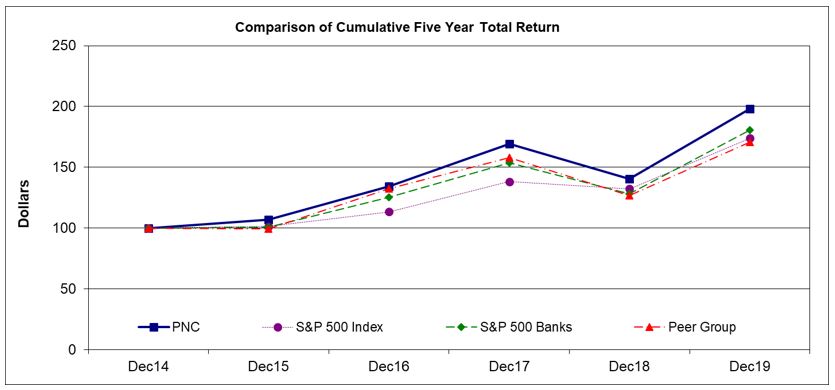
Base Period |
Assumes $100 investment at Close of Market on December 31, 2014
Total Return = Price change plus reinvestment of dividends
|
5-Year Compound Growth Rate |
||||||||||||||||||
Dec. 2014 |
Dec. 2015 |
Dec. 2016 |
Dec. 2017 |
Dec. 2018 |
Dec. 2019 |
|||||||||||||||
PNC |
$ |
100 |
$ |
106.81 |
$ |
134.34 |
$ |
169.22 |
$ |
140.49 |
$ |
197.94 |
14.63 |
% |
||||||
S&P 500 Index |
$ |
100 |
$ |
101.37 |
$ |
113.49 |
$ |
138.26 |
$ |
132.19 |
$ |
173.80 |
11.69 |
% |
||||||
S&P 500 Banks |
$ |
100 |
$ |
100.85 |
$ |
125.36 |
$ |
153.64 |
$ |
128.38 |
$ |
180.55 |
12.54 |
% |
||||||
Peer Group |
$ |
100 |
$ |
99.30 |
$ |
132.37 |
$ |
157.91 |
$ |
126.57 |
$ |
170.67 |
11.28 |
% |
||||||
The Peer Group for the preceding chart and table consists of the following companies: Bank of America Corporation; Capital One Financial Corporation; Citizens Financial Group, Inc.; Fifth Third Bancorp; JPMorgan Chase & Co.; KeyCorp; M&T Bank Corporation; Regions Financial Corporation; The PNC Financial Services Group, Inc.; Truist Financial Corporation; U.S. Bancorp;
32 The PNC Financial Services Group, Inc. – 2019 Form 10-K
and Wells Fargo & Company. Originally, the Peer Group also included both SunTrust Banks, Inc. and BB&T Corporation. These entities merged to create Truist Financial Corporation on December 6, 2019. BB&T Corporation was the surviving entity in the merger, thus data used to produce the preceding chart and table reflects historical BB&T Corporation data for Truist Financial Corporation. Historical data for SunTrust Banks, Inc. is not included as a part of Truist Financial Corporation in the preceding chart and table. This Peer Group was approved for 2019 by the Board of Directors’ Personnel and Compensation Committee, and the Committee has approved the same peer group for 2020.
Each yearly point for the Peer Group is determined by calculating the cumulative total shareholder return for each company in the Peer Group from December 31, 2014 to December 31 of that year (End of Month Dividend Reinvestment Assumed) and then using the median of these returns as the yearly plot point.
In accordance with the rules of the SEC, this section, captioned “Common Stock Performance Graph,” is not incorporated by reference into any of our future filings made under the Securities Exchange Act of 1934 or the Securities Act of 1933. The Common Stock Performance Graph, including its accompanying table and footnotes, is not deemed to be soliciting material or to be filed under the Exchange Act or the Securities Act.
ITEM 6 – SELECTED FINANCIAL DATA
This Selected Financial Data should be reviewed in conjunction with the Consolidated Financial Statements and Notes included in
Item 8 of this Report as well as the other disclosures in this Report concerning our historical financial performance, our future
prospects and the risks associated with our business and financial performance.
Year ended December 31 |
||||||||||||||||||||
Dollars in millions, except per share data |
2019 |
2018 |
2017 |
2016 |
2015 |
|||||||||||||||
Summary of Operations |
||||||||||||||||||||
Interest income |
$ |
13,762 |
$ |
12,582 |
$ |
10,814 |
$ |
9,652 |
$ |
9,323 |
||||||||||
Interest expense |
3,797 |
2,861 |
1,706 |
1,261 |
1,045 |
|||||||||||||||
Net interest income |
9,965 |
9,721 |
9,108 |
8,391 |
8,278 |
|||||||||||||||
Noninterest income |
7,862 |
7,411 |
7,221 |
6,771 |
6,947 |
|||||||||||||||
Total revenue |
17,827 |
17,132 |
16,329 |
15,162 |
15,225 |
|||||||||||||||
Provision for credit losses |
773 |
408 |
441 |
433 |
255 |
|||||||||||||||
Noninterest expense |
10,574 |
10,296 |
10,398 |
9,476 |
9,463 |
|||||||||||||||
Income before income taxes and noncontrolling interests |
6,480 |
6,428 |
5,490 |
5,253 |
5,507 |
|||||||||||||||
Income taxes |
1,062 |
1,082 |
102 |
1,268 |
1,364 |
|||||||||||||||
Net income |
5,418 |
5,346 |
5,388 |
3,985 |
4,143 |
|||||||||||||||
Less: Net income attributable to noncontrolling interests |
49 |
45 |
50 |
82 |
37 |
|||||||||||||||
Preferred stock dividends |
236 |
236 |
236 |
209 |
220 |
|||||||||||||||
Preferred stock discount accretion and redemptions |
4 |
4 |
26 |
6 |
5 |
|||||||||||||||
Net income attributable to common shareholders |
$ |
5,129 |
$ |
5,061 |
$ |
5,076 |
$ |
3,688 |
$ |
3,881 |
||||||||||
Per Common Share |
||||||||||||||||||||
Basic earnings |
$ |
11.43 |
$ |
10.79 |
$ |
10.49 |
$ |
7.42 |
$ |
7.52 |
||||||||||
Diluted earnings |
$ |
11.39 |
$ |
10.71 |
$ |
10.36 |
$ |
7.30 |
$ |
7.39 |
||||||||||
Book value |
$ |
104.59 |
$ |
95.72 |
$ |
91.94 |
$ |
85.94 |
$ |
81.84 |
||||||||||
Cash dividends declared |
$ |
4.20 |
$ |
3.40 |
$ |
2.60 |
$ |
2.12 |
$ |
2.01 |
||||||||||
Effective tax rate (a)
|
16.4 |
% |
16.8 |
% |
1.9 |
% |
24.1 |
% |
24.8 |
% |
||||||||||
Performance Ratios |
||||||||||||||||||||
Net interest margin (b) |
2.89 |
% |
2.97 |
% |
2.87 |
% |
2.73 |
% |
2.74 |
% |
||||||||||
Noninterest income to total revenue |
44 |
% |
43 |
% |
44 |
% |
45 |
% |
46 |
% |
||||||||||
Efficiency |
59 |
% |
60 |
% |
64 |
% |
62 |
% |
62 |
% |
||||||||||
Return on: |
||||||||||||||||||||
Average common shareholders' equity |
11.50 |
% |
11.83 |
% |
12.09 |
% |
8.85 |
% |
9.50 |
% |
||||||||||
Average assets |
1.35 |
% |
1.41 |
% |
1.45 |
% |
1.10 |
% |
1.17 |
% |
||||||||||
(a) |
The effective tax rates are generally lower than the statutory rate due to the relationship of pretax income to tax credits and earnings that are not subject to tax. |
(b) |
Net interest margin is the total yield on interest-earning assets minus the total rate on interest-bearing liabilities and includes the benefit from use of noninterest-bearing sources. To provide more meaningful comparisons of net interest margins, we use net interest income on a taxable-equivalent basis in calculating average yields used in the calculation of net interest margin by increasing the interest income earned on tax-exempt assets to make it fully equivalent to interest income earned on taxable investments. This adjustment is not permitted under GAAP in the Consolidated Income Statement. For additional information, see Reconciliation of Taxable-Equivalent Net Interest Income (Non-GAAP) Statistical Information (Unaudited) in Item 8 of this Report. |
The PNC Financial Services Group, Inc. – 2019 Form 10-K 33
At or for the year ended December 31 |
||||||||||||||||||||
Dollars in millions, except as noted |
2019 |
2018 |
2017 |
2016 |
2015 |
|||||||||||||||
Balance Sheet Highlights |
||||||||||||||||||||
Assets |
$ |
410,295 |
$ |
382,315 |
$ |
380,768 |
$ |
366,380 |
$ |
358,493 |
||||||||||
Loans |
$ |
239,843 |
$ |
226,245 |
$ |
220,458 |
$ |
210,833 |
$ |
206,696 |
||||||||||
Allowance for loan and lease losses |
$ |
2,742 |
$ |
2,629 |
$ |
2,611 |
$ |
2,589 |
$ |
2,727 |
||||||||||
Interest-earning deposits with banks (a) |
$ |
23,413 |
$ |
10,893 |
$ |
28,595 |
$ |
25,711 |
$ |
30,546 |
||||||||||
Investment securities |
$ |
86,824 |
$ |
82,701 |
$ |
76,131 |
$ |
75,947 |
$ |
70,528 |
||||||||||
Loans held for sale |
$ |
1,083 |
$ |
994 |
$ |
2,655 |
$ |
2,504 |
$ |
1,540 |
||||||||||
Equity investments (b) |
$ |
13,734 |
$ |
12,894 |
$ |
11,392 |
$ |
10,728 |
$ |
10,587 |
||||||||||
Mortgage servicing rights |
$ |
1,644 |
$ |
1,983 |
$ |
1,832 |
$ |
1,758 |
$ |
1,589 |
||||||||||
Goodwill |
$ |
9,233 |
$ |
9,218 |
$ |
9,173 |
$ |
9,103 |
$ |
9,103 |
||||||||||
Other assets |
$ |
32,202 |
$ |
34,408 |
$ |
27,894 |
$ |
27,506 |
$ |
26,566 |
||||||||||
Noninterest-bearing deposits |
$ |
72,779 |
$ |
73,960 |
$ |
79,864 |
$ |
80,230 |
$ |
79,435 |
||||||||||
Interest-bearing deposits |
$ |
215,761 |
$ |
193,879 |
$ |
185,189 |
$ |
176,934 |
$ |
169,567 |
||||||||||
Total deposits |
$ |
288,540 |
$ |
267,839 |
$ |
265,053 |
$ |
257,164 |
$ |
249,002 |
||||||||||
Borrowed funds (c) |
$ |
60,263 |
$ |
57,419 |
$ |
59,088 |
$ |
52,706 |
$ |
54,532 |
||||||||||
Total shareholders’ equity |
$ |
49,314 |
$ |
47,728 |
$ |
47,513 |
$ |
45,699 |
$ |
44,710 |
||||||||||
Common shareholders’ equity |
$ |
45,321 |
$ |
43,742 |
$ |
43,530 |
$ |
41,723 |
$ |
41,258 |
||||||||||
Accumulated other comprehensive income (loss) |
$ |
799 |
$ |
(725 |
) |
$ |
(148 |
) |
$ |
(265 |
) |
$ |
130 |
|||||||
Period-end common shares outstanding (millions) |
433 |
457 |
473 |
485 |
504 |
|||||||||||||||
Loans to deposits |
83 |
% |
84 |
% |
83 |
% |
82 |
% |
83 |
% |
||||||||||
Client Assets (billions)
|
||||||||||||||||||||
Discretionary client assets under management |
$ |
154 |
$ |
148 |
$ |
151 |
$ |
137 |
$ |
134 |
||||||||||
Nondiscretionary client assets under administration |
143 |
124 |
131 |
120 |
119 |
|||||||||||||||
Total client assets under administration |
297 |
272 |
282 |
257 |
253 |
|||||||||||||||
Brokerage account client assets |
54 |
47 |
49 |
44 |
43 |
|||||||||||||||
Total |
$ |
351 |
$ |
319 |
$ |
331 |
$ |
301 |
$ |
296 |
||||||||||
Capital Ratios (d) (e) |
||||||||||||||||||||
Basel III (f) |
||||||||||||||||||||
Common equity Tier 1 |
9.5 |
% |
9.6 |
% |
9.8 |
% |
10.0 |
% |
10.0 |
% |
||||||||||
Tier 1 risk-based |
10.7 |
% |
10.8 |
% |
N/A |
N/A |
N/A |
|||||||||||||
Total capital risk-based |
12.7 |
% |
13.0 |
% |
N/A |
N/A |
N/A |
|||||||||||||
Pro forma Basel III (Non-GAAP) (g) |
||||||||||||||||||||
Common equity Tier 1 |
10.1 |
% |
N/A |
N/A |
N/A |
N/A |
||||||||||||||
Tier 1 risk-based |
11.2 |
% |
N/A |
N/A |
N/A |
N/A |
||||||||||||||
Total capital risk-based |
13.4 |
% |
N/A |
N/A |
N/A |
N/A |
||||||||||||||
Transitional Basel III |
||||||||||||||||||||
Common equity Tier I |
N/A |
N/A |
10.4 |
% |
10.6 |
% |
10.6 |
% |
||||||||||||
Tier 1 risk-based capital |
N/A |
N/A |
11.6 |
% |
12.0 |
% |
12.0 |
% |
||||||||||||
Other Selected Ratios |
||||||||||||||||||||
Dividend payout |
36.7 |
% |
31.5 |
% |
24.7 |
% |
29.0 |
% |
27.0 |
% |
||||||||||
Common shareholders’ equity to total assets |
11.0 |
% |
11.4 |
% |
11.4 |
% |
11.4 |
% |
11.5 |
% |
||||||||||
Average common shareholders’ equity to average assets |
11.1 |
% |
11.3 |
% |
11.3 |
% |
11.5 |
% |
11.5 |
% |
||||||||||
Selected Statistics |
||||||||||||||||||||
Employees |
51,918 |
53,063 |
52,906 |
52,006 |
52,513 |
|||||||||||||||
Retail Banking branches |
2,296 |
2,372 |
2,459 |
2,520 |
2,616 |
|||||||||||||||
ATMs |
9,091 |
9,162 |
9,051 |
9,024 |
8,956 |
|||||||||||||||
(a) |
Includes balances held with the Federal Reserve Bank of Cleveland of $23.2 billion, $10.5 billion, $28.3 billion, $25.1 billion and $30.0 billion as of December 31, 2019, 2018, 2017, 2016 and 2015, respectively.
|
(b) |
Includes our equity investment in BlackRock. |
(c) |
Includes long-term borrowings of $33.2 billion, $37.4 billion, $43.1 billion, $38.3 billion and $43.6 billion for 2019, 2018, 2017, 2016 and 2015, respectively. Borrowings which mature more than one year after December 31, 2019 are considered to be long-term.
|
(d) |
See capital ratios discussion in the Supervision and Regulation section of Item 1 and in the Liquidity and Capital Management portion of the Risk Management section in Item 7 of this Report for additional discussion on these capital ratios. Additional information on the 2015-2017 fully phased-in ratios and Transitional Basel III ratios is included in the Statistical Information (Unaudited) section in Item 8 of this Report. |
(e) |
All ratios are calculated using the regulatory capital methodology applicable to PNC during each period presented, except for the 2015-2017 Basel III Common equity Tier 1 ratios, which are fully phased-in Basel III ratios and are presented as pro forma estimates. Ratios for all periods were calculated based on the standardized approach. |
34 The PNC Financial Services Group, Inc. – 2019 Form 10-K
(f) |
The 2019 and 2018 Basel III ratios for Common equity Tier 1 capital and Tier 1 risk-based capital reflect the full phase-in of all Basel III adjustments to these metrics applicable to PNC. The 2019 and 2018 Basel III Total capital risk-based ratios include nonqualifying trust preferred capital securities of $60 million and $80 million, respectively, that are subject to a phase-out period that runs through 2021. |
(g) |
Pro forma Basel III ratios are calculated as if the 2019 Tailoring Rules, and PNC's election to opt-out of the inclusion of certain elements of accumulated other comprehensive income in regulatory capital, had been in effect on December 31, 2019. We believe that the pro forma Basel III ratios are a useful tool to assess the impact to our capital position after adoption of the 2019 Tailoring Rules. |
ITEM 7 – MANAGEMENT’S DISCUSSION AND ANALYSIS OF FINANCIAL CONDITION AND RESULTS OF OPERATIONS (MD&A)
EXECUTIVE SUMMARY
Key Strategic Goals
At PNC we manage our company for the long term. We are focused on the fundamentals of growing customers, loans, deposits and revenue and improving profitability, while investing for the future and managing risk, expenses and capital. We continue to invest in our products, markets and brand, and embrace our commitments to our customers, shareholders, employees and the communities where we do business.
We strive to expand and deepen customer relationships by offering a broad range of deposit, credit and fee-based products and services. We are focused on delivering those products and services to our customers with the goal of addressing their financial objectives and putting customers’ needs first. Our business model is built on customer loyalty and engagement, understanding our customers’ financial goals and offering our diverse products and services to help them achieve financial well-being. Our approach is concentrated on organically growing and deepening client relationships across our businesses that meet our risk/return measures.
We are focused on our strategic priorities, which are designed to enhance value over the long term, and consist of:
• |
Expanding our leading banking franchise to new markets and digital platforms; |
• |
Deepening customer relationships by delivering a superior banking experience and financial solutions; and |
• |
Leveraging technology to innovate and enhance products, services, security and processes. |
Our capital priorities are to support client growth and business investment, maintain appropriate capital in light of economic conditions, the Basel III framework and other regulatory expectations, and return excess capital to shareholders. For more detail, see the Capital Highlights portion of this Executive Summary and the Liquidity and Capital Management portion of the Risk Management section of this Item 7 and the Supervision and Regulation section in Item 1 Business of this Report.
Key Factors Affecting Financial Performance
We face a variety of risks that may impact various aspects of our risk profile from time to time. The extent of such impacts may vary depending on factors such as the current business and economic conditions, political and regulatory environment and operational challenges. Many of these risks and our risk management strategies are described in more detail elsewhere in this Report.
Our financial performance is substantially affected by a number of external factors outside of our control, including the following:
• |
Global and domestic economic conditions, including the continuity and stamina of the current U.S. economic expansion; |
• |
The monetary policy actions and statements of the Federal Reserve and the Federal Open Market Committee (FOMC); |
• |
The level of, and direction, timing and magnitude of movement in, interest rates and the shape of the interest rate yield curve; |
• |
The functioning and other performance of, and availability of liquidity in, U.S. and global financial markets, including capital markets; |
• |
The impact of tariffs and other trade policies of the U.S. and its global trading partners; |
• |
Changes in the competitive and regulatory landscape; |
• |
The impact of legislative, regulatory and administrative initiatives and actions; |
• |
The impact of market credit spreads on asset valuations; |
• |
The ability of customers, counterparties and issuers to perform in accordance with contractual terms, and the resulting impact on our asset quality; |
• |
Loan demand, utilization of credit commitments and standby letters of credit; and |
• |
The impact on customers and changes in customer behavior due to changing business and economic conditions or regulatory or legislative initiatives. |
In addition, our success will depend upon, among other things:
• |
Effectively managing capital and liquidity including: |
• |
Continuing to maintain and grow our deposit base as a low-cost stable funding source; |
• |
Prudent liquidity and capital management to meet evolving regulatory capital, capital planning, stress testing and liquidity standards; and |
• |
Actions we take within the capital and other financial markets. |
The PNC Financial Services Group, Inc. – 2019 Form 10-K 35
• |
Execution of our strategic priorities; |
• |
Management of credit risk in our portfolio; |
• |
Our ability to manage and implement strategic business objectives within the changing regulatory environment; |
• |
The impact of legal and regulatory-related contingencies; and |
• |
The appropriateness of reserves needed for critical accounting estimates and related contingencies. |
For additional information, see the Cautionary Statement Regarding Forward-Looking Information section in this Item 7 and Item 1A Risk Factors in this Report.
Income Statement Highlights
Net income for 2019 was $5.4 billion, or $11.39 per diluted common share, an increase of 1% compared to $5.3 billion, or $10.71 per diluted common share, for 2018.
• |
Total revenue increased $695 million, or 4%, to $17.8 billion.
|
• |
Net interest income increased $244 million, or 3%, to $10.0 billion.
|
• |
Net interest margin decreased to 2.89% for 2019 compared to 2.97% for 2018.
|
• |
Noninterest income increased $451 million, or 6%, to $7.9 billion.
|
• |
Provision for credit losses was $773 million in 2019 compared to $408 million for 2018.
|
• |
Noninterest expense increased $278 million, or 3%, to $10.6 billion.
|
• |
We generated positive operating leverage in 2019 of 1.4%. |
• |
Earnings per diluted common share increased reflecting lower average common shares outstanding due to share repurchases, and higher net income. |
For additional detail, see the Consolidated Income Statement Review section of this Item 7.
Balance Sheet Highlights
Our balance sheet was strong and well positioned at December 31, 2019 and 2018. In comparison to December 31, 2018:
• |
Total loans increased $13.6 billion, or 6%, to $239.8 billion.
|
• |
Total commercial lending grew $8.3 billion, or 5%, to $160.6 billion.
|
• |
Total consumer lending increased $5.3 billion, or 7%, to $79.2 billion.
|
• |
Total deposits increased $20.7 billion, or 8%, to $288.5 billion.
|
• |
Investment securities increased $4.1 billion, or 5%, to $86.8 billion.
|
• |
Interest earning deposits with banks, primarily with the Federal Reserve Bank, increased $12.5 billion to $23.4 billion.
|
• |
Borrowed funds of $60.3 billion increased $2.8 billion, or 5%. |
• |
Shareholders' equity increased $1.6 billion, or 3%, to $49.3 billion. |
For additional detail, see the Consolidated Balance Sheet Review section of this Item 7.
Credit Quality Highlights
Overall credit quality remained historically strong.
• |
At December 31, 2019 compared to December 31, 2018:
|
▪ |
Nonperforming assets of $1.8 billion decreased $56 million, or 3%.
|
▪ |
Overall loan delinquencies of $1.5 billion increased $19 million, or 1%. |
• |
Net charge-offs of $642 million in 2019 increased 53% compared to net charge-offs of $420 million for 2018.
|
• |
The allowance for loan and lease losses to total loans was 1.14% at December 31, 2019 and 1.16% at December 31, 2018. |
For additional detail, see the Credit Risk Management portion of the Risk Management section of this Item 7.
Capital Highlights
We maintained a strong capital position during 2019 and continued to return capital to shareholders.
• |
The Basel III common equity Tier 1 capital ratio was 9.5% at December 31, 2019 compared with 9.6% at December 31, 2018.
|
• |
In 2019, we returned $5.4 billion of capital to shareholders through repurchases of 25.9 million common shares for $3.5 billion and dividends on common shares of $1.9 billion.
|
• |
In June 2019, we announced share repurchase programs of up to $4.3 billion for the four quarter period beginning with the third quarter of 2019. In January 2020, we announced an increase to these programs of up to $1.0 billion in additional common share repurchases through the end of second quarter of 2020. |
• |
The quarterly cash dividend on common stock was increased from $.95 to $1.15 per share effective with the August 5, 2019 dividend payment date. |
36 The PNC Financial Services Group, Inc. – 2019 Form 10-K
Our ability to take certain capital actions, including plans to pay or increase common stock dividends or to repurchase shares under current or future programs, is subject to the results of the supervisory assessment of capital adequacy undertaken by the Federal Reserve as part of the Comprehensive Capital Analysis and Review (CCAR) process. For additional information, see the Supervision and Regulation section in Item 1 Business of this Report.
See the Liquidity and Capital Management portion of the Risk Management section of this Item 7 for more detail on our 2019 capital and liquidity actions as well as our capital ratios.
Business Outlook
Statements regarding our business outlook are forward-looking within the meaning of the Private Securities Litigation Reform Act of 1995. Our forward-looking financial statements are subject to the risk that economic and financial market conditions will be substantially different than those we are currently expecting and do not take into account potential legal and regulatory contingencies. These statements are based on our view that:
• |
The U.S. economy grew at a solid pace in 2019 albeit more slowly than in 2018. Economic growth is expected to slow noticeably in 2020. |
• |
Job growth will continue in 2020, but at a slower pace from 2019 due to both difficulty in finding workers and slower economic growth. The unemployment rate is expected to remain near its current level in the near term, but the labor market will remain tight, pushing wages higher and supporting continued gains in consumer spending. |
• |
Inflation is expected to continue to slow in the near term because of lower commodity prices associated with coronavirus. Inflation is expected to gradually increase in 2021. |
• |
Our current baseline forecast expects the federal funds rate to remain unchanged in 2020. The federal funds rate is modestly positive for near-term economic growth in its current range of 1.50% to 1.75%. |
Near-term risks are to the downside, including a further softening in the global economy, perhaps due to coronavirus; a further escalation in trade tensions; and geopolitical concerns. The federal funds rate is more likely to end 2020 below its current range than above it. But there are some upside opportunities as well, such as a comprehensive U.S.-China trade deal and stronger labor force growth.
See the Cautionary Statement Regarding Forward-Looking Information section in this Item 7 and Item 1A Risk Factors in this Report for other factors that could cause future events to differ, perhaps materially, from those anticipated in these forward-looking statements.
For information on financial results for the fourth quarter of 2019, see the Selected Quarterly Financial Data section in the Statistical Information (Unaudited) section of Item 8 of this Report.
For full year 2020, compared to full year 2019 where appropriate, we expect:
• |
Average loan growth to be between 4% and 5%; |
• |
Revenue growth on the low end of low-single digits, on a percentage basis, including approximately 1% of net interest income growth; |
• |
Noninterest expense to remain stable; |
• |
The effective tax rate to be approximately 17.5%; and |
• |
To generate positive operating leverage of approximately 1% in 2020. |
For the first quarter of 2020, compared to the fourth quarter of 2019 where appropriate, we expect:
• |
Average loans to be up approximately 1%; |
• |
Net interest income to decline approximately 2%, reflecting the first quarter of 2020 decline in interest rates as well as one less day in the quarter; |
• |
Fee income to be down approximately 6%, which includes the impact of a charitable contribution by BlackRock as previously announced in its Form 8-K filed on February 13, 2020. Fee income consists of asset management, consumer services, corporate services, residential mortgage and service charges on deposits; |
• |
Other noninterest income to be between $300 million and $350 million, excluding net securities gains and activities related to Visa Class B common shares; |
• |
Noninterest expense to be down in the mid-single digit range, on a percentage basis; and |
• |
Provision for credit losses to be between $225 million and $300 million. |
The PNC Financial Services Group, Inc. – 2019 Form 10-K 37
CONSOLIDATED INCOME STATEMENT REVIEW
Our Consolidated Income Statement is presented in Item 8 of this Report. For additional detail of the comparison of 2018 over 2017, see Item 7 of our 2018 Form 10-K.
Net income for 2019 was $5.4 billion, or $11.39 per diluted common share, an increase of $72 million or 1% compared with $5.3 billion, or $10.71 per diluted common share, for 2018. The increase was driven by higher noninterest income and net interest income, partially offset by increases in provision for credit losses and noninterest expense.
Net Interest Income
Table 1: Summarized Average Balances and Net Interest Income (a)
2019 |
2018 |
||||||||||||||||
|
Year ended December 31
Dollars in millions
|
Average
Balances
|
Average
Yields/
Rates
|
Interest
Income/
Expense
|
Average
Balances
|
Average
Yields/
Rates
|
Interest
Income/
Expense
|
|||||||||||
Assets |
|||||||||||||||||
Interest-earning assets |
|||||||||||||||||
Investment securities |
$ |
83,666 |
2.93 |
% |
$ |
2,450 |
$ |
78,784 |
2.91 |
% |
$ |
2,289 |
|||||
Loans |
235,016 |
4.51 |
% |
10,604 |
223,278 |
4.33 |
% |
9,667 |
|||||||||
Interest-earning deposits with banks |
16,878 |
2.09 |
% |
353 |
20,603 |
1.84 |
% |
379 |
|||||||||
Other |
12,425 |
3.69 |
% |
458 |
8,093 |
4.47 |
% |
362 |
|||||||||
Total interest-earning assets/interest income |
$ |
347,985 |
3.98 |
% |
13,865 |
$ |
330,758 |
3.84 |
% |
12,697 |
|||||||
Liabilities |
|||||||||||||||||
Interest-bearing liabilities |
|||||||||||||||||
Interest-bearing deposits |
$ |
204,588 |
.97 |
% |
1,986 |
$ |
186,361 |
.66 |
% |
1,229 |
|||||||
Borrowed funds |
61,528 |
2.94 |
% |
1,811 |
59,306 |
2.75 |
% |
1,632 |
|||||||||
Total interest-bearing liabilities/interest expense |
$ |
266,116 |
1.43 |
% |
3,797 |
$ |
245,667 |
1.16 |
% |
2,861 |
|||||||
Net interest income/margin (Non-GAAP) |
2.89 |
% |
10,068 |
2.97 |
% |
9,836 |
|||||||||||
Taxable-equivalent adjustments |
(103 |
) |
(115 |
) |
|||||||||||||
Net interest income (GAAP) |
$ |
9,965 |
$ |
9,721 |
|||||||||||||
(a) |
Interest income calculated as taxable-equivalent interest income. To provide more meaningful comparisons of interest income and yields for all interest-earning assets, as well as net interest margins, we use interest income on a taxable-equivalent basis in calculating average yields and net interest margins by increasing the interest income earned on tax-exempt assets to make it fully equivalent to interest income earned on taxable investments. This adjustment is not permitted under GAAP on the Consolidated Income Statement. For more information, see Reconciliation of Taxable-Equivalent Net Interest Income (Non-GAAP) in the Statistical Information (Unaudited) section in Item 8 of this Report. |
Changes in net interest income and margin result from the interaction of the volume and composition of interest-earning assets and related yields, interest-bearing liabilities and related rates paid, and noninterest-bearing sources of funding. See the Statistical Information (Unaudited) – Average Consolidated Balance Sheet And Net Interest Analysis and Analysis Of Year-To-Year Changes In Net Interest Income in Item 8 of this Report.
Net interest income increased $244 million, or 3%, in 2019 compared with 2018 as higher loan and securities yields and balances were partially offset by higher funding costs. Net interest margin of 2.89% decreased 8 basis points in 2019 compared to 2018, driven by the declining rate environment in 2019.
Average investment securities increased $4.9 billion, or 6%, reflecting net purchases of agency residential mortgage-backed securities of $4.1 billion, U.S. Treasury and government agency securities of $1.3 billion and commercial mortgage-backed securities of $.9 billion, partially offset by decreases of $.9 billion to other securities, $.4 billion to non-agency residential mortgage backed securities and $.1 billion to asset-backed securities . Average investment securities represented 24% of average interest-earning assets in both 2019 and 2018.
Average loans grew $11.7 billion, or 5%, driven by commercial and consumer lending growth. Average commercial lending increased $9.3 billion, or 6%, to $159.3 billion reflecting strong growth in our Corporate Banking and Business Credit businesses in our Corporate & Institutional Banking segment. Average consumer lending increased $2.4 billion, or 3%, to $75.7 billion as growth in residential real estate, auto, credit card and unsecured installment loans was partially offset by declines in home equity and education loans. Lower home equity loans reflected paydowns and payoffs that exceeded new originated volume and continued runoff of brokered home equity loans. Additionally, government guaranteed education loans continued to run off. Average loans represented 68% of average interest-earning assets in both 2019 and 2018.
Average interest-bearing deposits grew $18.2 billion, or 10%, reflecting overall deposit and customer growth. The increase included a shift from noninterest-bearing deposits, which declined $4.1 billion, or 5%, to interest-bearing deposits. Within average interest-
38 The PNC Financial Services Group, Inc. – 2019 Form 10-K
bearing deposits, average savings deposits increased $11.0 billion, due in part to a shift to relationship-based savings products from money market deposits, which decreased $.8 billion, and to growth from the retail national expansion strategy. Additionally, average interest-bearing demand deposits grew $5.1 billion and average time deposits grew $2.9 billion. Average interest-bearing deposits represented 77% of average interest-bearing liabilities in 2019 compared to 76% in 2018.
Further details regarding average loans and deposits are included in the Business Segments Review section of this Item 7.
Average borrowed funds increased $2.2 billion, or 4%, primarily due to higher federal funds purchased of $2.1 billion and Federal Home Loan Bank (FHLB) borrowings of $1.3 billion, partially offset by a decline in bank notes and senior debt of $1.1 billion. See the Consolidated Balance Sheet Review portion of this Item 7 for additional detail on the level and composition of borrowed funds.
Noninterest Income
Table 2: Noninterest Income
Year ended December 31 |
Change |
||||||||||
Dollars in millions |
2019 |
2018 |
$ |
% |
|||||||
Noninterest income |
|||||||||||
Asset management |
$ |
1,850 |
$ |
1,825 |
$ |
25 |
1 |
% |
|||
Consumer services |
1,555 |
1,502 |
53 |
4 |
% |
||||||
Corporate services |
1,914 |
1,849 |
65 |
4 |
% |
||||||
Residential mortgage |
368 |
316 |
52 |
16 |
% |
||||||
Service charges on deposits |
702 |
714 |
(12 |
) |
(2 |
)% |
|||||
Other |
1,473 |
1,205 |
268 |
22 |
% |
||||||
Total noninterest income |
$ |
7,862 |
$ |
7,411 |
$ |
451 |
6 |
% |
|||
Noninterest income as a percentage of total revenue was 44% for 2019 and 43% for 2018.
Asset management revenue increased driven by higher earnings from our equity investment in BlackRock. Increases in the average equity markets also contributed to revenue growth in 2019. These increases were partially offset by lower asset management fees related to the sales of businesses and the impact of lower yielding assets under management. PNC's discretionary client assets under management increased to $154 billion at December 31, 2019 compared with $148 billion at December 31, 2018 primarily attributable to higher equity markets partially offset by the impact of the sales of businesses.
Consumer services revenue increased primarily due to growth in debit and credit card fees, net of rewards, and higher brokerage fees, reflecting continued momentum in both transaction activity and customer growth.
Growth in corporate services revenue reflected broad-based increases, including higher treasury management product revenue, partially offset by a decline in loan syndication revenue.
Residential mortgage revenue increased due to a higher benefit from residential mortgage servicing rights valuation, net of economic hedge, and higher loan sales revenue driven by increased loan origination volume.
Service charges on deposits declined, reflecting our ongoing efforts to simplify products and reduce transaction fees for our customers.
Other noninterest income increased due to higher gains on asset sales, including gains on sales of the retirement recordkeeping business and components of the PNC Capital Advisors investment management business, including its PNC family of proprietary mutual funds, and higher net securities gains. In addition, revenue from private equity investments and capital markets-related revenue increased. These increases were partially offset by negative derivative fair value adjustments related to Visa Class B common shares.
Other noninterest income typically fluctuates from period to period depending on the nature and magnitude of transactions completed. Further details regarding our customer-related trading activities are included in the Market Risk Management – Customer-Related Trading Risk portion of the Risk Management section of this Item 7. Further details regarding private and other equity investments are included in the Market Risk Management – Equity and Other Investment Risk section, and further details regarding gains or losses related to our equity investment in BlackRock are included in the Business Segments Review section of this Item 7.
Provision for Credit Losses
The provision for credit losses was $773 million in 2019 compared to $408 million in 2018 driven by increases in both commercial and consumer. The commercial provision increase was driven by loan growth and reserves attributed to certain commercial credits.
The PNC Financial Services Group, Inc. – 2019 Form 10-K 39
The increase in the consumer provision was primarily a result of higher auto loan and credit card reserves due to loan growth and portfolio losses, and higher reserves for unsecured installment loans partially offset by a lower provision for home equity loans.
The Credit Risk Management portion of the Risk Management section of this Item 7 includes additional information regarding factors impacting the provision for credit losses.
Noninterest Expense
Table 3: Noninterest Expense
Year ended December 31 |
Change |
||||||||||
Dollars in millions |
2019 |
2018 |
$ |
% |
|||||||
Noninterest expense |
|||||||||||
Personnel |
$ |
5,647 |
$ |
5,471 |
$ |
176 |
3 |
% |
|||
Occupancy |
834 |
818 |
16 |
2 |
% |
||||||
Equipment |
1,210 |
1,103 |
107 |
10 |
% |
||||||
Marketing |
301 |
285 |
16 |
6 |
% |
||||||
Other |
2,582 |
2,619 |
(37 |
) |
(1 |
)% |
|||||
Total noninterest expense |
$ |
10,574 |
$ |
10,296 |
$ |
278 |
3 |
% |
|||
Noninterest expense increased reflecting continued investments in our strategies, technology and employees. The increase in personnel expense was driven by business growth and higher benefits expense including a year-end employee award of an additional contribution to health savings accounts. Equipment expense increased reflecting primarily technology-related write-offs, including for decommissioned compliance and regulatory software that resulted from the 2019 Tailoring Rules. Other expense decreased primarily as a result of lower Federal Deposit Insurance Corporation (FDIC) deposit insurance cost from the elimination of the surcharge assessment.
During 2019, we completed actions and achieved our 2019 continuous improvement program savings goal of $300 million. In 2020, our goal will once again be $300 million in cost savings, which we expect to contribute to the funding of our business and technology investments.
Effective Income Tax Rate
The effective income tax rate was 16.4% for 2019 compared with 16.8% for 2018.
The effective tax rate is generally lower than the statutory rate primarily due to tax credits we receive from our investments in low income housing and new markets investments, as well as earnings on other tax exempt investments.
Additional information regarding our effective tax rate is included in the Reconciliation of Statutory and Effective Tax Rates table in Note 17 Income Taxes in Item 8 of this Report.
40 The PNC Financial Services Group, Inc. – 2019 Form 10-K
CONSOLIDATED BALANCE SHEET REVIEW
Table 4: Summarized Balance Sheet Data
December 31 |
December 31 |
Change |
||||||||||||
Dollars in millions |
2019 |
2018 |
$ |
% |
||||||||||
Assets |
||||||||||||||
Interest-earning deposits with banks |
$ |
23,413 |
$ |
10,893 |
$ |
12,520 |
115 |
% |
||||||
Loans held for sale |
1,083 |
994 |
89 |
9 |
% |
|||||||||
Investment securities |
86,824 |
82,701 |
4,123 |
5 |
% |
|||||||||
Loans |
239,843 |
226,245 |
13,598 |
6 |
% |
|||||||||
Allowance for loan and lease losses |
(2,742 |
) |
(2,629 |
) |
(113 |
) |
(4 |
)% |
||||||
Mortgage servicing rights |
1,644 |
1,983 |
(339 |
) |
(17 |
)% |
||||||||
Goodwill |
9,233 |
9,218 |
15 |
— |
||||||||||
Other, net |
50,997 |
52,910 |
(1,913 |
) |
(4 |
)% |
||||||||
Total assets |
$ |
410,295 |
$ |
382,315 |
$ |
27,980 |
7 |
% |
||||||
Liabilities |
||||||||||||||
Deposits |
$ |
288,540 |
$ |
267,839 |
$ |
20,701 |
8 |
% |
||||||
Borrowed funds |
60,263 |
57,419 |
2,844 |
5 |
% |
|||||||||
Other |
12,149 |
9,287 |
2,862 |
31 |
% |
|||||||||
Total liabilities |
360,952 |
334,545 |
26,407 |
8 |
% |
|||||||||
Equity |
||||||||||||||
Total shareholders’ equity |
49,314 |
47,728 |
1,586 |
3 |
% |
|||||||||
Noncontrolling interests |
29 |
42 |
(13 |
) |
(31 |
)% |
||||||||
Total equity |
49,343 |
47,770 |
1,573 |
3 |
% |
|||||||||
Total liabilities and equity |
$ |
410,295 |
$ |
382,315 |
$ |
27,980 |
7 |
% |
||||||
The summarized balance sheet data in Table 4 is based upon our Consolidated Balance Sheet in Item 8 of this Report. For additional detail of the comparison of 2018 over 2017, see Item 7 of our 2018 Form 10-K.
Our balance sheet at December 31, 2019 increased compared to December 31, 2018 and we maintained strong capital and liquidity positions.
• |
Total assets increased as a result of loan growth, higher interest-earning deposits with banks and higher investment securities; |
• |
Total liabilities increased due to deposit growth and higher borrowed funds; |
• |
Total equity increased due to higher retained earnings driven by net income substantially offset by share repurchases and common and preferred dividends and as a result of higher accumulated other comprehensive income (AOCI). |
The following discussion provides additional information about the major components of our balance sheet. Information regarding our capital and regulatory compliance is included in the Liquidity and Capital Management portion of the Risk Management section of this Item 7 and in Note 18 Regulatory Matters in our Notes To Consolidated Financial Statements included in this Report.
Loans
Table 5: Loans
December 31 |
December 31 |
Change |
||||||||||||
Dollars in millions |
2019 |
2018 |
$ |
% |
||||||||||
Commercial lending |
||||||||||||||
Commercial |
$ |
125,337 |
$ |
116,834 |
$ |
8,503 |
7 |
% |
||||||
Commercial real estate |
28,110 |
28,140 |
(30 |
) |
— |
|||||||||
Equipment lease financing |
7,155 |
7,308 |
(153 |
) |
(2 |
)% |
||||||||
Total commercial lending |
160,602 |
152,282 |
8,320 |
5 |
% |
|||||||||
Consumer lending |
||||||||||||||
Home equity |
25,085 |
26,123 |
(1,038 |
) |
(4 |
)% |
||||||||
Residential real estate |
21,821 |
18,657 |
3,164 |
17 |
% |
|||||||||
Automobile |
16,754 |
14,419 |
2,335 |
16 |
% |
|||||||||
Credit card |
7,308 |
6,357 |
951 |
15 |
% |
|||||||||
Education |
3,336 |
3,822 |
(486 |
) |
(13 |
)% |
||||||||
Other consumer |
4,937 |
4,585 |
352 |
8 |
% |
|||||||||
Total consumer lending |
79,241 |
73,963 |
5,278 |
7 |
% |
|||||||||
Total loans |
$ |
239,843 |
$ |
226,245 |
$ |
13,598 |
6 |
% |
||||||
Loans at December 31, 2019 reflected growth in both commercial and consumer lending compared to December 31, 2018.
The PNC Financial Services Group, Inc. – 2019 Form 10-K 41
Commercial lending increased reflecting growth in our Corporate Banking and Business Credit businesses within our Corporate & Institutional Banking segment. In Corporate Banking, commercial loan growth was broad-based primarily driven by higher asset-backed financing as well as increased lending to large and mid-sized corporate clients. In Business Credit, commercial loans increased as a result of net new originations and higher overall utilization.
For commercial loans by industry and commercial real estate loans by geography and property type, see Loan Portfolio Characteristics and Analysis in the Credit Risk Management portion of the Risk Management section in this Item 7.
Consumer lending increased as growth in residential real estate, auto, credit card and other consumer loans was partially offset by lower home equity and education loans.
Residential real estate loans increased primarily from originations of nonconforming loans, which are loans that do not meet agency standards as a result of exceeding agency conforming loan limits. The growth in auto loans reflected higher indirect auto loans from new loan originations and expansion into franchised dealers in new markets as well as growth in direct auto loans. Credit card balances increased as we continued to focus on our long-term objective of deepening penetration within our existing customer base as well as new client acquisitions. Other consumer loans increased due to unsecured installment loans driven by growth outside of our retail branch network and product enhancements.
Home equity loans declined as paydowns and payoffs exceeded new originated volume and brokered home equity loans continued to run off. Education loans declined primarily due to continued runoff of the government guaranteed education loan portfolio.
For information on home equity and residential real estate loans, including by geography and lien priority, and our auto loan portfolio, see Loan Portfolio Characteristics and Analysis in the Credit Risk Management portion of the Risk Management section in this Item 7.
For additional information regarding our loan portfolio, see the Credit Risk Management portion of the Risk Management section in this Item 7 and Note 1 Accounting Policies, Note 3 Asset Quality and Note 4 Allowance for Loan and Lease Losses in our Notes To Consolidated Financial Statements included in Item 8 of this Report.
Investment Securities
The carrying value of investment securities of $86.8 billion at December 31, 2019 increased $4.1 billion, or 5%, compared to December 31, 2018, driven by net purchases and changes in unrealized gains and losses of agency residential mortgage-backed securities.
The level and composition of the investment securities portfolio fluctuates over time based on many factors including market conditions, loan and deposit growth, and balance sheet management activities. We manage our investment securities portfolio to optimize returns, while providing a reliable source of liquidity for our banking and other activities, considering LCR and other internal and external guidelines and constraints.
Table 6: Investment Securities
December 31, 2019 |
December 31, 2018 |
Ratings (a) As of December 31, 2019 |
|||||||||||||||||||||||||||||
Dollars in millions |
Amortized
Cost
|
Fair
Value
|
Amortized
Cost
|
Fair
Value
|
AAA/
AA
|
A |
BBB |
BB and
Lower
|
No
Rating
|
||||||||||||||||||||||
U.S. Treasury and government agencies |
$ |
16,926 |
$ |
17,348 |
$ |
18,862 |
$ |
18,863 |
100 |
% |
|||||||||||||||||||||
Agency residential mortgage-backed |
50,266 |
50,984 |
45,153 |
44,407 |
100 |
% |
|||||||||||||||||||||||||
Non-agency residential mortgage-backed |
1,648 |
1,954 |
2,076 |
2,365 |
13 |
% |
1 |
% |
2 |
% |
47 |
% |
37 |
% |
|||||||||||||||||
Agency commercial mortgage-backed |
3,153 |
3,178 |
2,773 |
2,720 |
100 |
% |
|||||||||||||||||||||||||
Non-agency commercial mortgage-backed (b) |
3,782 |
3,806 |
3,177 |
3,145 |
87 |
% |
4 |
% |
9 |
% |
|||||||||||||||||||||
Asset-backed (c) |
5,096 |
5,166 |
5,115 |
5,155 |
90 |
% |
2 |
% |
7 |
% |
1 |
% |
|||||||||||||||||||
Other debt (d) |
4,580 |
4,771 |
5,670 |
5,753 |
74 |
% |
16 |
% |
7 |
% |
1 |
% |
2 |
% |
|||||||||||||||||
Total investment securities (e) |
$ |
85,451 |
$ |
87,207 |
$ |
82,826 |
$ |
82,408 |
97 |
% |
1 |
% |
1 |
% |
1 |
% |
|||||||||||||||
(a) |
Ratings percentages allocated based on amortized cost. |
(b) |
Collateralized primarily by retail properties, office buildings, lodging properties and multifamily housing. |
(c) |
Collateralized primarily by corporate debt, government guaranteed education loans and other consumer credit products. |
(d) |
Includes state and municipal securities. |
(e) |
Includes available for sale and held to maturity securities, which are recorded on our balance sheet at fair value and amortized cost, respectively. |
Table 6 presents the distribution of our total investment securities portfolio by amortized cost and fair value, as well as by credit rating. The relationship of fair value to amortized cost at December 31, 2019 compared to December 31, 2018 primarily reflected the impact of lower interest rates at the end of 2019 on the valuation of fixed rate securities. We have included credit ratings information because we believe that the information is an indicator of the degree of credit risk to which we are exposed, which could affect our
42 The PNC Financial Services Group, Inc. – 2019 Form 10-K
risk-weighted assets and, therefore, our risk-based regulatory capital ratios under the regulatory capital rules. Changes in credit ratings classifications could indicate increased or decreased credit risk and could be accompanied by a reduction or increase in the fair value of our investment securities portfolio.
The duration of investment securities was 2.6 years at December 31, 2019. We estimate that at December 31, 2019 the effective duration of investment securities was 2.8 years for an immediate 50 basis points parallel increase in interest rates and 2.4 years for an immediate 50 basis points parallel decrease in interest rates. Comparable amounts at December 31, 2018 for the effective duration of investment securities were 3.5 years and 3.2 years, respectively.
Based on expected prepayment speeds, the weighted-average expected maturity of the investment securities portfolio was 4.1 years at December 31, 2019 compared to 5.3 years at December 31, 2018.
Table 7: Weighted-Average Expected Maturities of Mortgage and Asset-Backed Debt Securities
December 31, 2019 |
Years |
|
Agency residential mortgage-backed |
4.2 |
|
Non-agency residential mortgage-backed |
6.7 |
|
Agency commercial mortgage-backed |
4.6 |
|
Non-agency commercial mortgage-backed |
2.8 |
|
Asset-backed |
2.0 |
|
Additional information regarding our investment securities is included in Note 5 Investment Securities and Note 6 Fair Value in the Notes To Consolidated Financial Statements included in this Report.
Funding Sources
Table 8: Details of Funding Sources
December 31 |
December 31 |
Change |
||||||||||||
Dollars in millions |
2019 |
2018 |
$ |
% |
||||||||||
Deposits |
||||||||||||||
Noninterest-bearing |
$ |
72,779 |
$ |
73,960 |
$ |
(1,181 |
) |
(2 |
)% |
|||||
Interest-bearing |
||||||||||||||
Money market |
54,115 |
53,368 |
747 |
1 |
% |
|||||||||
Demand |
71,692 |
65,211 |
6,481 |
10 |
% |
|||||||||
Savings |
68,291 |
56,793 |
11,498 |
20 |
% |
|||||||||
Time deposits |
21,663 |
18,507 |
3,156 |
17 |
% |
|||||||||
Total interest-bearing deposits |
215,761 |
193,879 |
21,882 |
11 |
% |
|||||||||
Total deposits |
288,540 |
267,839 |
20,701 |
8 |
% |
|||||||||
Borrowed funds |
||||||||||||||
Federal Home Loan Bank (FHLB) borrowings |
16,341 |
21,501 |
(5,160 |
) |
(24 |
)% |
||||||||
Bank notes and senior debt |
29,010 |
25,018 |
3,992 |
16 |
% |
|||||||||
Subordinated debt |
6,134 |
5,895 |
239 |
4 |
% |
|||||||||
Other |
8,778 |
5,005 |
3,773 |
75 |
% |
|||||||||
Total borrowed funds |
60,263 |
57,419 |
2,844 |
5 |
% |
|||||||||
Total funding sources |
$ |
348,803 |
$ |
325,258 |
$ |
23,545 |
7 |
% |
||||||
Total deposits increased as growth in interest-bearing deposits was slightly offset by a decrease in noninterest-bearing deposits. The increase in interest-bearing deposits reflected overall growth in both commercial and consumer deposits, including from the retail national expansion strategy which contributed to the increase in savings. Interest-bearing demand deposits at December 31, 2019 included $4.1 billion of balances related to a new sweep deposit product offering for current asset management clients.
Borrowed funds increased in the comparison as a decline in FHLB borrowings was more than offset by increases in bank notes and senior debt and federal funds purchased. The level and composition of borrowed funds fluctuates over time based on many factors including market conditions, loan, investment securities and deposit growth and capital considerations. We manage our borrowed funds to provide a reliable source of liquidity for our banking and other activities, considering LCR and other internal and external guidelines and constraints.
The PNC Financial Services Group, Inc. – 2019 Form 10-K 43
See the Liquidity and Capital Management portion of the Risk Management section of this Item 7 for additional information regarding our 2019 liquidity and capital activities.
Shareholders’ Equity
Total shareholders’ equity was $49.3 billion at December 31, 2019, an increase of $1.6 billion compared to December 31, 2018. The increase resulted from net income of $5.4 billion and higher AOCI of $1.5 billion primarily related to net unrealized securities gains, partially offset by common share repurchases of $3.5 billion and common and preferred dividends of $2.1 billion.
Common shares outstanding were 433 million at December 31, 2019 and 457 million at December 31, 2018 as repurchases of 25.9 million shares during 2019 were partially offset by stock-based compensation activity.
BUSINESS SEGMENTS REVIEW
We have four reportable business segments:
• |
Retail Banking |
• |
Corporate & Institutional Banking |
• |
Asset Management Group |
• |
BlackRock |
Business segment results and a description of each business are included in Note 22 Segment Reporting included in the Notes To Consolidated Financial Statements in Item 8 of this Report. Certain amounts included in this Business Segments Review differ from those amounts shown in Note 22, primarily due to the presentation in this Item 7 of business net interest income on a taxable-equivalent basis. Note 22 presents results of businesses for 2019, 2018 and 2017.
Net interest income in business segment results reflects our internal funds transfer pricing methodology. Assets receive a funding charge and liabilities and capital receive a funding credit based on a transfer pricing methodology that incorporates product repricing characteristics, tenor and other factors.
Total business segment financial results differ from total consolidated net income. The impact of these differences is reflected in the “Other” category as shown in Table 99 in Note 22 Segment Reporting in Item 8 of this Report. “Other” includes residual activities that do not meet the criteria for disclosure as a separate reportable business, such as asset and liability management activities including net securities gains or losses, other-than-temporary impairment of investment securities, certain trading activities, certain runoff consumer loan portfolios, private equity investments, intercompany eliminations, certain corporate overhead, tax adjustments that are not allocated to business segments, gains or losses related to BlackRock transactions, exited businesses, and differences between business segment performance reporting and financial statement reporting (GAAP), including the presentation of net income attributable to noncontrolling interests as the segments’ results exclude their portion of net income attributable to noncontrolling interests.
44 The PNC Financial Services Group, Inc. – 2019 Form 10-K
Retail Banking
Retail Banking's core strategy is to acquire and retain customers who maintain their primary checking and transaction relationships with us. We seek to deepen relationships by meeting the broad range of our customers’ financial needs with savings, liquidity, lending, investment and retirement solutions. A strategic priority for us is to differentiate the customer experience and drive transformation and automation. A key element of our strategy is to expand the use of lower-cost alternative distribution channels, with an emphasis on digital capabilities, while continuing to optimize the traditional branch network. In addition, we have a disciplined process to continually improve the engagement of both our employees and customers, which is a strong driver of customer growth, retention and relationship expansion. In 2018, we launched our national expansion strategy designed to grow customers with digitally-led banking and an ultra-thin branch network in markets outside of our existing retail branch network and began offering our digital high yield savings deposit product and opened our first solution center. Solution centers are an emerging branch operating model with a distinctive physical layout, where routine transactions are supported through a combination of technology and skilled banker assistance to create personalized customer experiences. The primary focus of the solution center is to bring a community element to our digital banking capabilities. The solution center provides a collaborative environment that connects our customers with our digital solutions and services, beyond deposits and withdrawals.
Table 9: Retail Banking Table
(Unaudited) |
|||||||||||||||
Year ended December 31 |
Change |
||||||||||||||
Dollars in millions, except as noted |
2019 |
2018 |
$ |
% |
|||||||||||
Income Statement |
|||||||||||||||
Net interest income |
$ |
5,520 |
$ |
5,119 |
$ |
401 |
8 |
% |
|||||||
Noninterest income |
2,648 |
2,631 |
17 |
1 |
% |
||||||||||
Total revenue |
8,168 |
7,750 |
418 |
5 |
% |
||||||||||
Provision for credit losses |
517 |
373 |
144 |
39 |
% |
||||||||||
Noninterest expense |
6,061 |
5,978 |
83 |
1 |
% |
||||||||||
Pretax earnings |
1,590 |
1,399 |
191 |
14 |
% |
||||||||||
Income taxes |
377 |
335 |
42 |
13 |
% |
||||||||||
Earnings |
$ |
1,213 |
$ |
1,064 |
$ |
149 |
14 |
% |
|||||||
Average Balance Sheet |
|||||||||||||||
Loans held for sale |
$ |
627 |
$ |
636 |
$ |
(9 |
) |
(1 |
)% |
||||||
Loans |
|||||||||||||||
Consumer lending |
|||||||||||||||
Home equity |
$ |
22,657 |
$ |
23,991 |
$ |
(1,334 |
) |
(6 |
)% |
||||||
Residential real estate |
16,196 |
13,985 |
2,211 |
16 |
% |
||||||||||
Automobile |
15,510 |
13,827 |
1,683 |
12 |
% |
||||||||||
Education |
3,611 |
4,135 |
(524 |
) |
(13 |
)% |
|||||||||
Credit cards |
6,550 |
5,838 |
712 |
12 |
% |
||||||||||
Other |
2,244 |
1,843 |
401 |
22 |
% |
||||||||||
Total consumer lending |
66,768 |
63,619 |
3,149 |
5 |
% |
||||||||||
Commercial and commercial real estate |
10,410 |
10,383 |
27 |
— |
|||||||||||
Total loans |
$ |
77,178 |
$ |
74,002 |
$ |
3,176 |
4 |
% |
|||||||
Total assets |
$ |
92,959 |
$ |
89,739 |
$ |
3,220 |
4 |
% |
|||||||
Deposits |
|||||||||||||||
Noninterest-bearing demand |
$ |
31,675 |
$ |
30,670 |
$ |
1,005 |
3 |
% |
|||||||
Interest-bearing demand |
42,077 |
42,042 |
35 |
— |
|||||||||||
Money market |
25,317 |
29,798 |
(4,481 |
) |
(15 |
)% |
|||||||||
Savings |
56,722 |
47,019 |
9,703 |
21 |
% |
||||||||||
Certificates of deposit |
12,613 |
12,007 |
606 |
5 |
% |
||||||||||
Total deposits |
$ |
168,404 |
$ |
161,536 |
$ |
6,868 |
4 |
% |
|||||||
Performance Ratios |
|||||||||||||||
Return on average assets |
1.30 |
% |
1.19 |
% |
|||||||||||
Noninterest income to total revenue |
32 |
% |
34 |
% |
|||||||||||
Efficiency |
74 |
% |
77 |
% |
|||||||||||
(continued on following page)
The PNC Financial Services Group, Inc. – 2019 Form 10-K 45
(continued from previous page)
Year ended December 31 |
Change |
||||||||||||||
Dollars in millions, except as noted |
2019 |
2018 |
$ |
% |
|||||||||||
Supplemental Noninterest Income Information |
|||||||||||||||
Consumer services (a) |
$ |
1,174 |
$ |
1,128 |
$ |
46 |
4 |
% |
|||||||
Brokerage (b) |
$ |
356 |
$ |
350 |
$ |
6 |
2 |
% |
|||||||
Residential mortgage |
$ |
368 |
$ |
316 |
$ |
52 |
16 |
% |
|||||||
Service charges on deposits |
$ |
687 |
$ |
688 |
$ |
(1 |
) |
— |
|||||||
Residential Mortgage Information |
|||||||||||||||
Residential mortgage servicing statistics (in billions, except as noted) (c) |
|||||||||||||||
Serviced portfolio balance (d) |
$ |
120 |
$ |
125 |
$ |
(5 |
) |
(4 |
)% |
||||||
Serviced portfolio acquisitions |
$ |
12 |
$ |
12 |
$ |
— |
— |
||||||||
MSR asset value (d) |
$ |
1.0 |
$ |
1.3 |
$ |
(.3 |
) |
(23 |
)% |
||||||
MSR capitalization value (in basis points) (d) |
83 |
100 |
(17 |
) |
(17 |
)% |
|||||||||
Servicing income: (in millions) |
|||||||||||||||
Servicing fees, net (e) |
$ |
178 |
$ |
181 |
$ |
(3 |
) |
(2 |
)% |
||||||
Mortgage servicing rights valuation, net of economic hedge |
$ |
47 |
$ |
3 |
$ |
44 |
* |
||||||||
Residential mortgage loan statistics |
|||||||||||||||
Loan origination volume (in billions) |
$ |
11.5 |
$ |
7.4 |
$ |
4.1 |
55 |
% |
|||||||
Loan sale margin percentage |
2.41 |
% |
2.41 |
% |
|||||||||||
Percentage of originations represented by: |
|||||||||||||||
Purchase volume (f) |
47 |
% |
67 |
% |
|||||||||||
Refinance volume |
53 |
% |
33 |
% |
|||||||||||
Other Information (d) |
|||||||||||||||
Customer-related statistics (average) |
|||||||||||||||
Non-teller deposit transactions (g) |
57 |
% |
55 |
% |
|||||||||||
Digital consumer customers (h) |
69 |
% |
66 |
% |
|||||||||||
Credit-related statistics |
|||||||||||||||
Nonperforming assets (i) |
$ |
1,046 |
$ |
1,126 |
$ |
(80 |
) |
(7 |
)% |
||||||
Net charge-offs |
$ |
534 |
$ |
420 |
$ |
114 |
27 |
% |
|||||||
Other statistics |
|||||||||||||||
ATMs |
9,091 |
9,162 |
(71 |
) |
(1 |
)% |
|||||||||
Branches (j) |
2,296 |
2,372 |
(76 |
) |
(3 |
)% |
|||||||||
Brokerage account client assets (in billions) (k) |
$ |
54 |
$ |
47 |
$ |
7 |
15 |
% |
|||||||
* - Not Meaningful
(a) |
Excludes brokerage noninterest income, which is included in Consumer services on our Consolidated Income Statement.
|
(b) |
Included in Consumer services on our Consolidated Income Statement.
|
(c) |
Represents mortgage loan servicing balances for third parties and the related income.
|
(d) |
Presented as of December 31, except for customer-related statistics, which are averages for the year ended, and net charge-offs, which are for the year ended.
|
(e) |
Servicing fees net of impact of decrease in MSR value due to passage of time, including the impact from both regularly scheduled loan payments, prepayments, and loans that were paid down or paid off during the period.
|
(f) |
Mortgages with borrowers as part of residential real estate purchase transactions.
|
(g) |
Percentage of total consumer and business banking deposit transactions processed at an ATM or through our mobile banking application.
|
(h) |
Represents consumer checking relationships that process the majority of their transactions through non-teller channels.
|
(i) |
Includes nonperforming loans of $1.0 billion and $1.1 billion at December 31, 2019 and 2018, respectively.
|
(j) |
Excludes stand-alone mortgage offices and satellite offices (e.g., drive-ups, electronic branches and retirement centers) that provide limited products and/or services.
|
(k) |
Includes cash and money market balances.
|
Retail Banking earned $1.2 billion in 2019 compared with $1.1 billion in 2018. The increase in earnings was attributable to higher net interest income and noninterest income partially offset by an increase in provision for credit losses and higher noninterest expense.
Net interest income increased primarily due to wider interest rate spreads on the value of deposits as well as growth in deposit and loan balances.
Noninterest income increased largely due to growth in residential mortgage revenue attributable to a higher benefit from residential mortgage servicing rights valuation, net of economic hedge, and increased loan sales revenue from higher origination volumes. Higher noninterest income also reflected growth in consumer services, including debit and credit card, brokerage fees, and merchant services. These increases were partially offset by negative derivative fair value adjustments related to Visa Class B common shares of $100 million in 2019 compared with positive adjustments of $35 million in 2018.
46 The PNC Financial Services Group, Inc. – 2019 Form 10-K
Provision for credit losses increased in 2019 compared to 2018 primarily as a result of higher auto loan and credit card reserves due to loan growth and portfolio losses, and higher reserves for unsecured installment loans partially offset by a lower provision for home equity loans.
Higher noninterest expense primarily resulted from an increase in ATM expense driven by enhanced checking product benefits, higher equipment expense, and increased customer transaction related costs.
The deposit strategy of Retail Banking is to remain disciplined on pricing and focused on growing and retaining relationship-based balances, executing on market-specific deposit growth strategies and providing a source of low-cost funding and liquidity to PNC. In 2019, average total deposits increased compared to 2018 primarily driven by savings deposits which increased due, in part, to a shift from money market deposits to relationship-based savings products as well as growth in consumer deposits, including from our national expansion. The increase in deposits was also attributable to higher noninterest-bearing demand deposits and certificates of deposit reflecting shifts in consumer preferences to time deposits.
Retail Banking average total loans grew in 2019 compared with 2018:
• |
Average residential mortgages increased primarily as a result of growth in nonconforming residential mortgage loans. |
• |
Average auto loans increased primarily due to strong new indirect auto loan volumes, including in our Southeast and expansion markets, as well as growth in direct auto loans. |
• |
Average credit card balances increased as we continued to focus on our long-term objective of deepening penetration within our existing customer base as well as new client acquisition. |
• |
Average home equity loans decreased as paydowns and payoffs on loans exceeded new originated volume. |
• |
Average education loans decreased driven by a decline in the runoff portfolio of government guaranteed education loans. |
Our national expansion initiative launched in 2018 with deposit products led by a digital high yield savings account. Following the first solution center opening in Kansas City in 2018, four additional solution centers were opened in 2019 with a second in Kansas City and three in the Dallas/Fort Worth market.
Retail Banking continues to enhance the customer experience with refinements to product and service offerings that drive value for consumers and small businesses. We are focused on meeting the financial needs of our customers by providing a broad range of liquidity, banking and investment products. Retail Banking continued to execute on its strategy of transforming the customer experience through transaction channel migration, branch network and home lending process transformations and multi-channel engagement and service strategies.
• |
Approximately 69% of consumer customers used non-teller channels for the majority of their transactions in 2019 compared with 66% in 2018.
|
• |
Deposit transactions via ATM and mobile channels increased to 57% of total deposit transactions in 2019 from 55% in 2018.
|
Retail Banking continues to make progress on its multi-year initiative to redesign the home lending process, including integrating mortgage and home equity lending into a common platform. Technology enhancements supported increased residential mortgage origination volume. In addition, we enhanced the home equity origination process to make it easier and to reach additional customers by offering the product in new states. The improvements and expansion will continue throughout 2020.
Corporate & Institutional Banking
Corporate & Institutional Banking’s strategy is to be the leading relationship-based provider of traditional banking products and services to its customers through the economic cycles. We aim to grow our market share and drive higher returns by delivering value-added solutions that help our clients better run their organizations, all while maintaining prudent risk and expense management. We continue to focus on building client relationships where the risk-return profile is attractive.
The PNC Financial Services Group, Inc. – 2019 Form 10-K 47
Table 10: Corporate & Institutional Banking Table
(Unaudited) |
|||||||||||||||
Year ended December 31 |
Change |
||||||||||||||
Dollars in millions, except as noted |
2019 |
2018 |
$ |
% |
|||||||||||
Income Statement |
|||||||||||||||
Net interest income |
$ |
3,714 |
$ |
3,637 |
$ |
77 |
2 |
% |
|||||||
Noninterest income |
2,537 |
2,406 |
131 |
5 |
% |
||||||||||
Total revenue |
6,251 |
6,043 |
208 |
3 |
% |
||||||||||
Provision for credit losses |
284 |
85 |
199 |
234 |
% |
||||||||||
Noninterest expense |
2,813 |
2,706 |
107 |
4 |
% |
||||||||||
Pretax earnings |
3,154 |
3,252 |
(98 |
) |
(3 |
)% |
|||||||||
Income taxes |
706 |
744 |
(38 |
) |
(5 |
)% |
|||||||||
Earnings |
$ |
2,448 |
$ |
2,508 |
$ |
(60 |
) |
(2 |
)% |
||||||
Average Balance Sheet |
|||||||||||||||
Loans held for sale |
$ |
505 |
$ |
739 |
$ |
(234 |
) |
(32 |
)% |
||||||
Loans |
|||||||||||||||
Commercial lending |
|||||||||||||||
Commercial |
$ |
112,809 |
$ |
103,285 |
$ |
9,524 |
9 |
% |
|||||||
Commercial real estate |
26,340 |
26,569 |
(229 |
) |
(1 |
)% |
|||||||||
Equipment lease financing |
7,255 |
7,437 |
(182 |
) |
(2 |
)% |
|||||||||
Total commercial lending |
146,404 |
137,291 |
9,113 |
7 |
% |
||||||||||
Consumer |
15 |
42 |
(27 |
) |
(64 |
)% |
|||||||||
Total loans |
$ |
146,419 |
$ |
137,333 |
$ |
9,086 |
7 |
% |
|||||||
Total assets |
$ |
164,243 |
$ |
154,119 |
$ |
10,124 |
7 |
% |
|||||||
Deposits |
|||||||||||||||
Noninterest-bearing demand |
$ |
39,141 |
$ |
44,099 |
$ |
(4,958 |
) |
(11 |
)% |
||||||
Interest-bearing demand |
19,487 |
15,114 |
4,373 |
29 |
% |
||||||||||
Money market |
28,091 |
24,060 |
4,031 |
17 |
% |
||||||||||
Other |
6,676 |
5,136 |
1,540 |
30 |
% |
||||||||||
Total deposits |
$ |
93,395 |
$ |
88,409 |
$ |
4,986 |
6 |
% |
|||||||
Performance Ratios |
|||||||||||||||
Return on average assets |
1.49 |
% |
1.63 |
% |
|||||||||||
Noninterest income to total revenue |
41 |
% |
40 |
% |
|||||||||||
Efficiency |
45 |
% |
45 |
% |
|||||||||||
Other Information |
|||||||||||||||
Consolidated revenue from: (a) |
|||||||||||||||
Treasury Management (b) |
$ |
1,866 |
$ |
1,779 |
$ |
87 |
5 |
% |
|||||||
Capital Markets (b) |
$ |
1,140 |
$ |
1,088 |
$ |
52 |
5 |
% |
|||||||
Commercial mortgage banking activities: |
|||||||||||||||
Commercial mortgage loans held for sale (c) |
$ |
97 |
$ |
107 |
$ |
(10 |
) |
(9 |
)% |
||||||
Commercial mortgage loan servicing income (d) |
261 |
247 |
14 |
6 |
% |
||||||||||
Commercial mortgage servicing rights valuation, net of economic hedge (e) |
19 |
27 |
(8 |
) |
(30 |
)% |
|||||||||
Total |
$ |
377 |
$ |
381 |
$ |
(4 |
) |
(1 |
)% |
||||||
Commercial mortgage servicing rights asset value (f) |
$ |
649 |
$ |
726 |
$ |
(77 |
) |
(11 |
)% |
||||||
Average Loans by C&IB Business (g) |
|||||||||||||||
Corporate Banking |
$ |
74,016 |
$ |
66,503 |
$ |
7,513 |
11 |
% |
|||||||
Real Estate |
37,149 |
37,571 |
(422 |
) |
(1 |
)% |
|||||||||
Business Credit |
22,586 |
20,800 |
1,786 |
9 |
% |
||||||||||
Commercial Banking |
7,984 |
8,109 |
(125 |
) |
(2 |
)% |
|||||||||
Other |
4,684 |
4,350 |
334 |
8 |
% |
||||||||||
Total average loans |
$ |
146,419 |
$ |
137,333 |
$ |
9,086 |
7 |
% |
|||||||
Credit-related statistics |
|||||||||||||||
Nonperforming assets (f) (h) |
$ |
444 |
$ |
377 |
$ |
67 |
18 |
% |
|||||||
Net charge-offs |
$ |
105 |
$ |
10 |
$ |
95 |
950 |
% |
|||||||
(a) |
See the additional revenue discussion regarding treasury management, capital markets-related products and services, and commercial mortgage banking activities in the Product Revenue section of this Corporate & Institutional Banking section. |
(b) |
Amounts reported in net interest income and noninterest income.
|
(c) |
Represents other noninterest income for valuations on commercial mortgage loans held for sale and related commitments, derivative valuations, originations fees, gains on sale of loans held for sale and net interest income on loans held for sale.
|
(d) |
Represents net interest income and noninterest income (primarily in corporate service fees) from loan servicing net of reduction in commercial mortgage servicing rights due to amortization expense and payoffs. Commercial mortgage servicing rights valuation, net of economic hedge is shown separately.
|
48 The PNC Financial Services Group, Inc. – 2019 Form 10-K
(e) |
Amounts are reported in corporate service fees. |
(f) |
As of December 31. |
(g) |
As a result of our first quarter 2019 C&IB business realignment, average loans previously reported as Equipment Finance were reclassified to other C&IB businesses for all periods presented. |
(h) |
Primarily nonperforming loans of $.4 billion and $.3 billion at December 31, 2019 and 2018, respectively.
|
Corporate & Institutional Banking earned $2.4 billion in 2019 compared to $2.5 billion in 2018. Higher revenue was more than offset by an increase in the provision for credit losses and higher noninterest expense.
Net interest income increased in the comparison primarily due to higher average loan and deposit balances, partially offset by narrower interest rate spreads on the value of loans.
Growth in noninterest income in the comparison reflected broad-based increases including higher treasury management product revenue and higher capital markets-related revenue.
The increase in provision for credit losses was primarily driven by loan growth and reserves attributed to certain commercial credits. Nonperforming assets and net charge-offs in 2019 increased from recent historic lows.
Noninterest expense increased in the comparison largely due to investments in strategic initiatives and variable costs associated with increased business activity.
Average loans increased compared with 2018 due to strong growth in Corporate Banking and Business Credit:
• |
Corporate Banking provides lending, treasury management and capital markets-related products and services to mid-sized and large corporations, and government and not-for-profit entities. Average loans for this business grew reflecting strong production in asset-backed financing as well as increased lending to large and mid-sized corporate clients. |
• |
PNC Business Credit provides asset-based lending. The loan portfolio is relatively high yielding, with acceptable risk as the loans are mainly secured by short-term assets. Average loans for this business increased primarily due to net new originations and higher utilization. |
• |
PNC Real Estate provides banking, financing and servicing solutions for commercial real estate clients across the country. Average loans for this business decreased slightly primarily driven by project loan payoffs, partially offset by higher commercial mortgage balances. |
• |
Commercial Banking provides lending, treasury management and capital markets-related products and services to smaller corporations and businesses. Average loans for this business were relatively unchanged. |
The deposit strategy of Corporate & Institutional Banking is to remain disciplined on pricing and focused on growing and retaining relationship-based balances over time, executing on customer and segment-specific deposit growth strategies and continuing to provide funding and liquidity to PNC. Average total deposits increased in the comparison driven by growth in interest-bearing deposits including a shift from noninterest-bearing deposits. We continue to monitor and balance the relationship between rates paid and the overall profitability of our deposit balances.
Corporate & Institutional Banking expanded its Corporate Banking business, focused on the middle market and larger sectors, into the Boston and Phoenix markets in 2019. This followed offices opened in Denver, Houston and Nashville in 2018, and offices opened in Dallas, Kansas City and Minneapolis in 2017. These locations complement Corporate & Institutional Banking national businesses with a significant presence in these cities, and build on past successes in the markets where PNC’s retail banking presence was limited, such as in the Southeast. Our full suite of commercial products and services is offered in these locations. We also plan to expand into the Portland and Seattle markets in 2020.
Product Revenue
In addition to credit and deposit products for commercial customers, Corporate & Institutional Banking offers other services, including treasury management, capital markets-related products and services, and commercial mortgage banking activities, for customers of all business segments. On a consolidated basis, the revenue from these other services is included in net interest income, corporate service fees and other noninterest income. From a business segment perspective, the majority of the revenue and expense related to these services is reflected in the Corporate & Institutional Banking segment results and the remainder is reflected in the results of other businesses. The Other Information section in Table 10 reflects the consolidated revenue to PNC for these services. A discussion of the consolidated revenue from these services follows.
The Treasury Management business provides payables, receivables, deposit and account services, liquidity and investments, and online and mobile banking products and services to our clients. Treasury management revenue is reported in noninterest income and net interest income. Noninterest income includes treasury management product revenue less earnings credits provided to customers on compensating deposit balances used to pay for products and services. Net interest income primarily includes revenue from all treasury
The PNC Financial Services Group, Inc. – 2019 Form 10-K 49
management customer deposit balances. Compared with 2018, treasury management revenue increased primarily due to higher product revenue and higher deposit balances.
Capital markets-related products and services include foreign exchange, derivatives, securities underwriting, loan syndications, mergers and acquisitions advisory and equity capital markets advisory related services. The increase in capital markets-related revenue in the comparison was broad based across most products and services and included higher asset-backed finance structuring fees, underwriting fees, and customer-related derivatives fees, partially offset by lower loan syndication revenue.
Commercial mortgage banking activities include revenue derived from commercial mortgage servicing (both net interest income and noninterest income) and revenue derived from commercial mortgage loans held for sale and related hedges. Total revenue from commercial mortgage banking activities decreased in the comparison due to lower revenue from commercial mortgage loans held for sale and related hedges and a lower benefit from commercial mortgage servicing rights valuation, net of economic hedge, mostly offset by higher commercial mortgage loan servicing income.
50 The PNC Financial Services Group, Inc. – 2019 Form 10-K
Asset Management Group
Asset Management Group is focused on being a premier bank-held individual and institutional asset manager in each of the markets it serves. The business seeks to deliver high quality banking, trust and investment management services to our high net worth, ultra high net worth and institutional client sectors through a broad array of products and services. Asset Management Group’s priorities are to serve our clients' financial objectives, grow and deepen customer relationships and deliver solid financial performance with prudent risk and expense management.
Table 11: Asset Management Group Table
(Unaudited) |
|||||||||||||||
Year ended December 31 |
Change |
||||||||||||||
Dollars in millions, except as noted |
2019 |
2018 |
$ |
% |
|||||||||||
Income Statement |
|||||||||||||||
Net interest income |
$ |
288 |
$ |
287 |
$ |
1 |
— |
||||||||
Noninterest income |
991 |
892 |
99 |
11 |
% |
||||||||||
Total revenue |
1,279 |
1,179 |
100 |
8 |
% |
||||||||||
Provision for credit losses |
(1 |
) |
2 |
(3 |
) |
(150 |
)% |
||||||||
Noninterest expense |
939 |
913 |
26 |
3 |
% |
||||||||||
Pretax earnings |
341 |
264 |
77 |
29 |
% |
||||||||||
Income taxes |
79 |
62 |
17 |
27 |
% |
||||||||||
Earnings |
$ |
262 |
$ |
202 |
$ |
60 |
30 |
% |
|||||||
Average Balance Sheet |
|||||||||||||||
Loans |
|||||||||||||||
Consumer lending |
|||||||||||||||
Residential real estate |
$ |
1,923 |
$ |
1,588 |
$ |
335 |
21 |
% |
|||||||
Other |
4,232 |
4,656 |
(424 |
) |
(9 |
)% |
|||||||||
Total consumer lending |
6,155 |
6,244 |
(89 |
) |
(1 |
)% |
|||||||||
Commercial and commercial real estate |
759 |
727 |
32 |
4 |
% |
||||||||||
Total loans |
$ |
6,914 |
$ |
6,971 |
$ |
(57 |
) |
(1 |
)% |
||||||
Total assets |
$ |
7,360 |
$ |
7,423 |
$ |
(63 |
) |
(1 |
)% |
||||||
Deposits |
|||||||||||||||
Noninterest-bearing demand |
$ |
1,360 |
$ |
1,458 |
$ |
(98 |
) |
(7 |
)% |
||||||
Interest-bearing demand |
4,060 |
3,323 |
737 |
22 |
% |
||||||||||
Money market |
1,832 |
2,253 |
(421 |
) |
(19 |
)% |
|||||||||
Savings |
6,216 |
4,890 |
1,326 |
27 |
% |
||||||||||
Other |
822 |
466 |
356 |
76 |
% |
||||||||||
Total deposits |
$ |
14,290 |
$ |
12,390 |
$ |
1,900 |
15 |
% |
|||||||
Performance Ratios |
|||||||||||||||
Return on average assets |
3.56 |
% |
2.72 |
% |
|||||||||||
Noninterest income to total revenue |
77 |
% |
76 |
% |
|||||||||||
Efficiency |
73 |
% |
77 |
% |
|||||||||||
Supplemental Noninterest Income Information |
|||||||||||||||
Asset management fees |
$ |
862 |
$ |
883 |
$ |
(21 |
) |
(2 |
)% |
||||||
Other Information |
|||||||||||||||
Nonperforming assets (a) (b) |
$ |
39 |
$ |
46 |
$ |
(7 |
) |
(15 |
)% |
||||||
Net charge-offs |
$ |
5 |
$ |
9 |
$ |
(4 |
) |
(44 |
)% |
||||||
Client Assets Under Administration (in billions) (a) (c) |
|||||||||||||||
Discretionary client assets under management |
$ |
154 |
$ |
148 |
$ |
6 |
4 |
% |
|||||||
Nondiscretionary client assets under administration |
143 |
124 |
19 |
15 |
% |
||||||||||
Total |
$ |
297 |
$ |
272 |
$ |
25 |
9 |
% |
|||||||
Discretionary client assets under management |
|||||||||||||||
Personal |
$ |
99 |
$ |
87 |
$ |
12 |
14 |
% |
|||||||
Institutional |
55 |
61 |
(6 |
) |
(10 |
)% |
|||||||||
Total |
$ |
154 |
$ |
148 |
$ |
6 |
4 |
% |
|||||||
(a) |
As of December 31. |
(b) |
Includes nonperforming loans of $38 million at December 31, 2019 and $45 million at December 31, 2018.
|
(c) |
Excludes brokerage account client assets. |
The PNC Financial Services Group, Inc. – 2019 Form 10-K 51
Asset Management Group earned $262 million in 2019 compared with $202 million in 2018. Earnings increased primarily due to higher revenue partially offset by higher noninterest expense.
Growth in noninterest income was driven by the gains on sale of the retirement recordkeeping business and the sale of components of the PNC Capital Advisors investment management business, including its PNC family of proprietary mutual funds. Increases in the average equity markets also contributed to noninterest income growth in 2019. These increases were partially offset by lower asset management fees as a result of the business sales and the impact of lower yielding assets under management.
The increase in noninterest expense was primarily attributable to higher personnel expenses and costs associated with the sale transactions, including asset write-offs.
Asset Management Group’s discretionary client assets under management increased primarily attributable to higher equity markets as of December 31, 2019.
The Asset Management Group strives to be the leading relationship-based provider of investment, planning, banking and fiduciary services to wealthy individuals and institutions by proactively delivering value-added ideas and solutions and exceptional service.
Wealth Management and Hawthorn have nearly 100 offices operating in seven out of the ten most affluent states in the U.S. with a majority co-located with retail banking branches. The businesses provide customized investment management, wealth planning, trust and estate administration and private banking solutions to affluent individuals and ultra-affluent families.
Institutional Asset Management provides outsourced chief investment officer, custody, private real estate, cash and fixed income client solutions, and fiduciary retirement advisory services to institutional clients including corporations, healthcare systems, insurance companies, unions, municipalities and non-profits.
BlackRock
(Unaudited)
Information related to our equity investment in BlackRock follows:
Table 12: BlackRock Table
Year ended December 31 |
||||||||
Dollars in millions |
2019 |
2018 |
||||||
Business segment earnings (a) |
$ |
838 |
$ |
781 |
||||
PNC’s economic interest in BlackRock (b) |
22 |
% |
22 |
% |
||||
(a) |
Represents our share of BlackRock’s reported GAAP earnings net of income taxes on those earnings incurred by us. |
(b) |
At December 31.
|
In billions |
December 31, 2019 |
December 31, 2018 |
||||||
Carrying value of our investment in BlackRock (c) |
$ |
8.7 |
$ |
8.2 |
||||
Market value of our investment in BlackRock (d) |
$ |
17.5 |
$ |
13.7 |
||||
(c) |
We account for our investment in BlackRock under the equity method of accounting, exclusive of a related deferred tax liability of $1.8 billion at December 31, 2019 and $1.7 billion at December 31, 2018. Our voting interest in BlackRock common stock was approximately 22% at December 31, 2019.
|
(d) |
Does not include liquidity discount. |
52 The PNC Financial Services Group, Inc. – 2019 Form 10-K
RISK MANAGEMENT
Enterprise Risk Management
We encounter risk as part of the normal course of operating our business. Accordingly, we design risk management processes to help manage this risk. We manage risk in light of our risk appetite to optimize long-term shareholder value while supporting our employees, customers and communities.
Our Enterprise Risk Management (ERM) Framework is structurally aligned with enhanced prudential standards that establish minimum requirements for the design and implementation of a risk management framework. This Risk Management section describes our ERM Framework which consists of risk culture, enterprise strategy (including risk appetite, strategic planning, capital planning and stress testing), risk governance and oversight, risk identification, risk assessments, risk controls and monitoring, and risk aggregation and reporting. The overall Risk Management section of this Item 7 also provides an analysis of our key areas of risk, which include but are not limited to credit, liquidity and capital, market and operational. Our use of financial derivatives as part of our overall asset and liability risk management process is also addressed within this Risk Management section.
We operate within a rapidly evolving regulatory environment. Accordingly, we are actively focused on the timely adoption of applicable regulatory pronouncements within our ERM Framework.
We view risk management as a cohesive combination of the following risk elements which form our ERM Framework:
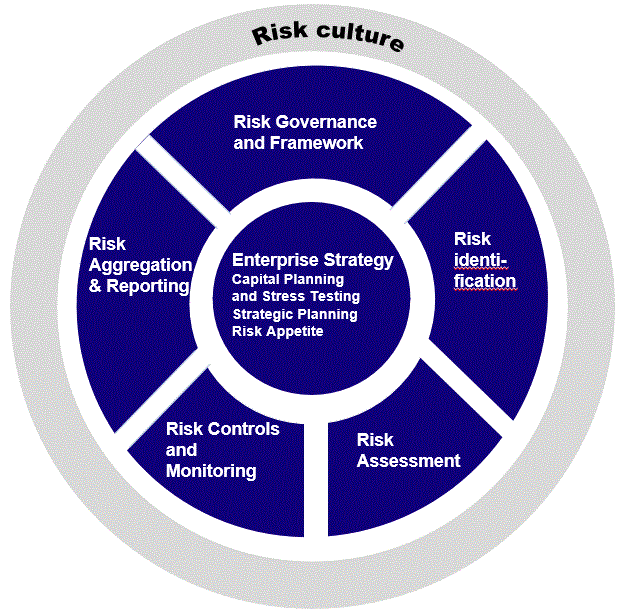
The PNC Financial Services Group, Inc. – 2019 Form 10-K 53
Risk Culture
A strong risk culture helps us make well-informed decisions, ensures individuals conform to the established culture, reduces an individual’s ability to do something for personal gain, and rewards employees working toward a common goal rather than individual interests. Our risk culture reinforces the appropriate protocols for responsible and ethical behavior. These protocols are especially critical in terms of our risk awareness, risk-taking behavior and risk management practices.
Managing risk is every employee’s responsibility. All of our employees individually and collectively are responsible for ensuring the organization is performing with the utmost integrity, is applying sound risk management practices and is striving to achieve our stated objectives rather than pursuing individual interests. All employees are also responsible for understanding our Enterprise Risk Appetite Statement, the ERM Framework and how risk management applies to their respective roles and responsibilities. Employees are encouraged to collaborate across groups to identify and mitigate risks and elevate issues as required. We reinforce risk management responsibilities through a performance management system where employee performance goals include risk management objectives and incentives for employees to reinforce balanced measures of risk-adjusted performance.
Proactive communication, between groups and up to the Board of Directors, facilitates timely identification and resolution of risk issues. Our multi-level risk committee structure provides formal channels to identify and report risk.
Enterprise Strategy
We ensure that our overall enterprise strategy is within acceptable risk parameters through our risk appetite, strategic planning, capital planning and stress testing processes. These components are reviewed and approved at least annually by the Board of Directors.
Risk Appetite: Our risk appetite represents the organization’s desired enterprise risk position, set within our capital based risk and liquidity capacity to achieve our strategic objectives and business plans. The Enterprise Risk Appetite Statement qualitatively describes the aggregate level of risk we are willing to accept in order to execute our business strategies. Qualitative guiding principles further define each of the risks within our taxonomy to support the risk appetite statement. Risk appetite metrics and limits, including forward-looking metrics, quantitatively measure whether we are operating within our stated Risk Appetite. Our risk appetite metrics reflect material risks, align with our established Risk Appetite Framework, balance risk and reward, leverage analytics, and adjust in a timely manner to changes in the external and internal risk environments.
Strategic Planning: Our enterprise and line of business strategic plans outline major objectives, strategies and goals which are expected to be achieved over the next five years while seeking to ensure we remain compliant with all capital, risk appetite and liquidity targets and guidelines. Our CEO and CFO lead the development of the corporate strategic plan, the strategic objectives and the comprehensive identification of material risks that could hinder successful implementation and execution of strategies. Strategic planning is linked to our risk management and capital planning processes.
Capital Planning and Stress Testing: Capital planning helps to ensure we are maintaining safe and sound operations and viability. The capital planning process and the resulting capital plan evolve as our overall risks, activities and risk management practices change. Capital planning aligns with our strategic planning process.
Stress testing is an essential element of the capital planning process. Effective stress testing enables us to consider the estimated effect on capital of various hypothetical scenarios.
Risk Governance and Framework
We employ a comprehensive risk management governance framework to help ensure that risks are identified, balanced decisions are made that consider risk and return, and risks are adequately monitored and managed. Risk committees established within this risk governance and oversight framework provide oversight for risk management activities at the Board of Directors, executive, corporate and business levels. Committee composition is designed to provide effective oversight balanced across the three lines of defense in accordance with the OCC’s heightened risk management and governance standards and guidelines. See discussion of the enhanced prudential standards in the Supervision and Regulation section in Item 1 of this Report.
To ensure the appropriate risks are being taken and effectively managed and controlled, risk is managed across three lines of defense. The Board of Directors’ and each line of defense’s responsibilities are detailed below:
Board of Directors – The Board of Directors oversees our risk-taking activities and is responsible for exercising sound, independent judgment when assessing risk.
First line of defense – The front line units are accountable for identifying, owning and managing risks to within acceptable levels while adhering to the risk management framework established by the Independent Risk Management department. Our businesses strive to enhance risk management and internal control processes within their areas. Integrated and comprehensive processes are designed to adequately identify, measure, manage, monitor and report risks which may significantly impact each business.
54 The PNC Financial Services Group, Inc. – 2019 Form 10-K
Second line of defense – The second line of defense is independent from the first line of defense and is responsible for establishing the standards for identifying, measuring, monitoring, controlling and reporting aggregate risks. As the second line of defense, the independent risk areas monitor the risks generated by the first line of defense, review and challenge the implementation of effective risk management practices, and report any issues or exceptions. The risk areas help to ensure processes and controls owned by the businesses are designed and operating as intended, and they may intervene directly in modifying and developing first line of defense risk processes and controls.
Third line of defense – As the third line of defense, Internal Audit is independent from the first and second lines of defense. Internal Audit provides the Board of Directors and executive management comprehensive assurance on the effectiveness of risk management practices across the organization.
Within the three lines of defense, the independent risk organization has sufficient authority to influence material decisions. Our business oversight and decision-making is supported through a governance structure at the Board of Directors and management level. Specific responsibilities include:
Board of Directors – Our Board of Directors oversees our business and affairs as managed by our officers and employees. The Board of Directors may receive assistance in carrying out its duties and may delegate authority through the following standing committees:
• |
Audit Committee: monitors the integrity of our consolidated financial statements; monitors internal control over financial reporting; monitors compliance with our code of ethics; evaluates and monitors the qualifications and independence of our independent auditors; and evaluates and monitors the performance of our Internal Audit function and our independent auditors.
|
• |
Nominating and Governance Committee: oversees the implementation of sound corporate governance principles and practices while promoting our best interests and those of our shareholders
|
• |
Personnel and Compensation Committee: oversees the compensation of our executive officers and other specified responsibilities related to personnel and compensation matters affecting us. The committee is also responsible for evaluating the relationship between risk-taking activities and incentive compensation plans.
|
• |
Risk Committee: oversees enterprise-wide risk structure and the processes established to identify, measure, monitor and manage the organization’s risks and evaluates and approves our risk governance framework. The Risk Committee has formed a Technology Subcommittee and a Compliance Subcommittee to facilitate Board-level oversight of risk management in these areas.
|
Executive Committee – The Executive Committee is responsible for guiding the creation and execution of our business strategy across the company. With this responsibility, the Executive Committee executes various strategic approval and review activities, with a focus on capital deployment, business performance and risk management.
Corporate Committees – The Corporate Committees operate at the senior management level and are designed to facilitate the review, evaluation, oversight and approval of key risk activities.
Working Committees – The Working Committees are generally subcommittees of the Corporate Committees. Working Committees are intended to assist in the implementation of key enterprise-level activities within a business or function and support the oversight of the businesses key risk activities.
Transactional Committees – Transactional Committees are generally created for the specific purpose of approving individual transactions or movements on the organization’s balance sheet.
Policies and Procedures – We have established risk management Policies and Procedures to support our ERM Framework, articulate our risk culture, define the parameters and processes within which employees are to manage risk and conduct our business activities and to provide direction, guidance and clarity on roles and responsibilities to management and the Board of Directors. These Policies and Procedures are organized in a multi-tiered framework and require periodic review and approval by relevant Committees or management.
Risk Identification
Risk identification takes place across a variety of risk types throughout the organization. These risk types consist of, but are not limited to, credit, liquidity and capital, market, operational and compliance. Risks are identified based on a balanced use of analytical tools and management judgment for both on- and off-balance sheet exposures. Our governance structure supports risk identification by facilitating assessment of key risk issues, emerging risks and idiosyncratic risks and implementation of mitigation strategies as appropriate. These risks are prioritized based on quantitative and qualitative analysis and assessed against the risk appetite. Multiple tools and approaches are used to help identify and prioritize risks, including Risk Appetite Metrics, Key Risk Indicators, Key Performance Indicators, Risk Control and Self-Assessments, scenario analysis, stress testing and special investigations.
The PNC Financial Services Group, Inc. – 2019 Form 10-K 55
Risks are aggregated and assessed within and across risk functions or businesses. The aggregated risk information is reviewed and reported at an enterprise level for adherence to the Risk Appetite Framework and approved by the Board of Directors or by appropriate committees. This enterprise aggregation and reporting approach promotes the identification and appropriate escalation of material risks across the organization and supports an understanding of the cumulative impact of risk in relation to our risk appetite.
Risk Assessment
Once risks are identified, they are evaluated based on quantitative and qualitative analysis to determine whether they are material. Risk assessments support the overall management of an effective ERM Framework and allow us to control and monitor our actual risk level and risk management effectiveness through the use of risk measures. Comprehensive, accurate and timely assessments of risk are essential to an effective ERM Framework. Effective risk measurement practices will uncover recurring risks that have been experienced in the past; make the known risks easy to see, understand, compare and report; and reveal unanticipated risks that may not be easy to understand or predict.
Risk Controls and Monitoring
Our ERM Framework consists of policies, processes, personnel and control systems. Risk controls and limits provide the linkage from our Risk Appetite Statement and associated guiding principles to the risk-taking activities of our businesses. In addition to risk appetite limits, a system of more detailed internal controls exists which oversees and monitors our various processes and functions. These control systems measure performance, help employees make correct decisions, help ensure information is accurate and reliable, and document compliance with laws and regulations.
We design our monitoring and evaluation of risks and controls to provide assurance that policies, procedures and controls are effective and also to result in the identification of control improvement recommendations. Risk monitoring is a daily, ongoing process used by both the first and second line of defense to ensure compliance with our ERM Framework. Risk monitoring is accomplished in many ways, including performing risk assessments at the prime process and risk assessment unit level, monitoring an area’s key controls, the timely reporting of issues, and establishing a quality control and/or quality assurance function, as applicable.
Risk Aggregation and Reporting
Risk reporting is a comprehensive way to: (i) aggregate risks; (ii) identify concentrations; (iii) help ensure we remain within our established risk appetite; (iv) serve as a basis for monitoring our risk profile in relation to our risk appetite and (v) communicate risks to the Board of Directors and executive management.
Risk reports are produced at the line of business, functional risk and enterprise levels. The enterprise level risk report aggregates risks identified in the functional and business reports to define the enterprise risk profile. The enterprise risk profile is a point-in-time assessment of enterprise risk and represents our overall risk position in relation to the desired enterprise risk appetite. The determination of the enterprise risk profile is based on analysis of quantitative reporting of risk limits and other measures along with qualitative assessments. Quarterly aggregation of our risk profile enables a clear view of our risk level relative to our quantitative risk appetite. The enterprise level report is provided through the governance structure to the Board of Directors.
Each individual risk report includes an assessment of inherent risk, quality of risk management, residual risk, risk appetite and risk outlook. The enterprise level risk report includes an aggregate view of risks identified in the individual report and provides a summary of our overall risk profile compared to our risk appetite.
Credit Risk Management
Credit risk represents the possibility that a customer, counterparty or issuer may not perform in accordance with contractual terms. Credit risk is inherent in the financial services business and results from extending credit to customers, purchasing securities, and entering into financial derivative transactions and certain guarantee contracts. Credit risk is one of our most significant risks. Our processes for managing credit risk are embedded in our risk culture and in our decision-making processes using a systematic approach whereby credit risks and related exposures are identified and assessed, managed through specific policies and processes, measured and evaluated against our risk appetite and credit concentration limits, and reported, along with specific mitigation activities, to management and the Board of Directors through our governance structure. Our most significant concentration of credit risk is in our loan portfolio.
56 The PNC Financial Services Group, Inc. – 2019 Form 10-K
Loan Portfolio Characteristics and Analysis
Table 13: Details of Loans
In billions
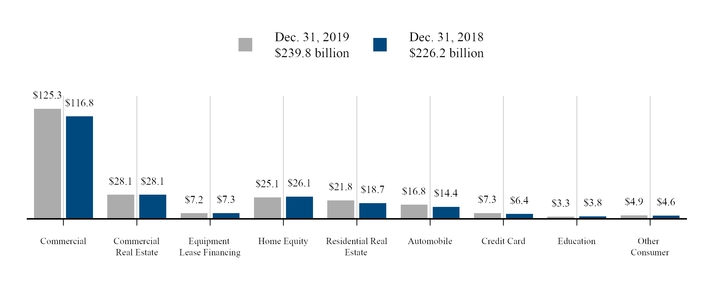
We use several asset quality indicators, as further detailed in Note 3 Asset Quality in the Notes To Consolidated Financial Statements in Item 8 of this Report, to monitor and measure our exposure to credit risk within our loan portfolio. The following provides additional information about our significant loan classes.
Commercial
Commercial loans comprised 52% of our total loan portfolio at both December 31, 2019 and 2018. The majority of our commercial loans are secured by collateral that provides a secondary source of repayment for the loan should the borrower experience cash generation difficulties. Examples of this collateral include short-term assets, such as accounts receivable, inventory and securities, and long-lived assets, such as equipment, real estate and other business assets.
We actively manage our commercial loans to assess any changes (both positive and negative) in the level of credit risk at both the borrower and portfolio level. To evaluate the level of credit risk, we assign internal risk ratings reflecting our estimates of the borrower’s probability of default (PD) and loss given default (LGD) for each related credit facility. This two-dimensional credit risk rating methodology provides granularity in the risk monitoring process and is updated on an ongoing basis through our credit risk management processes. In addition to monitoring the level of credit risk, we also monitor concentrations of credit risk pertaining to both specific industries and geography that may exist in our portfolio. Our portfolio is well-diversified as shown in the following table which provides a breakout of our commercial loans by industry classification (classified based on the North American Industry Classification System (NAICS)).
Table 14: Commercial Loans by Industry
December 31, 2019 |
December 31, 2018 |
||||||||||||||
Dollars in millions |
Amount |
% of Total |
Amount |
% of Total |
|||||||||||
Commercial |
|||||||||||||||
Manufacturing |
$ |
21,540 |
17 |
% |
$ |
21,207 |
18 |
% |
|||||||
Retail/wholesale trade |
21,565 |
17 |
20,850 |
18 |
|||||||||||
Service providers |
16,112 |
13 |
14,869 |
13 |
|||||||||||
Real estate related (a) |
12,346 |
10 |
12,312 |
11 |
|||||||||||
Financial services |
11,318 |
9 |
9,500 |
8 |
|||||||||||
Health care |
8,035 |
6 |
8,886 |
8 |
|||||||||||
Transportation and warehousing |
7,474 |
6 |
5,781 |
5 |
|||||||||||
Other industries |
26,947 |
22 |
23,429 |
19 |
|||||||||||
Total commercial loans |
$ |
125,337 |
100 |
% |
$ |
116,834 |
100 |
% |
|||||||
(a) Represents loans to customers in the real estate and construction industries.
The PNC Financial Services Group, Inc. – 2019 Form 10-K 57
Environmental and social risks are incorporated into the transaction and portfolio management policies and procedures that govern our underwriting and portfolio management practices. All Corporate & Institutional Banking transactions are subject to an Environmental and Social Risk Management assessment designed to help us better identify and mitigate environmental and human rights risks early in the credit application process. Transactions identified as having a potential environmental or human rights risk are evaluated to determine whether enhanced due diligence is warranted. We have also chosen to limit new originations in sectors that are no longer consistent with our strategic direction, such as mountain-top removal coal mining and private prisons. We periodically review environmental and social risk topics in PNC’s Credit Portfolio Strategy Committee, and outcomes of these reviews may result in changes to our due diligence, origination requirements, or limits on credit exposure. Our approach to identifying environmental and social risks is regularly reviewed by senior management and overseen by our Board of Directors. PNC will continue to refine its approach as banking conditions, regulatory requirements, investors’ perspectives and our strategic direction evolve.
Commercial Real Estate
Commercial real estate loans comprised $17.0 billion related to commercial mortgages, $5.6 billion of real estate project loans and $5.5 billion of intermediate term financing loans as of December 31, 2019. Comparable amounts were $14.4 billion, $6.6 billion and $7.1 billion, respectively, as of December 31, 2018.
We monitor credit risk associated with our commercial real estate loans similar to commercial loans by analyzing PD and LGD. Additionally, risks associated with these types of credit activities tend to be correlated to the loan structure, collateral location, project progress and business environment. These attributes are also monitored and utilized in assessing credit risk. The portfolio is geographically diverse due to the nature of our business involving clients throughout the U.S. The following table presents our commercial real estate loans by geography and property type.
Table 15: Commercial Real Estate Loans by Geography and Property Type
December 31, 2019 |
December 31, 2018 |
||||||||||||||
Dollars in millions |
Amount |
% of Total |
Amount |
% of Total |
|||||||||||
Geography |
|||||||||||||||
California |
$ |
4,393 |
16 |
% |
$ |
4,154 |
15 |
% |
|||||||
Florida |
2,557 |
9 |
2,157 |
8 |
|||||||||||
Maryland |
1,889 |
7 |
1,966 |
7 |
|||||||||||
Texas |
1,717 |
6 |
1,531 |
5 |
|||||||||||
Virginia |
1,547 |
6 |
1,682 |
6 |
|||||||||||
Pennsylvania |
1,310 |
4 |
1,214 |
4 |
|||||||||||
Ohio |
1,307 |
4 |
1,053 |
4 |
|||||||||||
New Jersey |
1,106 |
4 |
884 |
3 |
|||||||||||
North Carolina |
1,015 |
4 |
915 |
3 |
|||||||||||
Illinois |
1,001 |
4 |
1,368 |
5 |
|||||||||||
Other |
10,268 |
36 |
11,216 |
40 |
|||||||||||
Total commercial real estate loans |
$ |
28,110 |
100 |
% |
$ |
28,140 |
100 |
% |
|||||||
Property Type |
|||||||||||||||
Multifamily |
$ |
9,003 |
32 |
% |
$ |
8,770 |
31 |
% |
|||||||
Office |
7,641 |
27 |
7,279 |
26 |
|||||||||||
Retail |
3,702 |
13 |
4,065 |
14 |
|||||||||||
Industrial/Warehouse |
2,003 |
7 |
1,678 |
6 |
|||||||||||
Hotel/Motel |
1,813 |
7 |
1,686 |
6 |
|||||||||||
Senior Housing |
1,123 |
4 |
1,092 |
4 |
|||||||||||
Mixed Use |
943 |
3 |
933 |
3 |
|||||||||||
Other |
1,882 |
7 |
2,637 |
10 |
|||||||||||
Total commercial real estate loans |
$ |
28,110 |
100 |
% |
$ |
28,140 |
100 |
% |
|||||||
Home Equity
Home equity loans comprised $13.9 billion of primarily variable-rate home equity lines of credit and $11.2 billion of closed-end home equity installment loans at December 31, 2019. Comparable amounts were $15.5 billion and $10.6 billion, respectively, as of December 31, 2018.
We track borrower performance monthly, including obtaining original loan-to-value ratios (LTV), updated FICO scores at least quarterly, updated LTVs at least semi-annually, and other credit metrics at least quarterly, including the historical performance of any related mortgage loans regardless of lien position that we do or do not hold. This information is used for internal reporting and risk management. For internal reporting and risk management we also segment the population into pools based on product type (e.g., home
58 The PNC Financial Services Group, Inc. – 2019 Form 10-K
equity loans, brokered home equity loans, home equity lines of credit, brokered home equity lines of credit). As part of our overall risk analysis and monitoring, we also segment the portfolio based upon the loan delinquency, nonperforming status, modification and bankruptcy status, FICO scores, LTV, lien position and geographic concentration.
The credit quality of newly originated loans in 2019 was strong overall with a weighted-average LTV on originations of 68% and a weighted-average FICO score of 768.
The credit performance of the majority of the home equity portfolio where we hold the first lien position is superior to the portion of the portfolio where we hold the second lien position, but do not hold the first lien. Lien position information is generally determined at the time of origination and monitored on an ongoing basis for risk management purposes. We use an industry-leading third-party service provider to obtain updated loan information, including lien and collateral data that is aggregated from public and private sources.
The following table presents our home equity loans by geography and lien type.
Table 16: Home Equity Loans by Geography and by Lien Type
December 31, 2019 |
December 31, 2018 |
||||||||||||||
Dollars in millions |
Amount |
% of Total |
Amount |
% of Total |
|||||||||||
Geography |
|||||||||||||||
Pennsylvania |
$ |
5,812 |
23 |
% |
$ |
6,160 |
24 |
% |
|||||||
New Jersey |
3,728 |
15 |
3,935 |
15 |
|||||||||||
Ohio |
2,899 |
12 |
3,095 |
12 |
|||||||||||
Illinois |
1,544 |
6 |
1,634 |
6 |
|||||||||||
Maryland |
1,420 |
6 |
1,481 |
6 |
|||||||||||
Michigan |
1,371 |
5 |
1,340 |
5 |
|||||||||||
Florida |
1,340 |
5 |
1,227 |
5 |
|||||||||||
North Carolina |
1,092 |
4 |
1,161 |
4 |
|||||||||||
Kentucky |
990 |
4 |
1,040 |
4 |
|||||||||||
Indiana |
820 |
3 |
845 |
3 |
|||||||||||
Other |
4,069 |
17 |
4,205 |
16 |
|||||||||||
Total home equity loans |
$ |
25,085 |
100 |
% |
$ |
26,123 |
100 |
% |
|||||||
Lien type |
|||||||||||||||
1st lien |
59 |
% |
58 |
% |
|||||||||||
2nd lien |
41 |
42 |
|||||||||||||
Total |
100 |
% |
100 |
% |
|||||||||||
Residential Real Estate
Residential real estate loans primarily consisted of residential mortgage loans at both December 31, 2019 and 2018.
We track borrower performance of this portfolio monthly similarly to home equity loans. This information is used for internal reporting and risk management. For internal reporting and risk management we also segment the mortgage portfolio into pools based on product type (e.g., nonconforming, conforming). As part of our overall risk analysis and monitoring, we also segment the portfolio based upon loan delinquency, nonperforming status, modification and bankruptcy status, FICO scores, LTV and geographic concentrations. Loan performance is evaluated by source originators and loan servicers.
The credit quality of newly originated loans that we retained on our balance sheet in 2019 was strong overall as evidenced by a weighted-average LTV on originations of 70% and a weighted-average FICO score of 769.
The PNC Financial Services Group, Inc. – 2019 Form 10-K 59
The following table presents our residential real estate loans by geography.
Table 17: Residential Real Estate Loans by Geography
December 31, 2019 |
December 31, 2018 |
||||||||||||||
Dollars in millions |
Amount |
% of Total |
Amount |
% of Total |
|||||||||||
Geography |
|||||||||||||||
California |
$ |
6,800 |
31 |
% |
$ |
4,666 |
25 |
% |
|||||||
New Jersey |
1,779 |
8 |
1,649 |
9 |
|||||||||||
Florida |
1,580 |
7 |
1,544 |
8 |
|||||||||||
Illinois |
1,118 |
5 |
1,161 |
6 |
|||||||||||
Pennsylvania |
1,113 |
5 |
1,031 |
6 |
|||||||||||
New York |
1,008 |
5 |
956 |
5 |
|||||||||||
Maryland |
923 |
4 |
913 |
5 |
|||||||||||
North Carolina |
877 |
4 |
854 |
5 |
|||||||||||
Virginia |
868 |
4 |
825 |
4 |
|||||||||||
Ohio |
704 |
3 |
682 |
4 |
|||||||||||
Other |
5,051 |
24 |
4,376 |
23 |
|||||||||||
Total residential real estate loans |
$ |
21,821 |
100 |
% |
$ |
18,657 |
100 |
% |
|||||||
We originate residential mortgage loans nationwide through our national mortgage business as well as within our branch network. Residential mortgage loans underwritten to agency standards, including conforming loan amount limits, are typically sold with servicing retained by us. We also originate nonconforming residential mortgage loans that do not meet agency standards, which we retain on our balance sheet. The nonconforming residential mortgage portfolio had strong credit quality at December 31, 2019 with an average original LTV of 70% and an average original FICO score of 772. Our portfolio of nonconforming residential mortgage loans totaled $16.0 billion at December 31, 2019 with 38% located in California.
Automobile
Within auto loans, $15.1 billion resided in the indirect auto portfolio while $1.7 billion were in the direct auto portfolio as of December 31, 2019. Comparable amounts as of December 31, 2018 were $12.9 billion and $1.5 billion, respectively. The indirect auto portfolio relates to loan applications originated through franchised dealers, including from expansion into new markets. This business is strategically aligned with our core retail banking business.
We continue to focus on borrowers with strong credit profiles as evidenced by a weighted-average loan origination FICO score of 757 during 2019 and 740 during 2018 for indirect auto loans, and 769 during 2019 and 762 during 2018 for direct auto loans. The weighted-average term of loan originations during 2019 was 74 months for indirect auto loans and 63 months for direct auto loans. We offer both new and used auto financing to customers through our various channels. At December 31, 2019, the portfolio was composed of 55% new vehicle loans and 45% used vehicle loans. Comparable amounts at December 31, 2018 were 53% and 47%, respectively.
The auto loan portfolio's performance is measured monthly, including updated collateral values that are obtained monthly and updated FICO scores that are obtained at least quarterly. For internal reporting and risk management, we analyze the portfolio by product channel and product type and regularly evaluate default and delinquency experience. As part of our overall risk analysis and monitoring, we segment the portfolio by loan structure, collateral attributes and credit metrics which include FICO score, LTV and term.
Nonperforming Assets and Loan Delinquencies
Nonperforming Assets
Nonperforming assets include nonperforming loans and leases for which ultimate collectability of the full amount of contractual principal and interest is not probable and include nonperforming troubled debt restructurings (TDRs), other real estate owned (OREO) and foreclosed assets. Loans held for sale, certain government insured or guaranteed loans, purchased impaired loans and loans accounted for under the fair value option are excluded from nonperforming loans. Additional information regarding our nonperforming loans and nonaccrual policies is included in Note 1 Accounting Policies in the Notes To Consolidated Financial Statements in Item 8 of this Report. A summary of the major categories of nonperforming assets are presented in Table 18. See Note 3 Asset Quality in the Notes To Consolidated Financial Statements in Item 8 of this Report for further detail of nonperforming asset categories.
60 The PNC Financial Services Group, Inc. – 2019 Form 10-K
Table 18: Nonperforming Assets by Type
December 31 2019 |
December 31 2018 |
Change |
|||||||||||||
Dollars in millions |
$ |
% |
|||||||||||||
Nonperforming loans |
|||||||||||||||
Commercial lending |
$ |
501 |
$ |
432 |
$ |
69 |
16% |
||||||||
Consumer lending (a) |
1,134 |
1,262 |
(128 |
) |
(10)% |
||||||||||
Total nonperforming loans |
1,635 |
1,694 |
(59 |
) |
(3)% |
||||||||||
OREO and foreclosed assets |
117 |
114 |
3 |
3% |
|||||||||||
Total nonperforming assets |
$ |
1,752 |
$ |
1,808 |
$ |
(56 |
) |
(3)% |
|||||||
TDRs included in nonperforming loans |
$ |
843 |
$ |
863 |
$ |
(20 |
) |
(2)% |
|||||||
Percentage of total nonperforming loans |
52 |
% |
51 |
% |
|||||||||||
Nonperforming loans to total loans |
.68 |
% |
.75 |
% |
|||||||||||
Nonperforming assets to total loans, OREO and foreclosed assets |
.73 |
% |
.80 |
% |
|||||||||||
Nonperforming assets to total assets |
.43 |
% |
.47 |
% |
|||||||||||
Allowance for loan and lease losses to total nonperforming loans |
168 |
% |
155 |
% |
|||||||||||
(a) |
Excludes most unsecured consumer loans and lines of credit, which are charged off after 120 to 180 days past due and are not placed on nonperforming status. |
Table 19: Change in Nonperforming Assets
In millions |
2019 |
2018 |
|||||||
January 1 |
$ |
1,808 |
$ |
2,035 |
|||||
New nonperforming assets |
1,342 |
1,110 |
|||||||
Charge-offs and valuation adjustments |
(664 |
) |
(556 |
) |
|||||
Principal activity, including paydowns and payoffs |
(472 |
) |
(476 |
) |
|||||
Asset sales and transfers to loans held for sale |
(95 |
) |
(139 |
) |
|||||
Returned to performing status |
(167 |
) |
(166 |
) |
|||||
December 31 |
$ |
1,752 |
$ |
1,808 |
|||||
As of December 31, 2019, approximately 88% of total nonperforming loans were secured by collateral which lessened reserve requirements and is expected to reduce credit losses. As of December 31, 2019, commercial lending nonperforming loans were carried at approximately 74% of their unpaid principal balance, due to charge-offs recorded to date, before consideration of the ALLL.
Within consumer lending nonperforming loans, residential real estate TDRs comprised 79% and 81% of total residential real estate nonperforming loans at December 31, 2019 and 2018, respectively. Home equity TDRs comprised 49% of home equity nonperforming loans at December 31, 2019, up from 47% at December 31, 2018. TDRs generally remain in nonperforming status until a borrower has made at least six consecutive months of both principal and interest payments under the modified terms or ultimate resolution occurs. Loans where borrowers have been discharged from personal liability through Chapter 7 bankruptcy and have not formally reaffirmed their loan obligations to us and loans to borrowers not currently obligated to make both principal and interest payments under the restructured terms are not returned to accrual status.
At December 31, 2019, our largest nonperforming asset was $29 million in the Retail Trade industry and the ten largest individual nonperforming assets represented 10% of total nonperforming assets.
Loan Delinquencies
We regularly monitor the level of loan delinquencies and believe these levels may be a key indicator of loan portfolio asset quality. Measurement of delinquency status is based on the contractual terms of each loan. Loans that are 30 days or more past due in terms of payment are considered delinquent. Loan delinquencies exclude loans held for sale and purchased impaired loans, but include government insured or guaranteed loans and loans accounted for under the fair value option.
The PNC Financial Services Group, Inc. – 2019 Form 10-K 61
Table 20: Accruing Loans Past Due (a)
Amount |
Percentage of Total Loans Outstanding |
|||||||||||||||||||||
December 31, 2019 |
December 31, 2018 |
Change |
December 31, 2019 |
December 31, 2018 |
||||||||||||||||||
Dollars in millions |
$ |
% |
||||||||||||||||||||
Early stage loan delinquencies |
||||||||||||||||||||||
Accruing loans past due 30 to 59 days |
$ |
661 |
$ |
585 |
$ |
76 |
13 |
% |
.28 |
% |
.26 |
% |
||||||||||
Accruing loans past due 60 to 89 days |
258 |
271 |
(13 |
) |
(5 |
)% |
.11 |
% |
.12 |
% |
||||||||||||
Total |
919 |
856 |
63 |
7 |
% |
.38 |
% |
.38 |
% |
|||||||||||||
Late stage loan delinquencies |
||||||||||||||||||||||
Accruing loans past due 90 days or more |
585 |
629 |
(44 |
) |
(7 |
)% |
.24 |
% |
.28 |
% |
||||||||||||
Total |
$ |
1,504 |
$ |
1,485 |
$ |
19 |
1 |
% |
.63 |
% |
.66 |
% |
||||||||||
(a) |
Past due loan amounts include government insured or guaranteed loans of $.6 billion at December 31, 2019 and $.7 billion at December 31, 2018.
|
Accruing loans past due 90 days or more continue to accrue interest because they are (i) well secured by collateral and are in the process of collection, (ii) managed in homogeneous portfolios with specified charge-off timeframes adhering to regulatory guidelines, or (iii) certain government insured or guaranteed loans. As such, they are excluded from nonperforming loans.
Troubled Debt Restructurings and Loan Modifications
Troubled Debt Restructurings
A TDR is a loan whose terms have been restructured in a manner that grants a concession to a borrower experiencing financial difficulties. TDRs result from our loss mitigation activities and include rate reductions, principal forgiveness, postponement/reduction of scheduled amortization and extensions, which are intended to minimize economic loss and to avoid foreclosure or repossession of collateral. Additionally, TDRs also result from court imposed concessions (e.g., a Chapter 7 bankruptcy where the debtor is discharged from personal liability to us and a court approved Chapter 13 bankruptcy repayment plan).
Table 21: Summary of Troubled Debt Restructurings (a)
December 31 2019 |
December 31 2018 |
Change |
|||||||||||||
In millions |
$ |
% |
|||||||||||||
Total commercial lending |
$ |
361 |
$ |
409 |
$ |
(48 |
) |
(12)% |
|||||||
Total consumer lending |
1,303 |
1,442 |
(139 |
) |
(10)% |
||||||||||
Total TDRs |
$ |
1,664 |
$ |
1,851 |
$ |
(187 |
) |
(10)% |
|||||||
Nonperforming |
$ |
843 |
$ |
863 |
$ |
(20 |
) |
(2)% |
|||||||
Accruing (b) |
821 |
988 |
(167 |
) |
(17)% |
||||||||||
Total TDRs |
$ |
1,664 |
$ |
1,851 |
$ |
(187 |
) |
(10)% |
|||||||
(a) |
Amounts in table represent recorded investment, which includes the unpaid principal balance plus net accounting adjustments, less any charge-offs. Recorded investment does not include any associated valuation allowance. |
(b) |
Accruing loans include consumer credit card loans and loans that have demonstrated a period of at least six months of performance under the restructured terms and are excluded from nonperforming loans. |
Excluded from TDRs are $1.0 billion and $1.1 billion of consumer loans held for sale, loans accounted for under the fair value option and pooled purchased impaired loans, as well as certain government insured or guaranteed loans at December 31, 2019 and 2018, respectively. Nonperforming TDRs represented approximately 52% and 51% of total nonperforming loans at December 31, 2019 and 2018, respectively, while representing 51% and 47% of total TDRs at December 31, 2019 and 2018, respectively. The remaining portion of TDRs represents TDRs that have been returned to accrual status after performing under the restructured terms for at least six consecutive months.
See Note 3 Asset Quality in the Notes To Consolidated Financial Statements in Item 8 of this Report for additional information on TDRs.
Commercial Loan Modifications
Modifications of terms for commercial loans are based on individual facts and circumstances. Commercial loan modifications may involve reduction of the interest rate, extension of the loan term and/or forgiveness of principal. We evaluate these modifications for TDR classification based upon whether we granted a concession to a borrower experiencing financial difficulties.
Consumer Loan Modifications
We modify loans under government and PNC-developed programs based upon our commitment to help eligible homeowners and borrowers avoid foreclosure, where appropriate. Initially, a borrower is evaluated for a modification under a government program. If a borrower does not qualify under a government program, the borrower is then evaluated under a PNC program. Our programs utilize both temporary and permanent modifications and typically reduce the interest rate, extend the term and/or defer principal. Loans that
62 The PNC Financial Services Group, Inc. – 2019 Form 10-K
are either temporarily or permanently modified under programs involving a change to loan terms are generally classified as TDRs. Further, loans that have certain types of payment plans and trial payment arrangements which do not include a contractual change to loan terms may be classified as TDRs.
A temporary modification, with a term up to 24 months, involves a change in original loan terms for a period of time and reverts to a calculated exit rate for the remaining term of the loan as of a specific date. A permanent modification, with a term greater than 24 months, is a modification in which the terms of the original loan are changed. Permanent modification programs generally result in principal forgiveness, interest rate reduction, term extension, capitalization of past due amounts, interest-only period or deferral of principal.
We also monitor the success rates and delinquency status of our loan modification programs to assess their effectiveness in serving our borrowers’ and servicing customers’ needs while mitigating credit losses.
Allowances for Loan and Lease Losses and Unfunded Loan Commitments and Letters of Credit
On January 1, 2020 we adopted Accounting Standards Update (ASU) 2016-13 - Credit Losses (CECL). The following discussion refers to our Allowance for Loan and Leases Losses and Unfunded Loan Commitments and Letters of Credit prior to the adoption. For additional information on our implementation of CECL refer to Note 1 Accounting Policies in Item 8 of this Report.
We maintain an ALLL to absorb losses from the loan and lease portfolio and determine this allowance based on quarterly assessments of the estimated probable credit losses incurred in the loan and lease portfolio. Our total ALLL of $2.7 billion at December 31, 2019 consisted of $1.8 billion and $.9 billion established for the commercial lending and consumer lending categories, respectively. We maintain the ALLL at a level that we believe to be appropriate to absorb estimated probable credit losses incurred in the loan and lease portfolio as of the balance sheet date. The reserve calculation and determination process is dependent on the use of key assumptions. Key reserve assumptions and estimation processes react to and are influenced by observed changes in loan and lease portfolio performance experience, the financial strength of the borrower, and economic conditions. Key reserve assumptions and estimation processes are periodically updated.
Reserves are established for non-impaired commercial loan classes based primarily on PD and LGD. Our commercial pool reserve methodology is sensitive to changes in key risk parameters such as PD and LGD. The results of these parameters are then applied to the loan balance to determine the amount of the respective reserves. The majority of the commercial portfolio is secured by collateral, including loans to asset-based lending customers, which generally demonstrate lower LGDs compared to loans not secured by collateral. Our PDs and LGDs are primarily determined using internal commercial loan loss data. This internal data is supplemented with third-party data and management judgment, as deemed necessary. We continue to evaluate and enhance our use of internal commercial loss data and will periodically update our PDs and LGDs as well as consider third-party data, regulatory guidance and management judgment.
Allowances for non-impaired consumer loan classes are primarily based upon transition matrices, including using a roll-rate model. The roll-rate model uses statistical relationships, calculated from historical data that estimate the movement of loan outstandings through the various stages of delinquency and ultimately charge-off.
We establish specific allowances for loans considered impaired using methods prescribed by GAAP. All impaired loans are subject to individual analysis, except leases and large groups of smaller-balance homogeneous loans which may include, but are not limited to, credit card, residential real estate secured and consumer installment loans. Specific allowances for individual loans (including commercial and consumer TDRs) are determined based on an analysis of the present value of expected future cash flows from the loans discounted at their effective interest rate, observable market price or the fair value of the underlying collateral.
A portion of the ALLL is related to qualitative measurement factors. These factors may include, but are not limited to, the following:
• |
Industry concentrations and conditions, |
• |
Changes in market conditions, |
• |
Recent credit quality trends, |
• |
Recent loss experience in particular portfolios, including specific and unique events, |
• |
Recent macro-economic factors, |
• |
Model imprecision, |
• |
Changes in lending policies and procedures, |
• |
Timing of available information, including the performance of first lien positions, and |
• |
Limitations of available historical data. |
Our determination of the ALLL for non-impaired loans is sensitive to the risk grades assigned to commercial loans and loss rates for consumer loans. There are several other qualitative and quantitative factors considered in determining the ALLL. Periodically, reserve
The PNC Financial Services Group, Inc. – 2019 Form 10-K 63
sensitivity analyses are performed. Such analyses provide insight into the impact of adverse changes to risk grades and loss rates. Given the current processes used, we believe the risk grades and loss rates currently assigned are appropriate.
Purchased impaired loans are initially recorded at fair value and applicable accounting guidance prohibits the carryover or creation of valuation allowances at acquisition. Because the initial fair values of these loans already reflect a credit component, additional reserves are established when performance is expected to be worse than our expectations as of the acquisition date. At December 31, 2019, we had established reserves of $.3 billion for purchased impaired loans. In addition, loans (purchased impaired and non-impaired) acquired after January 1, 2009 were recorded at fair value. No allowance for loan losses was carried over and no allowance was created at the date of acquisition.
In determining the appropriateness of the ALLL, we make specific allocations to impaired loans and allocations to portfolios of commercial and consumer loans. We also allocate reserves to provide coverage for probable losses incurred in the portfolio at the balance sheet date based upon current market conditions, which may not be reflected in historical loss data. Commercial lending is the largest category of credits and the determination of its ALLL is sensitive to changes in assumptions and judgments.
In addition to the ALLL, we maintain an allowance for unfunded loan commitments and letters of credit. We report this allowance as a liability on our Consolidated Balance Sheet. We maintain the allowance for unfunded loan commitments and letters of credit at a level we believe is appropriate to absorb estimated probable losses on these unfunded credit facilities. We determine this amount using estimates of the probability of the ultimate funding and losses related to those credit exposures. Other than the estimation of the probability of funding, this methodology is very similar to the one we use for determining our ALLL.
See Note 1 Accounting Policies and Note 3 Asset Quality in the Notes To Consolidated Financial Statements in Item 8 of this Report for further information on certain key asset quality indicators that we use to evaluate our portfolios and establish the allowances.
Table 22: Allowance for Loan and Lease Losses
Dollars in millions |
2019 |
2018 |
|||||||
January 1 |
$ |
2,629 |
$ |
2,611 |
|||||
Total net charge-offs |
(642 |
) |
(420 |
) |
|||||
Provision for credit losses |
773 |
408 |
|||||||
Net decrease / (increase) in allowance for unfunded loan commitments and letters of credit |
(33 |
) |
12 |
||||||
Other |
15 |
18 |
|||||||
December 31 |
$ |
2,742 |
$ |
2,629 |
|||||
Net charge-offs to average loans (for the year ended) |
.27 |
% |
.19 |
% |
|||||
ALLL to total loans |
1.14 |
% |
1.16 |
% |
|||||
Commercial lending net charge-offs |
$ |
(138 |
) |
$ |
(25 |
) |
|||
Consumer lending net charge-offs |
(504 |
) |
(395 |
) |
|||||
Total net charge-offs |
$ |
(642 |
) |
$ |
(420 |
) |
|||
Net charge-offs to average loans (for the year ended) |
|||||||||
Commercial lending |
.09 |
% |
.02 |
% |
|||||
Consumer lending |
.67 |
% |
.54 |
% |
|||||
The ALLL balance increases or decreases across periods in relation to fluctuating risk factors, including asset quality trends, net charge-offs and changes in aggregate portfolio balances. During 2019, overall credit quality remained historically strong, which resulted in an essentially flat ratio of ALLL to total loans as of December 31, 2019 compared to December 31, 2018.
64 The PNC Financial Services Group, Inc. – 2019 Form 10-K
The following table summarizes our loan charge-offs and recoveries.
Table 23: Loan Charge-Offs and Recoveries
|
Year ended December 31
Dollars in millions
|
Gross Charge-offs |
Recoveries |
Net Charge-offs / (Recoveries) |
Percent of Average Loans |
||||||||||||
2019 |
||||||||||||||||
Commercial |
$ |
183 |
$ |
59 |
$ |
124 |
.10 |
% |
||||||||
Commercial real estate |
18 |
11 |
7 |
.02 |
% |
|||||||||||
Equipment lease financing |
15 |
8 |
7 |
.10 |
% |
|||||||||||
Home equity |
68 |
74 |
(6 |
) |
(.02 |
)% |
||||||||||
Residential real estate |
9 |
14 |
(5 |
) |
(.02 |
)% |
||||||||||
Automobile |
261 |
114 |
147 |
.95 |
% |
|||||||||||
Credit card |
263 |
27 |
236 |
3.60 |
% |
|||||||||||
Education |
26 |
8 |
18 |
.50 |
% |
|||||||||||
Other consumer |
131 |
17 |
114 |
2.41 |
% |
|||||||||||
Total |
$ |
974 |
$ |
332 |
$ |
642 |
.27 |
% |
||||||||
2018 |
||||||||||||||||
Commercial |
$ |
108 |
$ |
67 |
$ |
41 |
.04 |
% |
||||||||
Commercial real estate |
8 |
24 |
(16 |
) |
(.06 |
)% |
||||||||||
Equipment lease financing |
8 |
8 |
— |
|||||||||||||
Home equity |
110 |
98 |
12 |
.04 |
% |
|||||||||||
Residential real estate |
6 |
21 |
(15 |
) |
(.08 |
)% |
||||||||||
Automobile |
171 |
77 |
94 |
.68 |
% |
|||||||||||
Credit card |
217 |
24 |
193 |
3.30 |
% |
|||||||||||
Education |
31 |
8 |
23 |
.56 |
% |
|||||||||||
Other consumer |
105 |
17 |
88 |
1.98 |
% |
|||||||||||
Total |
$ |
764 |
$ |
344 |
$ |
420 |
.19 |
% |
||||||||
Total net charge-offs increased $222 million, or 53%, in 2019 compared to 2018. The increase in net charge-offs was primarily attributable to loan growth, some credit normalization in our portfolio and the impact of certain individual credits in commercial loans.
See Note 1 Accounting Policies and Note 4 Allowance for Loan and Lease Losses in the Notes To Consolidated Financial Statements in Item 8 of this Report for further information on the ALLL. Additionally, see Note 1 Accounting Policies for information on our implementation of Accounting Standards Update (ASU) 2016-13 - Credit Losses, including the impact of adoption at January 1, 2020 on our reserves and other selected financial information.
Liquidity and Capital Management
Liquidity risk has two fundamental components. The first is potential loss assuming we were unable to meet our funding requirements at a reasonable cost. The second is the potential inability to operate our businesses because adequate contingent liquidity is not available. We manage liquidity risk at the consolidated company level (bank, parent company and nonbank subsidiaries combined) to help ensure that we can obtain cost-effective funding to meet current and future obligations under both normal “business as usual” and stressful circumstances, and to help ensure that we maintain an appropriate level of contingent liquidity.
Management monitors liquidity through a series of early warning indicators that may indicate a potential market, or PNC-specific, liquidity stress event. In addition, management performs a set of liquidity stress tests over multiple time horizons with varying levels of severity and maintains a contingency funding plan to address a potential liquidity stress event. In the most severe liquidity stress simulation, we assume that our liquidity position is under pressure, while the market in general is under systemic pressure. The simulation considers, among other things, the impact of restricted access to both secured and unsecured external sources of funding, accelerated runoff of customer deposits, valuation pressure on assets and heavy demand to fund committed obligations. Parent company liquidity guidelines are designed to help ensure that sufficient liquidity is available to meet our parent company obligations over the succeeding 24-month period. Liquidity-related risk limits are established within our Enterprise Liquidity Management Policy and supporting policies. Management committees, including the Asset and Liability Committee, and the Board of Directors and its Risk Committee regularly review compliance with key established limits.
In addition to these liquidity monitoring measures and tools described above, we also monitor our liquidity by reference to the Liquidity Coverage Ratio (LCR) which is further described in the Supervision and Regulation section in Item 1 of this Report. PNC and PNC Bank calculate the LCR on a daily basis and as of December 31, 2019, the LCR for PNC and PNC Bank exceeded the requirement of 100%.
The PNC Financial Services Group, Inc. – 2019 Form 10-K 65
We provide additional information regarding regulatory liquidity requirements, including information on the 2019 Tailoring Rules, and their potential impact on us in the Supervision and Regulation section of Item 1 Business and Item 1A Risk Factors of this Report.
Sources of Liquidity
Our largest source of liquidity on a consolidated basis is the customer deposit base generated by our banking businesses. These deposits provide relatively stable and low-cost funding. Total deposits increased to $288.5 billion at December 31, 2019 from $267.8 billion at December 31, 2018 driven by growth in interest-bearing deposits partially offset by a decrease in noninterest-bearing deposits. See the Funding Sources section of the Consolidated Balance Sheet Review in this Item 7 for additional information related to our deposits. Additionally, certain assets determined by us to be liquid as well as unused borrowing capacity from a number of sources are also available to manage our liquidity position.
At December 31, 2019, our liquid assets consisted of cash and due from banks and short-term investments (federal funds sold, resale agreements, trading securities and interest-earning deposits with banks) totaling $34.1 billion and securities available for sale totaling $69.2 billion. The level of liquid assets fluctuates over time based on many factors, including market conditions, loan and deposit growth and balance sheet management activities. Our liquid assets included $14.0 billion of securities available for sale and trading securities pledged as collateral to secure public and trust deposits, repurchase agreements and for other purposes. In addition, $.6 billion of securities held to maturity were also pledged as collateral for these purposes.
We also obtain liquidity through various forms of funding, including long-term debt (senior notes, subordinated debt and FHLB borrowings) and short-term borrowings (federal funds purchased, securities sold under repurchase agreements, commercial paper and other short-term borrowings). See Note 10 Borrowed Funds in the Notes To Consolidated Financial Statements in Item 8 and the Funding Sources section of the Consolidated Balance Sheet Review in this Item 7 for additional information related to our borrowings.
Total senior and subordinated debt, on a consolidated basis, increased due to the following activity:
Table 24: Senior and Subordinated Debt
In billions |
2019 |
|||
January 1 |
$ |
30.9 |
||
Issuances |
9.7 |
|||
Calls and maturities |
(6.3 |
) |
||
Other |
.8 |
|||
December 31 |
$ |
35.1 |
||
Bank Liquidity
Under PNC Bank’s 2014 bank note program, as amended, PNC Bank may from time to time offer up to $40.0 billion aggregate principal amount outstanding at any one time of its unsecured senior and subordinated notes with maturity dates more than nine months (in the case of senior notes) and five years or more (in the case of subordinated notes) from their date of issue. At December 31, 2019, PNC Bank had $25.0 billion of notes outstanding under this program of which $20.0 billion were senior bank notes and $5.0 billion were subordinated bank notes. The following table details issuances for the three months ended December 31, 2019.
66 The PNC Financial Services Group, Inc. – 2019 Form 10-K
Table 25: PNC Bank Notes Issued
Issuance Date |
Amount |
Description of Issuance |
October 22, 2019 |
$750 million |
Subordinated notes with a maturity date of October 22, 2029. Interest is payable semi-annually at a fixed rate of 2.70% per annum, on April 22 and October 22 of each year, beginning April 22, 2020. |
December 9, 2019 |
$750 million |
Senior floating rate notes with a maturity date of December 9, 2022. Redeemable in whole, but not in part, on or after December 9, 2021, and in whole or in part on or after November 9, 2022. Interest is payable quarterly, at the 3-month LIBOR rate plus 43 basis points, on March 9, June 9, September 9 and December 9 of each year, beginning March 9, 2020. |
December 9, 2019 |
$650 million |
Senior fixed-to-floating rate notes with a maturity date of December 9, 2022. Redeemable in whole, but not in part, on December 9, 2021, and in whole or in part on or after November 9, 2022. From the issue date of the notes to, but excluding, December 9, 2021, interest is payable semi-annually at a fixed rate of 2.028% per annum on December 9 and June 9 of each year, beginning June 9, 2020. Beginning on December 9, 2021, interest is payable quarterly, at the 3-month LIBOR rate, reset quarterly, plus 42 basis points, on March 9, June 9, September 9, and December 9, beginning on March 9, 2022.
|
See Note 25 Subsequent Events for information on the February 2020 issuances of $1.0 billion of senior floating rate notes and $500 million of senior fixed-to-floating rate notes by PNC Bank.
PNC Bank maintains additional secured borrowing capacity with the FHLB-Pittsburgh and through the Federal Reserve Bank discount window. The Federal Reserve Bank, however, is not viewed as a primary means of funding our routine business activities, but rather as a potential source of liquidity in a stressed environment or during a market disruption. At December 31, 2019, our unused secured borrowing capacity at the FHLB-Pittsburgh and the Federal Reserve Bank totaled $51.4 billion.
PNC Bank has the ability to offer up to $10.0 billion of its commercial paper to provide additional liquidity. As of December 31, 2019, there were no issuances outstanding under this program.
Parent Company Liquidity
In addition to managing liquidity risk at the bank level, we monitor the parent company’s liquidity. The parent company’s contractual obligations consist primarily of debt service related to parent company borrowings and funding non-bank affiliates. Additionally, the parent company maintains adequate liquidity to fund discretionary activities such as paying dividends to our shareholders, share repurchases and acquisitions.
As of December 31, 2019, available parent company liquidity totaled $6.7 billion. Parent company liquidity is primarily held in intercompany short-term investments, the terms of which provide for the availability of cash in 31 days or less. Investments with longer durations may also be acquired, but if so, the related maturities are aligned with scheduled cash needs, such as the maturity of parent company debt obligations.
The principal source of parent company liquidity is the dividends it receives from PNC Bank, which may be impacted by the following:
• |
Bank-level capital needs; |
• |
Laws and regulations; |
• |
Corporate policies; |
• |
Contractual restrictions; and |
• |
Other factors. |
There are statutory and regulatory limitations on the ability of a national bank to pay dividends or make other capital distributions or to extend credit to the parent company or its non-bank subsidiaries. The amount available for dividend payments by PNC Bank to the parent company without prior regulatory approval was approximately $3.1 billion at December 31, 2019. See Note 18 Regulatory Matters in the Notes To Consolidated Financial Statements in Item 8 of this Report for a further discussion of these limitations.
In addition to dividends from PNC Bank, other sources of parent company liquidity include cash and investments, as well as dividends and loan repayments from other subsidiaries and dividends or distributions from equity investments. We can also generate liquidity for the parent company and PNC’s non-bank subsidiaries through the issuance of debt and equity securities, including certain capital instruments, in public or private markets and commercial paper. Authorized by the Board of Directors, the parent company has the ability to offer up to $5.0 billion of commercial paper to provide additional liquidity. As of December 31, 2019 there were no commercial paper issuances outstanding.
The parent company has an effective shelf registration statement pursuant to which we can issue additional debt, equity and other capital instruments. On November 1, 2019, the parent company issued $650 million of senior notes with a maturity date of November 1, 2024, redeemable in whole or in part, on or after October 2, 2024. Interest is payable semi-annually at a fixed rate of 2.20% per
The PNC Financial Services Group, Inc. – 2019 Form 10-K 67
annum, on May 1 and November 1 of each year, beginning May 1, 2020. In addition, see Note 25 Subsequent Events in the Notes To Consolidated Financial Statements in Item 8 of this Report for more information on the January 22, 2020 issuance of $2.0 billion of senior notes by the parent company utilizing this shelf registration statement.
Parent company senior and subordinated debt outstanding totaled $9.8 billion at December 31, 2019 compared with $6.7 billion at December 31, 2018.
Contractual Obligations and Commitments
The following tables set forth contractual obligations and various other commitments as of December 31, 2019.
Table 26: Contractual Obligations
Payment Due By Period |
||||||||||||||||||||
December 31, 2019 – in millions |
Total |
Less than
one year
|
One to
three years
|
Four to
five years
|
After five
years
|
|||||||||||||||
Remaining contractual maturities of time deposits |
$ |
21,663 |
$ |
18,541 |
$ |
2,211 |
$ |
598 |
$ |
313 |
||||||||||
Borrowed funds (a) |
60,263 |
27,079 |
16,396 |
5,368 |
11,420 |
|||||||||||||||
Minimum annual rentals on noncancellable operating leases |
2,425 |
355 |
646 |
501 |
923 |
|||||||||||||||
Nonqualified pension and postretirement benefits |
453 |
54 |
102 |
94 |
203 |
|||||||||||||||
Purchase obligations (b) |
973 |
511 |
298 |
129 |
35 |
|||||||||||||||
Total contractual cash obligations |
$ |
85,777 |
$ |
46,540 |
$ |
19,653 |
$ |
6,690 |
$ |
12,894 |
||||||||||
(a) |
Includes basis adjustment relating to accounting hedges and purchase accounting adjustments. |
(b) |
Includes purchase obligations for goods and services covered by noncancellable contracts and contracts including cancellation fees. |
Table 27: Other Commitments (a)
Amount Of Commitment Expiration By Period |
||||||||||||||||||||
December 31, 2019 – in millions |
Total Amounts Committed |
Less than one
year
|
One to
three years
|
Four to
five years
|
After
five years
|
|||||||||||||||
Commitments to extend credit (b) |
$ |
185,589 |
$ |
86,126 |
$ |
44,444 |
$ |
54,244 |
$ |
775 |
||||||||||
Net outstanding standby letters of credit (c) |
9,843 |
4,249 |
3,804 |
1,786 |
4 |
|||||||||||||||
Reinsurance agreements (d) |
1,393 |
1 |
4 |
6 |
1,382 |
|||||||||||||||
Standby bond purchase agreements |
1,295 |
425 |
621 |
249 |
||||||||||||||||
Other commitments (e) |
1,498 |
1,098 |
301 |
80 |
19 |
|||||||||||||||
Total commitments |
$ |
199,618 |
$ |
91,899 |
$ |
49,174 |
$ |
56,365 |
$ |
2,180 |
||||||||||
(a) |
Other commitments are funding commitments that could potentially require performance in the event of demands by third parties or contingent events. Loan commitments are reported net of syndications, assignments and participations. |
(b) |
Commitments to extend credit, or net unfunded loan commitments, represent arrangements to lend funds or provide liquidity subject to specified contractual conditions. |
(c) |
Includes $4.1 billion of standby letters of credit that support remarketing programs for customers’ variable rate demand notes.
|
(d) |
Reinsurance agreements are with third-party insurers related to insurance sold to our customers. Balances represent estimates based on availability of financial information. |
(e) |
Includes other commitments of $.5 billion that were not on our Consolidated Balance Sheet. The remaining $1.0 billion of other commitments were included in Other liabilities on our Consolidated Balance Sheet. |
Credit Ratings
PNC’s credit ratings affect the cost and availability of short and long-term funding, collateral requirements for certain derivative instruments and the ability to offer certain products.
In general, rating agencies base their ratings on many quantitative and qualitative factors, including capital adequacy, liquidity, asset quality, business mix, level and quality of earnings, and the current legislative and regulatory environment, including implied government support. A decrease, or potential decrease, in credit ratings could impact access to the capital markets and/or increase the cost of debt, and thereby adversely affect liquidity and financial condition.
The PNC Financial Services Group, Inc. – 2019 Form 10-K 68
Table 28: Credit Ratings for PNC and PNC Bank
December 31, 2019 |
|||
Moody’s |
Standard & Poor’s |
Fitch |
|
PNC |
|||
Senior debt |
A3 |
A- |
A+ |
Subordinated debt |
A3 |
BBB+ |
A |
Preferred stock |
Baa2 |
BBB- |
BBB- |
PNC Bank |
|||
Senior debt |
A2 |
A |
A+ |
Subordinated debt |
A3 |
A- |
A |
Long-term deposits |
Aa2 |
A |
AA- |
Short-term deposits |
P-1 |
A-1 |
F1+ |
Short-term notes |
P-1 |
A-1 |
F1 |
Capital Management
We manage our funding and capital positions by making adjustments to our balance sheet size and composition, issuing or redeeming debt, issuing equity or other capital instruments, executing treasury stock transactions and capital redemptions or repurchases, and managing dividend policies and retaining earnings.
In 2019, we returned $5.4 billion of capital to shareholders through repurchases of 25.9 million common shares for $3.5 billion and dividends on common shares of $1.9 billion.
We repurchase shares of PNC common stock under share repurchase authorization provided by our Board of Directors in the amount of up to 100 million shares and consistent with capital plans submitted to, and accepted by, the Federal Reserve. Repurchases are made on the open market or in privately negotiated transactions and the extent and timing of share repurchases under authorizations depend on a number of factors including, among others, market and general economic conditions, economic and regulatory capital considerations, alternative uses of capital, the potential impact on our credit ratings, contractual and regulatory limitations, and the results of supervisory assessments of capital adequacy and capital planning processes undertaken by the Federal Reserve and the OCC as part of the CCAR and Dodd-Frank capital stress testing (DFAST) processes.
In relation to the 2018 capital plan accepted by the Federal Reserve, we completed our share repurchase programs for the four quarter period ended June 30, 2019, with total repurchases of 21.4 million shares for $2.8 billion. Of the total repurchased, 11.9 million shares for $1.5 billion occurred in the first two quarters of 2019.
On April 4, 2019, our Board of Directors approved the establishment of a new stock repurchase program authorization in the amount of 100 million shares of PNC common stock, effective July 1, 2019. The previous 2015 authorization was terminated on June 30, 2019.
In connection with the 2019 CCAR process, we submitted our capital plan, as approved by our Board of Directors, to the Federal Reserve in April 2019. The Federal Reserve accepted the capital plan and did not object to our proposed capital actions. As provided for in the 2019 capital plan, we announced new share repurchase programs of up to $4.3 billion for the four quarter period beginning in the third quarter of 2019. In January 2020, we announced an increase to these programs of up to $1.0 billion in additional common share repurchases through the end of the second quarter of 2020. We repurchased 14.0 million common shares for $2.0 billion during the third and fourth quarters of 2019 under this share repurchase program.
The quarterly cash dividend was increased from $.95 to $1.15 per share effective with the August 5, 2019 dividend payment date.
See the Supervision and Regulation section of Item 1 Business in this Report for further information concerning the CCAR and DFAST process and the factors the Federal Reserve takes into consideration in its evaluation of capital plans.
The PNC Financial Services Group, Inc. – 2019 Form 10-K 69
Table 29: Basel III Capital
Dollars in millions |
Basel III
December 31, 2019 (a)
|
Pro Forma
Basel III (Non-GAAP) (estimated)
December 31, 2019 (b)
|
||||
Common equity Tier 1 capital |
||||||
Common stock plus related surplus, net of treasury stock |
$ |
2,307 |
$ |
2,307 |
||
Retained earnings |
42,215 |
42,215 |
||||
Accumulated other comprehensive income (loss) for securities currently, and those transferred from, available for sale |
1,067 |
|||||
Accumulated other comprehensive income (loss) for pension and other postretirement plans |
(408 |
) |
||||
Goodwill, net of associated deferred tax liabilities |
(9,030 |
) |
(9,030 |
) |
||
Other disallowed intangibles, net of deferred tax liabilities |
(224 |
) |
(224 |
) |
||
Other adjustments/(deductions) |
(173 |
) |
(168 |
) |
||
Total common equity Tier 1 capital before threshold deductions |
35,754 |
35,100 |
||||
Total threshold deductions |
(3,276 |
) |
||||
Common equity Tier 1 capital |
$ |
32,478 |
$ |
35,100 |
||
Additional Tier 1 capital |
||||||
Preferred stock plus related surplus |
3,993 |
3,993 |
||||
Other adjustments/(deductions) |
(165 |
) |
||||
Tier 1 capital |
$ |
36,306 |
$ |
39,093 |
||
Additional Tier 2 capital |
||||||
Qualifying subordinated debt |
3,905 |
4,396 |
||||
Trust preferred capital securities |
60 |
60 |
||||
Eligible credit reserves includable in Tier 2 capital |
3,060 |
3,060 |
||||
Total Basel III capital |
$ |
43,331 |
$ |
46,609 |
||
Risk-weighted assets |
||||||
Basel III standardized approach risk-weighted assets (c) |
$ |
340,799 |
$ |
347,805 |
||
Basel III advanced approaches risk-weighted assets (d) |
$ |
318,722 |
||||
Average quarterly adjusted total assets |
$ |
397,446 |
$ |
400,887 |
||
Supplementary leverage exposure (e)
|
$ |
478,438 |
$ |
482,161 |
||
Basel III risk-based capital and leverage ratios (f) |
||||||
Common equity Tier 1 |
9.5 |
% |
10.1 |
% |
||
Tier 1 |
10.7 |
% |
11.2 |
% |
||
Total (g) |
12.7 |
% |
13.4 |
% |
||
Leverage (h) |
9.1 |
% |
9.8 |
% |
||
Supplementary leverage ratio (i) |
7.6 |
% |
8.1 |
% |
||
(a) |
The Basel III Common equity Tier 1 capital, Tier 1 risk-based capital, Leverage and Supplementary ratios as of December 31, 2019 reflect the full phase-in of all Basel III adjustments to these metrics applicable to PNC. |
(b) |
Pro forma Basel III ratios are calculated as if the 2019 Tailoring Rules, and PNC's election to opt-out of the inclusion of certain elements of accumulated other comprehensive income in regulatory capital, had been in effect at December 31, 2019. We believe that the pro forma Basel III ratios are a useful tool to assess the impact to our capital position after adoption of the 2019 Tailoring Rules. |
(c) |
Includes credit and market risk-weighted assets. |
(d) |
Basel III advanced approaches risk-weighted assets are calculated based on the Basel III advanced approaches rules, and include credit, market and operational risk-weighted assets. |
(e) |
Supplementary leverage exposure is the sum of Adjusted average assets and certain off-balance sheet exposures including undrawn credit commitments and derivative potential future exposures. |
(f) |
For comparative purposes only, the advanced approaches Basel III Common equity Tier 1, Tier 1 risk-based and Total risk-based ratios for December 31, 2019 were 10.2%, 11.4% and 12.7%, respectively. |
(g) |
The Basel III Total risk-based capital ratio includes $60 million of nonqualifying trust preferred capital securities that are subject to a phase-out period that runs through 2021. |
(h) |
Leverage ratio is calculated based on Tier 1 capital divided by Average quarterly adjusted total assets. |
(i) |
Supplementary leverage ratio is calculated based on Tier 1 capital divided by Supplementary leverage exposure. PNC and PNC Bank are subject to a 3% minimum supplementary leverage ratio. |
PNC’s Basel III regulatory risk-based capital ratios are calculated using the standardized approach for determining risk-weighted assets. Under the standardized approach for determining credit risk-weighted assets, exposures are generally assigned a pre-defined risk weight. Exposures to high volatility commercial real estate, past due exposures and equity exposures are generally subject to higher risk weights than other types of exposures.
70 The PNC Financial Services Group, Inc. – 2019 Form 10-K
Under the Basel III rules applicable to PNC during 2019, significant common stock investments in unconsolidated financial institutions (for PNC, primarily BlackRock), mortgage servicing rights and deferred tax assets must be deducted from common equity Tier 1 capital (net of associated deferred tax liabilities) to the extent they individually exceed 10%, or in the aggregate exceed 15%, of the institution's adjusted common equity Tier 1 capital. Also, PNC's Basel III regulatory capital during 2019 includes accumulated other comprehensive income (loss) related to securities currently, and those transferred from, available for sale, as well as pension and other postretirement plans.
As of January 1, 2020, the 2019 Tailoring Rules became effective for all bank holding companies (BHCs) with more than $100 billion in total consolidated assets, including PNC. For PNC, the most significant changes involve the election to exclude specific AOCI items from common equity Tier 1 capital and higher thresholds used to calculate common equity Tier 1 capital deductions. Effective January 1, 2020, PNC must deduct from common equity Tier 1 capital (net of associated deferred tax liabilities) significant investments in unconsolidated financial institutions (for PNC, primarily BlackRock), mortgage servicing rights and deferred tax assets to the extent such items individually exceed 25% of the institution’s adjusted common equity Tier 1 capital. See the Supervision and Regulation section in Item 1 for more detail, and Table 29 for pro forma capital ratios calculated based on if the 2019 Tailoring Rules had been in effect at December 31, 2019.
Federal banking regulators have stated that they expect the largest U.S. BHCs, including PNC, to have a level of regulatory capital well in excess of the regulatory minimum and have required the largest U.S. BHCs, including PNC, to have a capital buffer sufficient to withstand losses and allow them to meet the credit needs of their customers through estimated stress scenarios. We seek to manage our capital consistent with these regulatory principles, and believe that our December 31, 2019 capital levels were aligned with them.
At December 31, 2019, PNC and PNC Bank, our sole bank subsidiary, were both considered “well capitalized,” based on applicable U.S. regulatory capital ratio requirements. To qualify as “well capitalized”, PNC must have Basel III capital ratios of at least 6% for Tier 1 risk-based capital and 10% for Total risk-based capital, and PNC Bank must have Basel III capital ratios of at least 6.5% for Common equity Tier 1 risk-based capital, 8% for Tier 1 risk-based capital, 10% for Total risk-based capital and a Leverage ratio of at least 5%.
We provide additional information regarding regulatory capital requirements, including information on the 2019 Tailoring Rules, and some of their potential impacts on us in the Supervision and Regulation section of Item 1 Business, Item 1A Risk Factors and Note 18 Regulatory Matters in the Notes To Consolidated Financial Statements in Item 8 of this Report. See the Statistical Information (Unaudited) section in Item 8 of this Report for details on our December 31, 2017, 2016, and 2015 Transitional Basel III and Fully Phased-in Basel III Common equity Tier 1 capital ratios.
Market Risk Management
Market risk is the risk of a loss in earnings or economic value due to adverse movements in market factors such as interest rates, credit spreads, foreign exchange rates, commodity prices and equity prices. We are exposed to market risk primarily by our involvement in the following activities, among others:
• |
Traditional banking activities of gathering deposits and extending loans; |
• |
Equity and other investments and activities whose economic values are directly impacted by market factors; and |
• |
Fixed income securities, derivatives and foreign exchange activities, as a result of customer activities and securities underwriting. |
We have established enterprise-wide policies and methodologies to identify, measure, monitor and report market risk. Market Risk Management provides independent oversight by monitoring compliance with established guidelines and reporting significant risks in the business to the Risk Committee of the Board of Directors.
Market Risk Management – Interest Rate Risk
Interest rate risk results primarily from our traditional banking activities of gathering deposits and extending loans. Many factors, including economic and financial conditions, movements in interest rates and consumer preferences, affect the difference between the interest that we earn on assets and the interest that we pay on liabilities and the level of our noninterest-bearing funding sources. Due to the repricing term mismatches and embedded options inherent in certain of these products, changes in market interest rates not only affect expected near-term earnings, but also the economic values of these assets and liabilities.
Our Asset and Liability Management group centrally manages interest rate risk as prescribed in our risk management policies, which are approved by management’s Asset and Liability Committee and the Risk Committee of the Board of Directors.
The PNC Financial Services Group, Inc. – 2019 Form 10-K 71
Sensitivity results and market interest rate benchmarks for the fourth quarters of 2019 and 2018 follow.
Table 30: Interest Sensitivity Analysis
Fourth Quarter 2019 |
Fourth Quarter 2018 |
|||||
Net Interest Income Sensitivity Simulation (a) |
||||||
|
Effect on net interest income in first year from gradual interest rate change over the following 12
months of:
|
||||||
100 basis point increase |
1.5 |
% |
1.7 |
% |
||
100 basis point decrease |
(2.2 |
)% |
(2.2 |
)% |
||
|
Effect on net interest income in second year from gradual interest rate change over the preceding 12
months of:
|
||||||
100 basis point increase |
3.8 |
% |
3.7 |
% |
||
100 basis point decrease |
(6.9 |
)% |
(6.2 |
)% |
||
Duration of Equity Model (a) |
||||||
Base case duration of equity (in years) |
(3.7 |
) |
(1.0 |
) |
||
Key Period-End Interest Rates |
||||||
One-month LIBOR |
1.76 |
% |
2.50 |
% |
||
Three-month LIBOR |
1.91 |
% |
2.81 |
% |
||
Three-year swap |
1.69 |
% |
2.59 |
% |
||
(a) |
Given the inherent limitations in certain of these measurement tools and techniques, results become less meaningful as interest rates approach zero. |
In addition to measuring the effect on net interest income assuming parallel changes in current interest rates, we routinely simulate the effects of a number of nonparallel interest rate environments. Table 31 reflects the percentage change in net interest income over the next two 12-month periods assuming (i) the PNC Economist’s most likely rate forecast, (ii) implied market forward rates and (iii) yield curve slope flattening (a 100 basis point yield curve slope flattening between one-month and ten-year rates superimposed on current base rates) scenario.
All changes in forecasted net interest income are relative to results in a base rate scenario where current market rates are assumed to remain unchanged over the forecast horizon.
Table 31: Net Interest Income Sensitivity to Alternative Rate Scenarios
December 31, 2019 |
|||||||||
|
PNC
Economist
|
Market
Forward
|
Slope
Flattening
|
|||||||
First year sensitivity |
(.9 |
)% |
(.4 |
)% |
(1.2 |
)% |
|||
Second year sensitivity |
(1.7 |
)% |
.2 |
% |
(5.0 |
)% |
|||
When forecasting net interest income, we make assumptions about interest rates and the shape of the yield curve, the volume and characteristics of new business and the behavior of existing on- and off-balance sheet positions. These assumptions determine the future level of simulated net interest income in the base interest rate scenario and the other interest rate scenarios presented in Tables 30 and 31. These simulations assume that as assets and liabilities mature, they are replaced or repriced at then current market rates.
72 The PNC Financial Services Group, Inc. – 2019 Form 10-K
The following graph presents the LIBOR/Swap yield curves for the base rate scenario and each of the alternate scenarios one year forward.
Table 32: Alternate Interest Rate Scenarios: One Year Forward
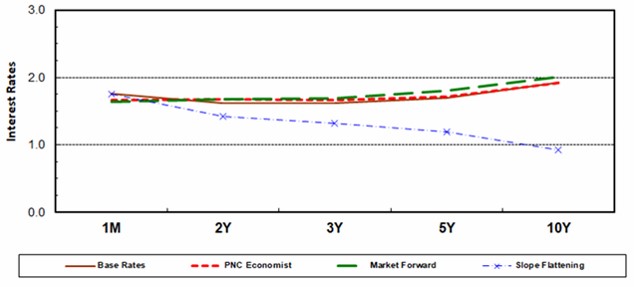
The fourth quarter 2019 interest sensitivity analyses indicate that our Consolidated Balance Sheet is positioned to benefit from an increase in interest rates and an upward sloping interest rate yield curve. We believe that we have the deposit funding base and balance sheet flexibility to adjust, where appropriate and permissible, to changing interest rates and market conditions.
As discussed in Item 1A Risk Factors, the planned discontinuance of the requirement that banks submit rates for the calculation of LIBOR after 2021 presents risks to the financial instruments originated, held or serviced by PNC that use LIBOR as a reference rate. PNC holds instruments and services its instruments and instruments owned by others that may be impacted by the likely discontinuance of LIBOR, including loans, investments, hedging products, floating-rate obligations, and other financial instruments that use LIBOR as a benchmark rate.
PNC has established a cross functional governance structure to oversee the overall strategy for the transition from LIBOR and mitigate risks associated with the transition. An initial LIBOR impact and risk assessment has been performed, which identified the associated risks across products, systems, models, and processes. PNC is actively monitoring its overall firm-wide exposure to LIBOR and using these results to plan transitional strategies and track progress versus these goals. PNC is also involved in industry discussions, preparing milestones for readiness and assessing progress against those milestones along with developing and delivering on internal and external LIBOR cessation communication plans. The transition from LIBOR as an interest rate benchmark will subject PNC to financial, legal, operational, and reputational risks.
Market Risk Management – Customer-Related Trading Risk
We engage in fixed income securities, derivatives and foreign exchange transactions to support our customers’ investing and hedging activities. These transactions, related hedges and the credit valuation adjustment related to our customer derivatives portfolio are marked-to-market daily and reported as customer-related trading activities. We do not engage in proprietary trading of these products.
We use value-at-risk (VaR) as the primary means to measure and monitor market risk in customer-related trading activities. VaR is used to estimate the probability of portfolio losses based on the statistical analysis of historical market risk factors. A diversified VaR reflects empirical correlations across different asset classes. We calculate a diversified VaR at a 95% confidence interval and the results for 2019 and 2018 were within our acceptable limits.
To help ensure the integrity of the models used to calculate VaR for each portfolio and enterprise-wide, we use a process known as backtesting. The backtesting process consists of comparing actual observations of gains or losses against the VaR levels that were calculated at the close of the prior day. Our VaR measure assumes that exposures remain constant and that recent market variability is a good predictor of future variability. Actual observations include customer related revenue and intraday hedging which helps to reduce losses and can reduce the number of instances actual losses exceed the prior day VaR measure. There were minimal instances during 2019 and 2018 under our diversified VaR measure where actual losses exceeded the prior day VaR measure and those losses were insignificant. Our portfolio and enterprise-wide VaR models utilize a historical approach with a 500 day look back period.
Customer-related trading revenue was $285 million in 2019 compared with $248 million in 2018 and is recorded in Other noninterest income and Other interest income on our Consolidated Income Statement. The increase was primarily due to higher derivative client sales revenues and improved client related trading results, which was partially offset by lower foreign exchange client revenues.
The PNC Financial Services Group, Inc. – 2019 Form 10-K 73
Market Risk Management – Equity And Other Investment Risk
Equity investment risk is the risk of potential losses associated with investing in both private and public equity markets. In addition to extending credit, taking deposits, underwriting securities and trading financial instruments, we make and manage direct investments in a variety of transactions, including management buyouts, recapitalizations and growth financings in a variety of industries. We also have investments in affiliated and non-affiliated funds that make similar investments in private equity. The economic and/or book value of these investments and other assets are directly affected by changes in market factors.
Various PNC business units manage our equity and other investment activities. Our businesses are responsible for making investment decisions within the approved policy limits and associated guidelines.
A summary of our equity investments follows:
Table 33: Equity Investments Summary
Dollars in millions |
December 31 2019 |
December 31 2018 |
Change |
||||||||||||
$ |
% |
||||||||||||||
BlackRock |
$ |
8,558 |
$ |
8,016 |
$ |
542 |
7 |
% |
|||||||
Tax credit investments |
2,218 |
2,219 |
(1 |
) |
— |
||||||||||
Private equity and other |
2,958 |
2,659 |
299 |
11 |
% |
||||||||||
Total |
$ |
13,734 |
$ |
12,894 |
$ |
840 |
7 |
% |
|||||||
BlackRock
We owned approximately 35 million common stock equivalent shares of BlackRock equity at December 31, 2019, accounted for under the equity method. The Business Segments Review section of this Item 7 includes additional information about BlackRock.
Tax Credit Investments
Included in our equity investments are direct tax credit investments and equity investments held by consolidated entities. These tax credit investment balances included unfunded commitments totaling $1.0 billion and $.8 billion at December 31, 2019 and 2018, respectively. These unfunded commitments are included in Other liabilities on our Consolidated Balance Sheet.
Note 2 Loan Sale and Servicing Activities and Variable Interest Entities in the Notes To Consolidated Financial Statements in Item 8 of this Report has further information on tax credit investments.
Private Equity and Other
The majority of our other equity investments consists of our private equity portfolio. The private equity portfolio is an illiquid portfolio consisting of mezzanine and equity investments that vary by industry, stage and type of investment. Private equity investments carried at estimated fair value totaled $1.5 billion at December 31, 2019 and 2018, respectively. As of December 31, 2019, $1.3 billion was invested directly in a variety of companies and $.2 billion was invested indirectly through various private equity funds. See the Supervision and Regulation section in Item 1 of this Report for discussion of the potential impacts of the Volcker Rule on our interests in and of private funds covered by the Volcker Rule.
Included in our other equity investments are Visa Class B common shares, which are recorded at cost. Visa Class B common shares that we own are transferable only under limited circumstances until they can be converted into shares of the publicly-traded Class A common shares, which cannot happen until the resolution of the pending interchange litigation. Based upon the December 31, 2019 per share closing price of $187.90 for a Visa Class A common share, the estimated value of our total investment in the Class B common shares was approximately $1.1 billion at the current conversion rate of Visa B shares to Visa A shares, while our cost basis was not significant. See Note 6 Fair Value and Note 19 Legal Proceedings in the Notes To Consolidated Financial Statements in Item 8 of this Report for additional information regarding our Visa agreements. The estimated value does not represent fair value of the Visa B common shares given the shares' limited transferability and the lack of observable transactions in the marketplace.
We also have certain other equity investments, the majority of which represent investments in affiliated and non-affiliated funds with both traditional and alternative investment strategies. Net gains related to these investments were not significant during 2019 and 2018.
Impact of Inflation
Our assets and liabilities are primarily financial in nature and typically have varying maturity dates. Accordingly, future changes in prices do not affect the obligations to pay or receive fixed and determinable amounts of money. However, during periods of inflation, there may be a subsequent impact affecting certain fixed costs or expenses, an erosion of consumer and customer purchasing power, and fluctuations in the need or demand for our products and services. Should significant levels of inflation occur, our business could
74 The PNC Financial Services Group, Inc. – 2019 Form 10-K
potentially be impacted by, among other things, reducing our tolerance for extending credit or causing us to incur additional credit losses resulting from possible increased default rates.
Financial Derivatives
We use a variety of financial derivatives to both mitigate exposure to market (primarily interest rate) and credit risks inherent in our business activities, as well as to facilitate customer risk management activities. We manage these risks as part of our overall asset and liability management process and through our credit policies and procedures.
Financial derivatives involve, to varying degrees, market and credit risk. Derivatives represent contracts between parties that usually require little or no initial net investment and result in one party delivering cash or another type of asset to the other party based on a notional and an underlying as specified in the contract. Therefore, cash requirements and exposure to credit risk are significantly less than the notional amount on these instruments.
Further information on our financial derivatives is presented in Note 1 Accounting Policies, Note 6 Fair Value and Note 13 Financial Derivatives in the Notes To Consolidated Financial Statements in Item 8 of this Report.
Not all elements of market and credit risk are addressed through the use of financial derivatives, and such instruments may be ineffective for their intended purposes due to unanticipated market changes, among other reasons.
Operational Risk Management
Operational risk is the risk to the current or projected financial condition and resilience arising from inadequate or failed internal processes or systems, human errors or misconduct, or adverse external events. Operational risk is inherent to the entire organization.
Operational risk management is embedded in our culture and decision-making processes through a systematic approach whereby operational risks and exposures are: 1) identified and assessed; 2) managed through the design and implementation of controls; 3) measured and evaluated against our risk tolerance limits; and 4) appropriately reported to management and the Risk Committee. Strong operational risk management and well-informed risk-based decisions benefit us by improving the customer experience, enhancing compliance, reducing reputational risk, minimizing losses and establishing an appropriate amount of required operational risk capital held by us.
The Operational Risk Management Framework is designed to provide effective and consistent management of operational risk. The primary purpose of the framework is to enable us to understand our operational risks and manage them to the desired risk profile, in line with our Risk Appetite. Additionally, the guidance established within the framework enables management to make well-informed risk-based business decisions.
The framework provides a disciplined and structured process for us to manage operational risk across eight operational risk domains. These domains provide a comprehensive view of operational risk and allow us to discuss operational risk in a standard way, facilitating reporting and ongoing risk mitigation.
The operational risk domains are:
• |
Operations: Risk resulting from inadequate or failed internal processes, misconduct or errors of people or fraud. |
• |
Compliance: Risk of legal or regulatory sanctions, financial loss, or damage to reputation resulting from failure to comply with laws, regulations, rules, self-regulatory standards, or other regulatory requirements. |
• |
Data Management: Risk associated with incomplete or inaccurate data. |
• |
Model: Risk associated with the design, implementation, and ongoing use and management of a model. |
• |
Technology and Systems: Risk associated with the use, operation, and adoption of technology. |
• |
Information Security: Risk resulting from the failure to protect information and ensure appropriate access to, and use and handling of information assets. |
• |
Business Continuity: Risk of potential disruptive events to business activities. |
• |
Third Party: Risk arising from failure of third party providers to conduct activity in a safe and sound manner and in compliance with contract provisions and applicable laws and regulations. |
We utilize operational risk management programs within the framework, including Risk Control and Self-Assessments, scenario analysis, and internal and external loss event review and analysis, to assess existing risks, determine potential/emerging risks and evaluate the effectiveness of internal controls. The program tools and methodology enable our business managers to identify potential risks and control gaps.
Lines of business are responsible for identifying, owning, managing and monitoring the operational risks and controls associated with its business activities and product or service offerings to within acceptable levels. Centralized functions, such as Business Continuity, Enterprise Third Party Management, and Information Security, are responsible for the development, implementation and management
The PNC Financial Services Group, Inc. – 2019 Form 10-K 75
of their individual programs and for the development and maintenance of the policies, procedures, methodologies, tools and technology utilized across the enterprise to identify, assess, monitor and report program risks. Additionally, independent risk management reviews and challenges line of business adherence to the framework to ensure proper controls are in place and appropriate risk mitigation plans are established as necessary.
Conduct, Reputational and Strategic Risk
PNC’s risk culture seeks to reinforce the appropriate protocols for responsible and ethical behavior through sound processes and controls. In order to promote a robust risk culture, the Board and executive management establish code of conduct and professional standards to which all employees must adhere. A strong risk culture discourages misconduct and supports Conduct Risk management at PNC. Conduct Risk is defined as the risk that employees fail to comply with the ethical standards expected of them. Strong Conduct Risk management is important in supporting PNC’s reputation and PNC maintains a corporate culture that emphasizes complying with laws, regulations, and managing reputational risks. Reputational Risk is the risk to the franchise and/or shareholder value based on a negative perception of PNC by its stakeholders and/or the changing expectations of its stakeholders. While managing PNC’s reputation preserves PNC’s brand value, Strategic Risk is another component of the ERM Framework that is also critical to optimizing shareholder returns. Strategic Risk is the risk to earnings that may arise from adverse business decisions, improper implementation of business decisions and/or inadequate response to changes in the business environment. Strategic Risk is considered and assessed by our businesses in the annual strategic planning processes and monitored on an on-going basis as those plans are carried out.
Compliance Risk
Enterprise Compliance is responsible for oversight of compliance risk for the organization. Compliance issues are identified and tracked through enterprise-wide monitoring and testing activities. Compliance risk issues are escalated through a comprehensive risk reporting process at both a business and enterprise level and incorporated, as appropriate, into the development and assessment of our operational risk profile. A management committee, co-chaired by the Chief Compliance Officer and the Chief Bank Secrecy Act (BSA)/Anti-Money Laundering (AML) Officer, is responsible for oversight of compliance and fiduciary risk management programs across PNC. Enterprise Compliance, through the Regulatory Change Program, helps PNC understand and proactively address emerging regulatory topics and risks as well as respond to changes in applicable laws and regulations. To understand emerging issues impacting the industry, Enterprise Compliance communicates regularly with various regulators having supervisory or regulatory responsibilities with respect to us, our subsidiaries, or businesses and participates in forums focused on regulatory and compliance matters in the financial services industry.
Information Security Risk
The Information Security component of our Operational Risk Management Framework is responsible for protecting information assets to achieve business objectives, which includes cyber security. PNC’s cyber security program is designed to identify risks to sensitive information, protect that information, detect threats and events, and maintain an appropriate response and recovery capability to help ensure resilience against information security incidents. The program includes, among other things, annual security and privacy training for all PNC employees and quarterly phishing exercises to raise employee awareness. Our security program is also regularly examined by federal regulators for compliance with financial regulations and standards. The program also establishes expectations for information asset management, system development security, identity and access management, incident management, threat and vulnerability management, security operations management, and third and fourth party security.
CRITICAL ACCOUNTING ESTIMATES AND JUDGMENTS
Our consolidated financial statements are prepared by applying certain accounting policies. Note 1 Accounting Policies in the Notes To Consolidated Financial Statements in Item 8 of this Report describes the most significant accounting policies that we use. Certain of these policies require us to make estimates or economic assumptions that may vary under different assumptions or conditions and such variations may significantly affect our reported results and financial position for the period or in future periods.
Fair Value Measurements
We must use estimates, assumptions and judgments when assets and liabilities are required to be recorded at, or adjusted to reflect, fair value. Assets and liabilities carried at fair value inherently result in a higher degree of financial statement volatility. Fair values and the information used to record valuation adjustments for certain assets and liabilities are based on either quoted market prices or are provided by independent third-party sources, including appraisers and valuation specialists, when available. When such third-party information is not available, we estimate fair value primarily by using cash flow and other financial modeling techniques. Changes in underlying factors, assumptions, or estimates in any of these areas could materially impact our future financial condition and results of operations.
We apply ASC 820 – Fair Value Measurements. This guidance defines fair value as the price that would be received to sell a financial asset or paid to transfer a financial liability in an orderly transaction between market participants at the measurement date. This guidance requires a three level hierarchy for disclosure of assets and liabilities recorded at fair value. The classification of assets and
76 The PNC Financial Services Group, Inc. – 2019 Form 10-K
liabilities within the hierarchy is based on whether the inputs to the valuation methodology used in the measurement are observable or unobservable. Level 3 assets and liabilities are those where the fair value is estimated using significant unobservable inputs.
For additional information on fair value measurements, see Note 6 Fair Value in the Notes To Consolidated Financial Statements in Item 8 of this Report.
Allowances for Loan and Lease Losses and Unfunded Loan Commitments and Letters of Credit
On January 1, 2020 we adopted Accounting Standards Update (ASU) 2016-13 - Credit Losses (CECL). The following discussion refers to our Allowance for Loan and Lease Losses and Unfunded Loan Commitments and Letters of Credit prior to the adoption. For additional information on our implementation of CECL refer to Note 1 Accounting Policies in Item 8 of this Report.
We maintain the ALLL and the Allowance for Unfunded Loan Commitments and Letters of Credit at levels that we believe to be appropriate to absorb estimated probable credit losses incurred in the loan and lease portfolios and on these unfunded credit facilities as of the balance sheet date. Our determination of the allowances is based on periodic evaluations of the loan and lease portfolios and unfunded credit facilities and other relevant factors. These critical estimates include significant use of our own historical data and complex methods to interpret them. We have an ongoing process to evaluate and enhance the quality, quantity and timeliness of our data and interpretation methods used in the determination of these allowances. These evaluations are inherently subjective, as they require material estimates and may be susceptible to significant change, and include, among others:
• |
Probability of default (PD); |
• |
Loss given default (LGD); |
• |
Exposure at default; |
• |
Movement through delinquency stages; |
• |
Amounts and timing of expected future cash flows; |
• |
Value of collateral; and |
• |
Qualitative factors, such as changes in current economic conditions, that may not be reflected in modeled results. For all loans, the ALLL is the sum of three components: (i) asset specific/individual impaired reserves, (ii) quantitative (formulaic or pooled) reserves and (iii) qualitative (judgmental) reserves. |
The reserve calculation and determination process is dependent on the use of key assumptions. Key reserve assumptions and estimation processes react to and are influenced by observed changes in loan portfolio performance experience, the financial strength of the borrower, and economic conditions. For unfunded commitments, the reserve estimate also includes estimation of the probability of funding. Key reserve assumptions are periodically updated.
To the extent actual outcomes differ from our estimates, additional provision for credit losses may be required that would reduce future earnings. See the following for additional information:
• |
Allowances For Loan And Lease Losses And Unfunded Loan Commitments And Letters Of Credit in the Credit Risk Management section of this Item 7; and |
• |
Note 1 Accounting Policies and Note 4 Allowance for Loan and Lease Losses in the Notes To Consolidated Financial Statements and Allocation of Allowance for Loan and Lease Losses in the Statistical Information (Unaudited) section of Item 8 of this Report.
|
Residential and Commercial Mortgage Servicing Rights
We elect to measure our residential and commercial mortgage servicing rights (MSRs) at fair value. This election was made to be consistent with our risk management strategy to hedge changes in the fair value of these assets. The fair value of residential and commercial MSRs is estimated by using a discounted cash flow valuation model which calculates the present value of estimated future net servicing cash flows, taking into consideration actual and expected mortgage loan prepayment rates, discount rates, servicing costs, and other factors which are determined based on current market conditions.
We employ risk management strategies designed to protect the value of MSRs from changes in interest rates and related market factors. The values of the residential and commercial MSRs are economically hedged with securities and derivatives, including interest-rate swaps, options, and forward mortgage-backed and futures contracts. As interest rates change, these financial instruments are expected to have changes in fair value negatively correlated to the change in fair value of the hedged MSR portfolios. The hedge relationships are actively managed in response to changing market conditions over the life of the MSRs. Selecting appropriate financial instruments to economically hedge residential or commercial MSRs requires significant management judgment to assess how mortgage rates and prepayment speeds could affect the future values of MSRs. Hedging results can frequently be less predictable in the short term, but over longer periods of time are expected to protect the economic value of the MSRs.
For additional information on our residential and commercial MSRs, see Note 6 Fair Value and Note 7 Goodwill and Mortgage Servicing Rights in the Notes To Consolidated Financial Statements in Item 8 of this Report.
The PNC Financial Services Group, Inc. – 2019 Form 10-K 77
Recently Issued Accounting Standards
Accounting Standards Update (ASU) |
Description |
Financial Statement Impact |
|
Goodwill -
ASU 2017-04
Issued January 2017
|
• Required effective date of January 1, 2020.
• Eliminates Step 2 from the goodwill impairment test to simplify the subsequent measurement of goodwill under which a loss was recognized only if the estimated implied fair value of the goodwill is below its carrying value.
• Requires impairment to be recognized if the reporting unit's carrying value exceeds the fair value.
|
• We adopted this standard on January 1, 2020.
• We do not expect the adoption of this standard to impact our consolidated results of operations or our consolidated financial position.
|
Recently Adopted Accounting Pronouncements
See Note 1 Accounting Policies in the Notes To Consolidated Financial Statements in Item 8 of this Report regarding the impact of new accounting pronouncements which we have adopted.
OFF-BALANCE SHEET ARRANGEMENTS AND VARIABLE INTEREST ENTITIES
We engage in a variety of activities that involve entities that are not consolidated or otherwise reflected in our Consolidated Balance Sheet that are generally referred to as “off-balance sheet arrangements.” Additional information on these types of activities is included in the following sections of this Report:
• |
Contractual Obligations and Commitments included within the Risk Management section of this Item 7; and |
• |
Note 2 Loan Sale and Servicing Activities and Variable Interest Entities; |
• |
Note 10 Borrowed Funds; |
• |
Note 15 Equity; and |
• |
Note 20 Commitments, all of which are in the Notes To Consolidated Financial Statements included in Item 8 of this Report. |
A summary and further description of variable interest entities (VIEs) as of December 31, 2019 and 2018 is included in Note 1 Accounting Policies and Note 2 Loan Sale and Servicing and Variable Interest Entities in the Notes To Consolidated Financial Statements included in Item 8 of this Report.
Trust Preferred Securities
See Note 10 Borrowed Funds in the Notes To Consolidated Financial Statements in Item 8 of this Report for additional information on trust preferred securities issued by PNC Capital Trust C including information on contractual limitations potentially imposed on payments (including dividends) with respect to PNC's equity securities.
GLOSSARY OF TERMS
Adjusted average total assets – Primarily consisted of total average quarterly (or annual) assets plus/less unrealized losses (gains) on investment securities, less goodwill and certain other intangible assets (net of eligible deferred taxes).
Basel III common equity Tier 1 capital – Common stock plus related surplus, net of treasury stock, plus retained earnings, plus accumulated other comprehensive income for securities currently, and those transferred from, available for sale and pension and other postretirement benefit plans, subject to phase-in limits, less goodwill, net of associated deferred tax liabilities, less other disallowed intangibles, net of deferred tax liabilities and plus/less other adjustments. Significant common stock investments in unconsolidated financial institutions, as well as mortgage servicing rights and deferred tax assets, must then be deducted to the extent such items individually exceed 10%, or in the aggregate exceed 15%, of our adjusted Basel III common equity Tier 1 capital.
Basel III common equity Tier 1 capital ratio – Common equity Tier 1 capital divided by period-end risk-weighted assets (as applicable).
Basel III Tier 1 capital – Common equity Tier 1 capital, plus qualifying preferred stock, plus certain trust preferred capital securities, plus certain noncontrolling interests that are held by others and plus/less other adjustments.
Basel III Tier 1 capital ratio – Tier 1 capital divided by period-end risk-weighted assets (as applicable).
Basel III Total capital – Tier 1 capital plus qualifying subordinated debt, plus certain trust preferred securities, plus, under the Basel III transitional rules and the standardized approach, the allowance for loan and lease losses included in Tier 2 capital and other.
Basel III Total capital ratio – Basel III Total capital divided by period-end risk-weighted assets (as applicable).
78 The PNC Financial Services Group, Inc. – 2019 Form 10-K
Charge-off – Process of removing a loan or portion of a loan from our balance sheet because it is considered uncollectible. We also record a charge-off when a loan is transferred from portfolio holdings to held for sale by reducing the loan carrying amount to the fair value of the loan, if fair value is less than carrying amount.
Combined loan-to-value ratio (CLTV) – This is the aggregate principal balance(s) of the mortgages on a property divided by its appraised value or purchase price.
Common shareholders’ equity – Total shareholders’ equity less the liquidation value of preferred stock.
Credit valuation adjustment – Represents an adjustment to the fair value of our derivatives for our own and counterparties’ non-performance risk.
Criticized commercial loans – Loans with potential or identified weaknesses based upon internal risk ratings that comply with the regulatory classification definitions of “Special Mention,” “Substandard” or “Doubtful.”
Discretionary client assets under management – Assets over which we have sole or shared investment authority for our customers/clients. We do not include these assets on our Consolidated Balance Sheet.
Duration of equity – An estimate of the rate sensitivity of our economic value of equity. A negative duration of equity is associated with asset sensitivity (i.e., positioned for rising interest rates), while a positive value implies liability sensitivity (i.e., positioned for declining interest rates). For example, if the duration of equity is -1.5 years, the economic value of equity increases by 1.5% for each 100 basis point increase in interest rates.
Earning assets – Assets that generate income, which include: interest-earning deposits with banks; loans held for sale; loans; investment securities; and certain other assets.
Effective duration – A measurement, expressed in years, that, when multiplied by a change in interest rates, would approximate the percentage change in value of on- and off- balance sheet positions.
Efficiency – Noninterest expense divided by total revenue.
Fair value – The price that would be received to sell an asset or paid to transfer a liability in an orderly transaction between market participants at the measurement date.
Fee income – Refers to the following categories within Noninterest income: Asset management; Consumer services; Corporate services; Residential mortgage; and Service charges on deposits.
FICO score – A credit bureau-based industry standard score created by Fair Isaac Co. which predicts the likelihood of borrower default. We use FICO scores both in underwriting and assessing credit risk in our consumer lending portfolio. Lower FICO scores indicate likely higher risk of default, while higher FICO scores indicate likely lower risk of default. FICO scores are updated on a periodic basis.
Foreign exchange contracts – Contracts that provide for the future receipt and delivery of foreign currency at previously agreed-upon terms.
Futures and forward contracts – Contracts in which the buyer agrees to purchase and the seller agrees to deliver a specific financial instrument at a predetermined price or yield. May be settled either in cash or by delivery of the underlying financial instrument.
GAAP – Accounting principles generally accepted in the United States of America.
Home price index (HPI) – A broad measure of the movement of single-family house prices in the U.S.
Impaired loans – Loans are determined to be impaired when, based on current information and events, it is probable that all contractually required payments will not be collected. Impaired loans include commercial nonperforming loans and consumer and commercial TDRs, regardless of nonperforming status. Excluded from impaired loans are nonperforming leases, loans held for sale, loans accounted for under the fair value option, smaller balance homogenous type loans and purchased impaired loans.
Interest rate swap contracts – Contracts that are entered into primarily as an asset/liability management strategy to reduce interest rate risk. Interest rate swap contracts are exchanges of interest rate payments, such as fixed-rate payments for floating-rate payments, based on notional principal amounts.
The PNC Financial Services Group, Inc. – 2019 Form 10-K 79
Intrinsic value – The difference between the price, if any, required to be paid for stock issued pursuant to an equity compensation arrangement and the fair market value of the underlying stock.
Leverage ratio – Basel III Tier 1 capital divided by average quarterly adjusted total assets.
LIBOR – Acronym for London InterBank Offered Rate. LIBOR is the average interest rate charged when banks in the London wholesale money market (or interbank market) borrow unsecured funds from each other. LIBOR rates are used as a benchmark for interest rates on a global basis. Our product set includes loans priced using LIBOR as a benchmark.
Loan-to-value ratio (LTV) – A calculation of a loan’s collateral coverage that is used both in underwriting and assessing credit risk in our lending portfolio. LTV is the sum total of loan obligations secured by collateral divided by the market value of that same collateral. Market value of the collateral is based on an independent valuation of the collateral. For example, a LTV of less than 90% is better secured and has less credit risk than a LTV of greater than or equal to 90%.
Loss given default (LGD) – An estimate of loss, net of recovery, based on collateral type, collateral value, loan exposure and other factors. Each loan has its own LGD. The LGD risk rating measures the percentage of exposure of a specific credit obligation that we expect to lose if default occurs. LGD is net of recovery, through any means, including but not limited to the liquidation of collateral or deficiency judgments rendered from foreclosure or bankruptcy proceedings.
Nonaccrual loans – Loans for which we do not accrue interest income. Nonaccrual loans include nonperforming loans, in addition to loans accounted for under fair value option and loans accounted for as held for sale for which full collection of contractual principal and/or interest is not probable.
Nondiscretionary client assets under administration – Assets we hold for our customers/clients in a nondiscretionary, custodial capacity. We do not include these assets on our Consolidated Balance Sheet.
Nonperforming assets – Nonperforming assets include nonperforming loans, OREO and foreclosed assets. We do not accrue interest income on assets classified as nonperforming.
Nonperforming loans – Loans accounted for at amortized cost whose credit quality has deteriorated to the extent that full collection of contractual principal and interest is not probable, including TDRs which have not returned to performing status. Interest income is not recognized on nonperforming loans. Nonperforming loans exclude certain government insured or guaranteed loans for which we expect to collect substantially all principal and interest, loans held for sale, loans accounted for under the fair value option and purchased impaired loans. Purchased impaired loans are excluded as we are currently accreting interest income over the expected life of the loans.
Notional amount – A number of currency units, shares or other units specified in a derivative contract.
Operating leverage – The period to period dollar or percentage change in total revenue less the dollar or percentage change in noninterest expense. A positive variance indicates that revenue growth exceeded expense growth (i.e., positive operating leverage) while a negative variance implies expense growth exceeded revenue growth (i.e., negative operating leverage).
Options – Contracts that grant the purchaser, for a premium payment, the right, but not the obligation, to either purchase or sell the associated financial instrument at a set price during a specified period or at a specified date in the future.
Other real estate owned (OREO) and foreclosed assets –Assets taken in settlement of troubled loans primarily through deed-in-lieu of foreclosure or foreclosure. Foreclosed assets include real and personal property. Certain assets that have a government-guarantee which are classified as other receivables are excluded.
Probability of default (PD) – An internal risk rating that indicates the likelihood that a credit obligor will enter into default status.
Recovery – Cash proceeds received on a loan that we had previously charged off. We credit the amount received to the allowance for loan and lease losses.
Risk – The potential that an event or series of events could occur that would threaten our ability to achieve our strategic objectives, thereby negatively affecting shareholder value or reputation.
Risk appetite – A dynamic, forward-looking view on the aggregate amount of risk we are willing and able to take in executing business strategy in light of the current business environment.
80 The PNC Financial Services Group, Inc. – 2019 Form 10-K
Risk limits – Quantitative measures based on forward-looking assumptions that allocate our aggregate risk appetite (e.g., measure of loss or negative events) to business lines, legal entities, specific risk categories, concentrations and as appropriate, other levels.
Risk profile – The risk profile is a point-in-time assessment of risk. The profile represents overall risk position in relation to the desired risk appetite. The determination of the risk profile’s position is based on qualitative and quantitative analysis of reported risk limits, metrics, operating guidelines and qualitative assessments.
Risk-weighted assets – Computed by the assignment of specific risk-weights (as defined by the Board of Governors of the Federal Reserve System) to assets and off-balance sheet instruments.
SOFR - Acronym for Secured Overnight Financing Rate. SOFR is a reference rate that is based on overnight transactions in the U.S. Treasury repurchase market.
Servicing rights – An intangible asset or liability created by an obligation to service assets for others. Typical servicing rights include the right to receive a fee for collecting and forwarding payments on loans and related taxes and insurance premiums held in escrow.
Supplementary leverage exposure - The sum of adjusted average assets and certain off-balance sheet exposures, including undrawn credit commitments and derivative potential future exposures.
Supplementary leverage ratio – Basel III Tier 1 capital divided by Supplementary leverage exposure.
Taxable-equivalent interest income – The interest income earned on certain assets that is completely or partially exempt from federal income tax. These tax-exempt instruments typically yield lower returns than taxable investments. To provide more meaningful comparisons of yields and margins for all interest-earning assets, we use interest income on a taxable-equivalent basis in calculating average yields and net interest margins by increasing the interest income earned on tax-exempt assets to make it fully equivalent to interest income earned on other taxable investments. This adjustment is not permitted under GAAP on the Consolidated Income Statement.
Transitional Basel III common equity Tier 1 capital – Common equity Tier 1 capital calculated under Basel III using phased-in definitions and deductions applicable to us during the related presentation period and standardized approach risk-weighted assets.
Troubled debt restructuring (TDR) – A loan whose terms have been restructured in a manner that grants a concession to a borrower experiencing financial difficulties.
Value-at-risk (VaR) – A statistically-based measure of risk that describes the amount of potential loss which may be incurred due to adverse market movements. The measure is of the maximum loss which should not be exceeded on 95 out of 100 days for a 95% VaR.
Yield curve – A graph showing the relationship between the yields on financial instruments or market indices of the same credit quality with different maturities. For example, a “normal” or “positive” yield curve exists when long-term bonds have higher yields than short-term bonds. A “flat” yield curve exists when yields are the same for short-term and long-term bonds. A “steep” yield curve exists when yields on long-term bonds are significantly higher than on short-term bonds. An “inverted” or “negative” yield curve exists when short-term bonds have higher yields than long-term bonds.
CAUTIONARY STATEMENT REGARDING FORWARD-LOOKING INFORMATION
We make statements in this Report, and we may from time to time make other statements, regarding our outlook for earnings, revenues, expenses, tax rates, capital and liquidity levels and ratios, asset levels, asset quality, financial position, and other matters regarding or affecting us and our future business and operations that are forward-looking statements within the meaning of the Private Securities Litigation Reform Act. Forward-looking statements are typically identified by words such as “believe,” “plan,” “expect,” “anticipate,” “see,” “look,” “intend,” “outlook,” “project,” “forecast,” “estimate,” “goal,” “will,” “should” and other similar words and expressions.
Forward-looking statements are necessarily subject to numerous assumptions, risks and uncertainties, which change over time. Future events or circumstances may change our outlook and may also affect the nature of the assumptions, risks and uncertainties to which our forward-looking statements are subject. Forward-looking statements speak only as of the date made. We do not assume any duty and do not undertake to update forward-looking statements. Actual results or future events could differ, possibly materially, from those anticipated in forward-looking statements, as well as from historical performance. As a result, we caution against placing undue reliance on any forward-looking statements.
The PNC Financial Services Group, Inc. – 2019 Form 10-K 81
Our forward-looking statements are subject to the following principal risks and uncertainties.
• |
Our businesses, financial results and balance sheet values are affected by business and economic conditions, including the following: |
– |
Changes in interest rates and valuations in debt, equity and other financial markets. |
– |
Disruptions in the U.S. and global financial markets. |
– |
Actions by the Federal Reserve Board, U.S. Treasury and other government agencies, including those that impact money supply and market interest rates. |
– |
Changes in customer behavior due to changing business and economic conditions or legislative or regulatory initiatives. |
– |
Changes in customers’, suppliers’ and other counterparties’ performance and creditworthiness. |
– |
Impacts of tariffs and other trade policies of the U.S. and its global trading partners. |
– |
Slowing or reversal of the current U.S. economic expansion. |
– |
Commodity price volatility. |
Our forward-looking financial statements are subject to the risk that economic and financial market conditions will be substantially different than those we are currently expecting and do not take into account potential legal and regulatory contingencies. These statements are based on our views that:
– |
The U.S. economy grew at a solid pace in 2019 albeit more slowly than in 2018. Economic growth is expected to slow noticeably in 2020. |
– |
Job growth will continue in 2020, but at a slower pace from 2019 due to both difficulty in finding workers and slower economic growth. The unemployment rate is expected to remain near its current level in the near term, but the labor market will remain tight, pushing wages higher and supporting continued gains in consumer spending. |
– |
Inflation is expected to continue to slow in the near term because of lower commodity prices associated with coronavirus. Inflation is expected to gradually increase in 2021. |
– |
Our current baseline forecast expects the federal funds rate to remain unchanged in 2020. The federal funds rate is modestly positive for near-term economic growth in its current range of 1.50% to 1.75%. |
• |
Near-term risks are to the downside, including a further softening in the global economy, perhaps due to coronavirus; a further escalation in trade tensions; and geopolitical concerns. The federal funds rate is more likely to end 2020 below its current range than above it. But there are some upside opportunities as well, such as a comprehensive U.S.-China trade deal and stronger labor force growth. |
• |
PNC’s ability to take certain capital actions, including returning capital to shareholders, is subject to review by the Federal Reserve Board as part of PNC’s comprehensive capital plan for the applicable period in connection with the Federal Reserve Board’s Comprehensive Capital Analysis and Review (CCAR) process and to the acceptance of such capital plan and non-objection to such capital actions by the Federal Reserve Board. |
• |
PNC’s regulatory capital ratios in the future will depend on, among other things, the company’s financial performance, the scope and terms of final capital regulations then in effect and management actions affecting the composition of PNC’s balance sheet. In addition, PNC’s ability to determine, evaluate and forecast regulatory capital ratios, and to take actions (such as capital distributions) based on actual or forecasted capital ratios, will be dependent at least in part on the development, validation and regulatory review of related models. |
• |
Legal and regulatory developments could have an impact on our ability to operate our businesses, financial condition, results of operations, competitive position, reputation, or pursuit of attractive acquisition opportunities. Reputational impacts could affect matters such as business generation and retention, liquidity, funding, and ability to attract and retain management. These developments could include: |
– |
Changes to laws and regulations, including changes affecting oversight of the financial services industry, consumer protection, bank capital and liquidity standards, pension, bankruptcy and other industry aspects, and changes in accounting policies and principles. |
– |
Unfavorable resolution of legal proceedings or other claims and regulatory and other governmental investigations or other inquiries. These matters may result in monetary judgments or settlements or other remedies, including fines, penalties, restitution or alterations in our business practices, and in additional expenses and collateral costs, and may cause reputational harm to PNC. |
– |
Results of the regulatory examination and supervision process, including our failure to satisfy requirements of agreements with governmental agencies. |
– |
Impact on business and operating results of any costs associated with obtaining rights in intellectual property claimed by others and of adequacy of our intellectual property protection in general. |
• |
Business and operating results are affected by our ability to identify and effectively manage risks inherent in our businesses, including, where appropriate, through effective use of systems and controls, third-party insurance, derivatives, and capital management techniques, and to meet evolving regulatory capital and liquidity standards. |
• |
Business and operating results also include impacts relating to our equity interest in BlackRock, Inc. and rely to a significant extent on information provided to us by BlackRock. Risks and uncertainties that could affect BlackRock are discussed in more detail by BlackRock in its SEC filings. |
• |
We grow our business in part through acquisitions and new strategic initiatives. Risks and uncertainties include those presented by the nature of the business acquired and strategic initiative, including in some cases those associated with our |
82 The PNC Financial Services Group, Inc. – 2019 Form 10-K
entry into new businesses or new geographic or other markets and risks resulting from our inexperience in those new areas, as well as risks and uncertainties related to the acquisition transactions themselves, regulatory issues, and the integration of the acquired businesses into PNC after closing.
• |
Competition can have an impact on customer acquisition, growth and retention and on credit spreads and product pricing, which can affect market share, deposits and revenues. Our ability to anticipate and respond to technological changes can also impact our ability to respond to customer needs and meet competitive demands. |
• |
Business and operating results can also be affected by widespread natural and other disasters, pandemics, dislocations, terrorist activities, system failures, security breaches, cyberattacks or international hostilities through impacts on the economy and financial markets generally or on us or our counterparties specifically. |
We provide greater detail regarding these as well as other factors in this Report, including in Item 1A Risk Factors, the Risk Management section of Item 7, and Note 19 Legal Proceedings and Note 20 Commitments in the Notes To Consolidated Financial Statements in Item 8 of this Report. Our forward-looking statements may also be subject to other risks and uncertainties, including those discussed elsewhere in this Report or in our other filings with the SEC.
ITEM 7A – QUANTITATIVE AND QUALITATIVE DISCLOSURES ABOUT MARKET RISK
This information is set forth in the Risk Management section of Item 7 and in Note 1 Accounting Policies, Note 6 Fair Value and Note 13 Financial Derivatives in the Notes To Consolidated Financial Statements in Item 8 of this Report.
The PNC Financial Services Group, Inc. – 2019 Form 10-K 83
ITEM 8 – FINANCIAL STATEMENTS AND SUPPLEMENTARY DATA
REPORT OF INDEPENDENT REGISTERED PUBLIC ACCOUNTING FIRM
To the Board of Directors and Shareholders of The PNC Financial Services Group, Inc.
Opinions on the Financial Statements and Internal Control over Financial Reporting
We have audited the accompanying consolidated balance sheets of The PNC Financial Services Group, Inc. and its subsidiaries (the “Company”) as of December 31, 2019 and 2018, and the related consolidated statements of income, comprehensive income, changes in equity and cash flows for each of the three years in the period ended December 31, 2019, including the related notes (collectively referred to as the “consolidated financial statements”). We also have audited the Company's internal control over financial reporting as of December 31, 2019, based on criteria established in Internal Control - Integrated Framework (2013) issued by the Committee of Sponsoring Organizations of the Treadway Commission (COSO).
In our opinion, the consolidated financial statements referred to above present fairly, in all material respects, the financial position of the Company as of December 31, 2019 and 2018, and the results of its operations and its cash flows for each of the three years in the period ended December 31, 2019 in conformity with accounting principles generally accepted in the United States of America. Also in our opinion, the Company maintained, in all material respects, effective internal control over financial reporting as of December 31, 2019, based on criteria established in Internal Control - Integrated Framework (2013) issued by the COSO.
Basis for Opinions
The Company's management is responsible for these consolidated financial statements, for maintaining effective internal control over financial reporting, and for its assessment of the effectiveness of internal control over financial reporting, included in Management’s Report on Internal Control over Financial Reporting appearing under Item 9A. Our responsibility is to express opinions on the Company’s consolidated financial statements and on the Company's internal control over financial reporting based on our audits. We are a public accounting firm registered with the Public Company Accounting Oversight Board (United States) (PCAOB) and are required to be independent with respect to the Company in accordance with the U.S. federal securities laws and the applicable rules and regulations of the Securities and Exchange Commission and the PCAOB.
We conducted our audits in accordance with the standards of the PCAOB. Those standards require that we plan and perform the audits to obtain reasonable assurance about whether the consolidated financial statements are free of material misstatement, whether due to error or fraud, and whether effective internal control over financial reporting was maintained in all material respects.
Our audits of the consolidated financial statements included performing procedures to assess the risks of material misstatement of the consolidated financial statements, whether due to error or fraud, and performing procedures that respond to those risks. Such procedures included examining, on a test basis, evidence regarding the amounts and disclosures in the consolidated financial statements. Our audits also included evaluating the accounting principles used and significant estimates made by management, as well as evaluating the overall presentation of the consolidated financial statements. Our audit of internal control over financial reporting included obtaining an understanding of internal control over financial reporting, assessing the risk that a material weakness exists, and testing and evaluating the design and operating effectiveness of internal control based on the assessed risk. Our audits also included performing such other procedures as we considered necessary in the circumstances. We believe that our audits provide a reasonable basis for our opinions.
Definition and Limitations of Internal Control over Financial Reporting
A company’s internal control over financial reporting is a process designed to provide reasonable assurance regarding the reliability of financial reporting and the preparation of financial statements for external purposes in accordance with generally accepted accounting principles. A company’s internal control over financial reporting includes those policies and procedures that (i) pertain to the maintenance of records that, in reasonable detail, accurately and fairly reflect the transactions and dispositions of the assets of the company; (ii) provide reasonable assurance that transactions are recorded as necessary to permit preparation of financial statements in accordance with generally accepted accounting principles, and that receipts and expenditures of the company are being made only in accordance with authorizations of management and directors of the company; and (iii) provide reasonable assurance regarding prevention or timely detection of unauthorized acquisition, use, or disposition of the company’s assets that could have a material effect on the financial statements.
Because of its inherent limitations, internal control over financial reporting may not prevent or detect misstatements. Also, projections of any evaluation of effectiveness to future periods are subject to the risk that controls may become inadequate because of changes in conditions, or that the degree of compliance with the policies or procedures may deteriorate.
84 The PNC Financial Services Group, Inc. – 2019 Form 10-K
Critical Audit Matters
The critical audit matters communicated below are matters arising from the current period audit of the consolidated financial statements that were communicated or required to be communicated to the audit committee and that (i) relate to accounts or disclosures that are material to the consolidated financial statements and (ii) involved our especially challenging, subjective, or complex judgments. The communication of critical audit matters does not alter in any way our opinion on the consolidated financial statements, taken as a whole, and we are not, by communicating the critical audit matters below, providing separate opinions on the critical audit matters or on the accounts or disclosures to which they relate.
Valuation of the Allowance for Loan and Lease Losses - Commercial Collectively Evaluated
As described in Notes 1 and 4 to the consolidated financial statements, the Company maintains the commercial allowance for loan and lease losses (“ALLL”) at a level to absorb estimated probable credit losses incurred in the loan and lease portfolio as of the balance sheet date. The allowance for commercial loans collectively evaluated for impairment was approximately $1.7 billion as of December 31, 2019. The commercial lending quantitative component is determined using a statistical loss model, which is dependent upon the use of key assumptions such as management’s internal risk ratings reflecting their best estimate of the borrower’s probability of default and the loss given default. Management assigns the probability of default and loss given default based upon borrower and transaction characteristics. These statistical parameters are determined based on internal historical data supplemented with third party data and management judgment.
The principal considerations for our determination that performing procedures relating to the valuation of the ALLL - commercial collectively evaluated is a critical audit matter are (i) the valuation involved the application of significant judgment by management, which led to a high degree of auditor subjectivity in performing audit procedures and in evaluating audit evidence related to significant assumptions, including management’s risk ratings; (ii) significant audit effort was necessary in performing audit procedures; and (iii) the audit effort involved professionals with specialized skill and knowledge to assist with the evaluation of audit evidence.
Addressing the matter involved performing procedures and evaluating audit evidence in connection with forming our overall opinion on the consolidated financial statements. These procedures included testing the effectiveness of controls relating to the valuation of the ALLL - commercial collectively evaluated, which included controls over the assignment and review of internal risk ratings reflecting management’s best estimate of the borrower’s probability of default and loss given default. These procedures also included, among others, testing management’s process for determining the commercial collectively evaluated allowance by evaluating the appropriateness of the methodology, testing the completeness and accuracy of principal balance data subject to the allowance calculation, and evaluating the reasonableness of significant assumptions, including internal risk ratings. Evaluating the reasonableness of significant assumptions included the involvement of professionals with specialized skill and knowledge to assist in determining whether the internal risk ratings assigned were developed consistently with the Company’s defined risk rating criteria for a sample of credit facilities.
Fair Value of Level 3 Non-Agency Residential Mortgage-Backed Securities Available for Sale
As described in Note 6 to the consolidated financial statements, the Company accounts for Level 3 non-agency residential mortgage-backed securities available for sale at fair value, which totals approximately $1.7 billion as of December 31, 2019. Management generally estimates fair value using pricing obtained from third-party vendors or, in some cases, using a dealer quote. The third-party vendors use a discounted cash flow approach that incorporates significant unobservable inputs and observable market activity where available. The significant unobservable inputs used to estimate the fair value of the securities are the constant prepayment rate, constant default rate, loss severity and spread over the benchmark curve.
The principal considerations for our determination that performing procedures relating to the fair value of Level 3 non-agency residential mortgage-backed securities available for sale is a critical audit matter are (i) the valuation involved the application of significant judgment by management, which led to a high degree of auditor judgment and subjectivity in performing audit procedures and in evaluating audit evidence related to the fair value of non-agency residential mortgage-backed securities available for sale; (ii) significant audit effort was necessary in performing audit procedures; and (iii) the audit effort involved professionals with specialized skill and knowledge to assist with performing procedures and evaluating audit evidence obtained.
Addressing the matter involved performing procedures and evaluating audit evidence in connection with forming our overall opinion on the consolidated financial statements. These procedures included testing the effectiveness of controls relating to the fair value of Level 3 non-agency residential mortgage-backed securities, including controls over the price validation of the securities. These procedures also included, among others, obtaining pricing from sources other than those used by management, where available. Additionally, for a sample of securities, professionals with specialized skill and knowledge were involved to assist in developing an independent estimate of fair value using independent assumptions, including the constant prepayment rate, constant default rate, loss severity and spread over the benchmark curve. The independently obtained prices or the independent estimates were compared to management’s prices to evaluate the reasonableness of the estimate.
The PNC Financial Services Group, Inc. – 2019 Form 10-K 85
Fair Value of Residential Mortgage Servicing Rights
As described in Notes 6 and 7 to the consolidated financial statements, the Company accounts for its residential mortgage servicing rights (“residential MSRs”) at fair value, which totals approximately $1.0 billion as of December 31, 2019. Residential MSRs are valued using a discounted cash flow model. The valuation derived from the discounted cash flow methodology is benchmarked for reasonableness by comparison against opinions of value from independent brokers. The significant unobservable inputs related to the valuation of residential MSRs are the constant prepayment rates and the spread over the benchmark curve.
The principal considerations for our determination that performing procedures relating to the fair value of residential mortgage servicing rights is a critical audit matter are (i) the valuation involved the application of significant judgment by management, which led to a high degree of auditor judgment and subjectivity in performing audit procedures and in evaluating audit evidence related to the residential mortgage servicing rights; (ii) significant audit effort was necessary in performing audit procedures; and (iii) the audit effort involved professionals with specialized skill and knowledge to assist with performing procedures and evaluating audit evidence obtained.
Addressing the matter involved performing procedures and evaluating audit evidence in connection with forming our overall opinion on the consolidated financial statements. These procedures included testing the effectiveness of controls relating to the fair value of residential mortgage servicing rights, including controls over the Company’s valuation, as well as the comparison of the valuation to opinions of value from third party independent brokers. These procedures also included, among others, using professionals with specialized skill and knowledge to assist in testing management’s process by evaluating the appropriateness of management’s valuation methodologies, and the reasonableness of calculations and the significant assumptions of constant prepayment rates and the spread over the benchmark curve.
/s/ PricewaterhouseCoopers LLP
Pittsburgh, Pennsylvania
February 28, 2020
We have served as the Company’s auditor since 2007.
86 The PNC Financial Services Group, Inc. – 2019 Form 10-K
CONSOLIDATED INCOME STATEMENT
THE PNC FINANCIAL SERVICES GROUP, INC.
Year ended December 31 |
|||||||||||
In millions, except per share data |
2019 |
2018 |
2017 |
||||||||
Interest Income |
|||||||||||
Loans |
$ |
$ |
$ |
||||||||
Investment securities |
|||||||||||
Other |
|||||||||||
Total interest income |
|||||||||||
Interest Expense |
|||||||||||
Deposits |
|||||||||||
Borrowed funds |
|||||||||||
Total interest expense |
|||||||||||
Net interest income |
|||||||||||
Noninterest Income |
|||||||||||
Asset management |
|||||||||||
Consumer services |
|||||||||||
Corporate services |
|||||||||||
Residential mortgage |
|||||||||||
Service charges on deposits |
|||||||||||
Other |
|||||||||||
Total noninterest income |
|||||||||||
Total revenue |
|||||||||||
Provision For Credit Losses |
|||||||||||
Noninterest Expense |
|||||||||||
Personnel |
|||||||||||
Occupancy |
|||||||||||
Equipment |
|||||||||||
Marketing |
|||||||||||
Other |
|||||||||||
Total noninterest expense |
|||||||||||
Income before income taxes and noncontrolling interests |
|||||||||||
Income taxes |
|||||||||||
Net income |
|||||||||||
Less: Net income attributable to noncontrolling interests |
|||||||||||
Preferred stock dividends |
|||||||||||
Preferred stock discount accretion and redemptions |
|||||||||||
Net income attributable to common shareholders |
$ |
$ |
$ |
||||||||
Earnings Per Common Share |
|||||||||||
Basic |
$ |
$ |
$ |
||||||||
Diluted |
$ |
$ |
$ |
||||||||
Average Common Shares Outstanding |
|||||||||||
Basic |
|||||||||||
Diluted |
|||||||||||
See accompanying Notes To Consolidated Financial Statements.
The PNC Financial Services Group, Inc. – 2019 Form 10-K 87
CONSOLIDATED STATEMENT OF COMPREHENSIVE INCOME
THE PNC FINANCIAL SERVICES GROUP, INC.
Year ended December 31 |
|||||||||||
In millions |
2019 |
2018 |
2017 |
||||||||
Net income |
$ |
$ |
$ |
||||||||
Other comprehensive income (loss), before tax and net of reclassifications into Net income: |
|||||||||||
Net unrealized gains (losses) on non-OTTI securities |
( |
) |
|||||||||
Net unrealized gains (losses) on OTTI securities |
( |
) |
|||||||||
Net unrealized gains (losses) on cash flow hedge derivatives |
( |
) |
( |
) |
|||||||
Pension and other postretirement benefit plan adjustments |
|||||||||||
Other |
( |
) |
|||||||||
Other comprehensive income (loss), before tax and net of reclassifications into Net income |
( |
) |
|||||||||
Income tax benefit (expense) related to items of other comprehensive income |
( |
) |
( |
) |
|||||||
Other comprehensive income (loss), after tax and net of reclassifications into Net income |
( |
) |
|||||||||
Comprehensive income |
|||||||||||
Less: Comprehensive income attributable to noncontrolling interests |
|||||||||||
Comprehensive income attributable to PNC |
$ |
$ |
$ |
||||||||
See accompanying Notes To Consolidated Financial Statements.
88 The PNC Financial Services Group, Inc. – 2019 Form 10-K
CONSOLIDATED BALANCE SHEET
THE PNC FINANCIAL SERVICES GROUP, INC.
December 31 |
December 31 |
||||||
In millions, except par value |
2019 |
2018 |
|||||
Assets |
|||||||
Cash and due from banks |
$ |
$ |
|||||
Interest-earning deposits with banks |
|||||||
Loans held for sale (a) |
|||||||
Investment securities – available for sale |
|||||||
Investment securities – held to maturity |
|||||||
Loans (a) |
|||||||
Allowance for loan and lease losses |
( |
) |
( |
) |
|||
Net loans |
|||||||
Equity investments (b) |
|||||||
Mortgage servicing rights |
|||||||
Goodwill |
|||||||
Other (a) |
|||||||
Total assets |
$ |
$ |
|||||
Liabilities |
|||||||
Deposits |
|||||||
Noninterest-bearing |
$ |
$ |
|||||
Interest-bearing |
|||||||
Total deposits |
|||||||
Borrowed funds |
|||||||
Federal Home Loan Bank borrowings |
|||||||
Bank notes and senior debt |
|||||||
Subordinated debt |
|||||||
Other (c) |
|||||||
Total borrowed funds |
|||||||
Allowance for unfunded loan commitments and letters of credit |
|||||||
Accrued expenses and other liabilities |
|||||||
Total liabilities |
|||||||
Equity |
|||||||
Preferred stock (d) |
|||||||
Common stock ($5 par value, Authorized 800 shares, issued 542 shares) |
|||||||
Capital surplus |
|||||||
Retained earnings |
|||||||
Accumulated other comprehensive income (loss) |
( |
) |
|||||
Common stock held in treasury at cost: 109 and 85 shares |
( |
) |
( |
) |
|||
Total shareholders’ equity |
|||||||
Noncontrolling interests |
|||||||
Total equity |
|||||||
Total liabilities and equity |
$ |
$ |
|||||
(a) |
Our consolidated assets included the following for which we have elected the fair value option: Loans held for sale of $ |
$.1 billion at December 31, 2019 and Loans held for sale of $.9 billion, Loans of $.8 billion, and Other assets of $.2 billion at December 31, 2018.
(b) |
Amounts include our equity investment in BlackRock. |
(c) |
Our consolidated liabilities included Other borrowed funds of $ |
(d) |
Par value less than $ |
See accompanying Notes To Consolidated Financial Statements.
The PNC Financial Services Group, Inc. – 2019 Form 10-K 89
CONSOLIDATED STATEMENT OF CHANGES IN EQUITY
THE PNC FINANCIAL SERVICES GROUP, INC.
Shareholders’ Equity |
||||||||||||||||||||||||||||
In millions |
Shares
Outstanding
Common
Stock
|
Common
Stock
|
Capital
Surplus -
Preferred
Stock
|
Capital
Surplus -
Common
Stock and
Other
|
Retained
Earnings
|
Accumulated
Other
Comprehensive
Income (Loss)
|
Treasury
Stock
|
Noncontrolling
Interests
|
Total
Equity
|
|||||||||||||||||||
Balance at December 31, 2016 (a) |
$ |
$ |
$ |
$ |
$ |
( |
) |
$ |
( |
) |
$ |
$ |
||||||||||||||||
Net income |
||||||||||||||||||||||||||||
Other comprehensive income (loss), net of tax |
||||||||||||||||||||||||||||
Cash dividends declared |
||||||||||||||||||||||||||||
Common |
( |
) |
( |
) |
||||||||||||||||||||||||
Preferred |
( |
) |
( |
) |
||||||||||||||||||||||||
Preferred stock discount accretion |
( |
) |
||||||||||||||||||||||||||
Redemption of noncontrolling interests (b) |
( |
) |
( |
) |
( |
) |
||||||||||||||||||||||
Common stock activity (c) |
||||||||||||||||||||||||||||
Treasury stock activity |
( |
) |
( |
) |
( |
) |
( |
) |
||||||||||||||||||||
Other |
( |
) |
( |
) |
||||||||||||||||||||||||
Balance at December 31, 2017 (a) |
$ |
$ |
$ |
$ |
$ |
( |
) |
$ |
( |
) |
$ |
$ |
||||||||||||||||
Cumulative effect of ASU adoptions (d) |
( |
) |
( |
) |
||||||||||||||||||||||||
Balance at January 1, 2018 (a) |
$ |
$ |
$ |
$ |
$ |
( |
) |
$ |
( |
) |
$ |
$ |
||||||||||||||||
Net income |
||||||||||||||||||||||||||||
Other comprehensive income (loss), net of tax |
( |
) |
( |
) |
||||||||||||||||||||||||
Cash dividends declared |
||||||||||||||||||||||||||||
Common |
( |
) |
( |
) |
||||||||||||||||||||||||
Preferred |
( |
) |
( |
) |
||||||||||||||||||||||||
Preferred stock discount accretion |
( |
) |
||||||||||||||||||||||||||
Common stock activity (c) |
||||||||||||||||||||||||||||
Treasury stock activity |
( |
) |
( |
) |
( |
) |
( |
) |
||||||||||||||||||||
Other |
( |
) |
( |
) |
( |
) |
( |
) |
||||||||||||||||||||
Balance at December 31, 2018 (a) |
$ |
$ |
$ |
$ |
$ |
( |
) |
$ |
( |
) |
$ |
$ |
||||||||||||||||
Cumulative effect of ASU adoptions (e) |
||||||||||||||||||||||||||||
Balance at January 1, 2019 (a) |
$ |
$ |
$ |
$ |
$ |
( |
) |
$ |
( |
) |
$ |
$ |
||||||||||||||||
Net income |
||||||||||||||||||||||||||||
Other comprehensive income (loss), net of tax |
||||||||||||||||||||||||||||
Cash dividends declared |
||||||||||||||||||||||||||||
Common |
( |
) |
( |
) |
||||||||||||||||||||||||
Preferred |
( |
) |
( |
) |
||||||||||||||||||||||||
Preferred stock discount accretion |
( |
) |
||||||||||||||||||||||||||
Common stock activity (c) |
||||||||||||||||||||||||||||
Treasury stock activity |
( |
) |
( |
) |
( |
) |
||||||||||||||||||||||
Other |
( |
) |
||||||||||||||||||||||||||
Balance at December 31, 2019 (a) |
$ |
$ |
$ |
$ |
$ |
$ |
( |
) |
$ |
$ |
||||||||||||||||||
(a) |
The par value of our preferred stock outstanding was less than $ |
(b) |
Relates to the redemption of Perpetual Trust Securities in the first quarter of 2017. See Note 15 in our 2017 Annual Report on Form 10-K for additional information. |
(c) |
Common stock activity totaled less than |
(d) |
Represents the cumulative effect of adopting ASU 2014-09, ASU 2016-01, ASU 2017-12 and ASU 2018-02. See the Recently Adopted Accounting Standards portion of Note 1 Accounting Policies in our 2018 Form 10-K for additional detail on the adoption of these ASUs. |
(e) |
Represents the impact of the adoption of ASU 2016-02 related primarily to deferred gains on previous sale-leaseback transactions. See the Recently Adopted Accounting Standards portion of Note 1 Accounting Policies for additional detail. |
See accompanying Notes To Consolidated Financial Statements.
90 The PNC Financial Services Group, Inc. – 2019 Form 10-K
CONSOLIDATED STATEMENT OF CASH FLOWS
THE PNC FINANCIAL SERVICES GROUP, INC.
Year ended December 31 |
||||||||||||
In millions |
2019 |
2018 |
2017 |
|||||||||
Operating Activities |
||||||||||||
Net income |
$ |
$ |
$ |
|||||||||
Adjustments to reconcile net income to net cash provided (used) by operating activities |
||||||||||||
Provision for credit losses |
||||||||||||
Depreciation and amortization |
||||||||||||
Deferred income taxes |
( |
) |
||||||||||
Changes in fair value of mortgage servicing rights |
||||||||||||
Undistributed earnings of BlackRock |
( |
) |
( |
) |
( |
) |
||||||
Net change in |
||||||||||||
Trading securities and other short-term investments |
( |
) |
||||||||||
Loans held for sale |
( |
) |
( |
) |
||||||||
Other assets |
( |
) |
||||||||||
Accrued expenses and other liabilities |
( |
) |
||||||||||
Other |
( |
) |
||||||||||
Net cash provided (used) by operating activities |
$ |
$ |
$ |
|||||||||
Investing Activities |
||||||||||||
Sales |
||||||||||||
Securities available for sale |
$ |
$ |
$ |
|||||||||
Loans |
||||||||||||
Repayments/maturities |
||||||||||||
Securities available for sale |
||||||||||||
Securities held to maturity |
||||||||||||
Purchases |
||||||||||||
Securities available for sale |
( |
) |
( |
) |
( |
) |
||||||
Securities held to maturity |
( |
) |
( |
) |
( |
) |
||||||
Loans |
( |
) |
( |
) |
( |
) |
||||||
Net change in |
||||||||||||
Federal funds sold and resale agreements |
( |
) |
( |
) |
||||||||
Interest-earning deposits with banks |
( |
) |
( |
) |
||||||||
Loans |
( |
) |
( |
) |
( |
) |
||||||
|
Net cash (paid for) received from acquisition and divestiture activity
|
( |
) |
||||||||||
Other |
( |
) |
( |
) |
( |
) |
||||||
Net cash provided (used) by investing activities |
$ |
( |
) |
$ |
( |
) |
$ |
( |
) |
|||
(continued on following page)
The PNC Financial Services Group, Inc. – 2019 Form 10-K 91
CONSOLIDATED STATEMENT OF CASH FLOWS
THE PNC FINANCIAL SERVICES GROUP, INC.
(continued from previous page)
Year ended December 31 |
||||||||||||
In millions |
2019 |
2018 |
2017 |
|||||||||
Financing Activities |
||||||||||||
Net change in |
||||||||||||
Noninterest-bearing deposits |
$ |
( |
) |
$ |
( |
) |
$ |
( |
) |
|||
Interest-bearing deposits |
||||||||||||
Federal funds purchased and repurchase agreements |
( |
) |
||||||||||
Federal Home Loan Bank borrowings |
||||||||||||
Commercial paper |
( |
) |
||||||||||
Other borrowed funds |
( |
) |
||||||||||
Sales/issuances |
||||||||||||
Federal Home Loan Bank borrowings |
||||||||||||
Bank notes and senior debt |
||||||||||||
Subordinated debt |
||||||||||||
Other borrowed funds |
||||||||||||
Preferred stock |
||||||||||||
Common and treasury stock |
||||||||||||
Repayments/maturities |
||||||||||||
Federal Home Loan Bank borrowings |
( |
) |
( |
) |
( |
) |
||||||
Bank notes and senior debt |
( |
) |
( |
) |
( |
) |
||||||
Subordinated debt |
( |
) |
( |
) |
( |
) |
||||||
Other borrowed funds |
( |
) |
( |
) |
( |
) |
||||||
Redemption of noncontrolling interests |
( |
) |
||||||||||
Acquisition of treasury stock |
( |
) |
( |
) |
( |
) |
||||||
Preferred stock cash dividends paid |
( |
) |
( |
) |
( |
) |
||||||
Common stock cash dividends paid |
( |
) |
( |
) |
( |
) |
||||||
Net cash provided (used) by financing activities |
$ |
$ |
( |
) |
$ |
|||||||
Net Increase (Decrease) In Cash And Due From Banks |
$ |
( |
) |
$ |
$ |
|||||||
Cash and due from banks at beginning of period |
||||||||||||
Cash and due from banks at end of period |
$ |
$ |
$ |
|||||||||
Supplemental Disclosures |
||||||||||||
Interest paid |
$ |
$ |
$ |
|||||||||
Income taxes paid |
$ |
$ |
$ |
|||||||||
Income taxes refunded |
$ |
$ |
$ |
|||||||||
Leased assets obtained in exchange for new operating lease liabilities |
$ |
|||||||||||
Right-of-use assets recognized at adoption of ASU 2016-02 |
$ |
|||||||||||
Non-cash Investing and Financing Items |
||||||||||||
Transfer from loans to loans held for sale, net |
$ |
$ |
$ |
|||||||||
Transfer from loans to foreclosed assets |
$ |
$ |
$ |
|||||||||
Transfer from trading securities to available for sale securities |
$ |
$ |
||||||||||
92 The PNC Financial Services Group, Inc. – 2019 Form 10-K
NOTES TO CONSOLIDATED FINANCIAL STATEMENTS
THE PNC FINANCIAL SERVICES GROUP, INC.
BUSINESS
The PNC Financial Services Group, Inc. (PNC) is one of the largest diversified financial services companies in the United States (U.S.) and is headquartered in Pittsburgh, Pennsylvania.
We have businesses engaged in retail banking, including residential mortgage, corporate and institutional banking and asset management, providing many of our products and services nationally. Our retail branch network is located primarily in markets across the Mid-Atlantic, Midwest and Southeast. We also have strategic international offices in four countries outside the U.S.
NOTE 1 ACCOUNTING POLICIES
Basis of Financial Statement Presentation
Our consolidated financial statements include the accounts of the parent company and its subsidiaries, most of which are wholly-owned, certain partnership interests, and variable interest entities.
We prepared these consolidated financial statements in accordance with accounting principles generally accepted in the United States of America (GAAP). We have eliminated intercompany accounts and transactions.
We have also considered the impact of subsequent events on these consolidated financial statements.
Use of Estimates
We prepared these consolidated financial statements using financial information available at the time of preparation, which requires us to make estimates and assumptions that affect the amounts reported. Our most significant estimates pertain to our fair value measurements and allowances for loan and lease losses and unfunded loan commitments and letters of credit. Actual results may differ from the estimates and the differences may be material to the consolidated financial statements.
Investment in BlackRock, Inc.
We account for our investment in the common stock and Series B Preferred Stock of BlackRock (deemed to be in-substance common stock) under the equity method of accounting. The investment in BlackRock is reflected on our Consolidated Balance Sheet in Equity investments, while our equity in earnings of BlackRock is reported on our Consolidated Income Statement in Asset management noninterest income.
Variable Interest Entities
A variable interest entity (VIE) is a corporation, partnership, limited liability company, or any other legal structure used to conduct activities or hold assets generally that either:
• |
Does not have equity investors with voting rights that can directly or indirectly make decisions about the entity’s activities through those voting rights or similar rights; or |
• |
Has equity investors that do not provide sufficient equity for the entity to finance its activities without additional subordinated financial support. |
A VIE often holds financial assets, including loans or receivables, real estate or other property.
VIEs are assessed for consolidation under ASC 810 – Consolidation when we hold a variable interest in these entities. We consolidate a VIE if we are its primary beneficiary. The primary beneficiary of a VIE is determined to be the party that meets both of the following criteria: (i) has the power to make decisions that most significantly affect the economic performance of the VIE; and (ii) has the obligation to absorb losses or the right to receive benefits that in either case could potentially be significant to the VIE. Upon consolidation of a VIE, we recognize all of the VIE’s assets, liabilities and noncontrolling interests on our Consolidated Balance Sheet. On a quarterly basis, we determine whether any changes occurred requiring a reassessment of whether we are the primary beneficiary of an entity.
See Note 2 Loan Sale and Servicing Activities and Variable Interest Entities for information about VIEs that we consolidate as well as those that we do not consolidate but in which we hold a significant variable interest.
The PNC Financial Services Group, Inc. – 2019 Form 10-K 93
Revenue Recognition
We earn interest and noninterest income from various sources, including:
• |
Lending; |
• |
Securities portfolio; |
• |
Asset management; |
• |
Customer deposits; |
• |
Loan sales, loan securitizations, and servicing; |
• |
Brokerage services; |
• |
Sale of loans and securities; |
• |
Certain private equity activities; and |
• |
Securities, derivatives and foreign exchange activities. |
In addition, we earn fees and commissions from:
• |
Issuing loan commitments, standby letters of credit and financial guarantees; |
• |
Deposit account services; |
• |
Merchant services; |
• |
Selling various insurance products; |
• |
Providing treasury management services; |
• |
Providing merger and acquisition advisory and related services; |
• |
Debit and credit card transactions; and |
• |
Participating in certain capital markets transactions. |
Our Asset management noninterest income also includes our share of the earnings of BlackRock recognized under the equity method of accounting.
Service charges on deposit accounts are recognized when earned. Brokerage fees and gains and losses on the sale of securities and certain derivatives are recognized on a trade-date basis.
We record private equity income or loss based on changes in the valuation of the underlying investments or when we dispose of our interest.
We recognize gain/(loss) on changes in the fair value of certain financial instruments where we have elected the fair value option. These financial instruments include certain commercial and residential mortgage loans originated for sale, certain residential mortgage portfolio loans and resale agreements. We also recognize gain/(loss) on changes in the fair value of residential and commercial mortgage servicing rights (MSRs).
We recognize revenue from servicing residential mortgages, commercial mortgages and other consumer loans for others as earned based on the specific contractual terms. These revenues are reported on the Consolidated Income Statement in the line items Residential mortgage, Corporate services and Consumer services. We recognize revenue from securities, derivatives and foreign exchange customer-related trading, as well as securities underwriting activities, as these transactions occur or as services are provided. We generally recognize gains from the sale of loans upon meeting the derecognition criteria for transfers of financial assets. Mortgage revenue recognized is reported net of mortgage repurchase reserves.
For the fee-based revenue within the scope of ASC Topic 606 - Revenue from Contracts with Customers, revenue is recognized when or as those services are transferred to the customer. See Note 23 Fee-Based Revenue from Contracts with Customers for additional information related to revenue within the scope of Topic 606.
Cash and Cash Equivalents
Cash and due from banks are considered cash and cash equivalents for financial reporting purposes because they represent a primary source of liquidity.
Investments
We hold interests in various types of investments. The accounting for these investments is dependent on a number of factors including, but not limited to, items such as:
• |
Ownership interest; |
• |
Our plans for the investment; and |
• |
The nature of the investment. |
94 The PNC Financial Services Group, Inc. – 2019 Form 10-K
Debt Securities
Debt securities are recorded on a trade-date basis. We classify debt securities as held to maturity and carry them at amortized cost if we have the positive intent and ability to hold the securities to maturity. Debt securities that we purchase for certain risk management activities or customer-related trading activities are carried at fair value and classified as trading securities and are reported in the Other assets line item on our Consolidated Balance Sheet. Realized and unrealized gains and losses on trading securities are included in Other noninterest income.
Debt securities not classified as held to maturity or trading are designated as securities available for sale and carried at fair value with unrealized gains and losses, net of income taxes, reflected in Accumulated other comprehensive income (AOCI).
On at least a quarterly basis, we review all debt securities that are in an unrealized loss position for other than temporary impairment (OTTI). An investment security is deemed impaired if the fair value of the investment is less than its amortized cost. Amortized cost includes adjustments (if any) made to the cost basis of an investment for accretion, amortization, previous other-than-temporary impairments and hedging gains and losses. After an investment security is determined to be impaired, we evaluate whether the decline in value is other-than-temporary. Declines in the fair value of available for sale and held to maturity debt securities that are deemed other-than-temporary and are attributable to credit deterioration are recognized in Other noninterest income on our Consolidated Income Statement in the period in which the determination is made. Declines in fair value which are deemed other-than-temporary and attributable to factors other than credit deterioration are recognized in AOCI on our Consolidated Balance Sheet.
We include all interest on debt securities, including amortization of premiums and accretion of discounts on investment securities, in net interest income using the constant effective yield method generally calculated over the contractual lives of the securities. Effective yields reflect either the effective interest rate implicit in the security at the date of acquisition or the effective interest rate determined based on improved cash flows subsequent to impairment. We compute gains and losses realized on the sale of available for sale debt securities on a specific security basis. These securities gains/(losses) are included in Other noninterest income on the Consolidated Income Statement.
Equity Securities and Partnership Interests
We account for equity securities, equity investments other than BlackRock, private equity investments, and investments in limited partnerships, limited liability companies and other investments that are not required to be consolidated under one of the following methods:
• |
We use the equity method for general and limited partner ownership interests and limited liability companies in which we are considered to have significant influence over the operations of the investee. Under the equity method, we record our equity ownership share of net income or loss of the investee in Noninterest income and any dividends received on equity method investments are recorded as a reduction to the investment balance. When an equity investment experiences an other-than-temporary decline in value, we may be required to record a loss on the investment. |
• |
We measure equity securities that have a readily determinable fair value at fair value through Net income. Both realized and unrealized gains and losses are included in Noninterest income. Dividend income on these equity securities is included in Other interest income on our Consolidated Income Statement. |
• |
We generally use the practicability exception to fair value measurement for all other investments without a readily determinable fair value. When we elect this alternative measurement method, the carrying value is adjusted for impairment, if any, plus or minus changes in value resulting from observable price changes in orderly transactions for identical or similar instruments of the same issuer. These investments are written down to fair value if a qualitative assessment indicates impairment and the fair value is less than the carrying value. The amount of the write-down is accounted for as a loss included in Noninterest income. Distributions received on these investments are included in Noninterest income. |
Investments described above are included in Equity investments on our Consolidated Balance Sheet.
Private Equity Investments
We report private equity investments, which include direct investments in companies, affiliated partnership interests and indirect investments in private equity funds, at estimated fair value. These estimates are based on available information and may not necessarily represent amounts that we will ultimately realize through distribution, sale or liquidation of the investments. Fair values of publicly-traded direct investments are determined using quoted market prices and are subject to various discount factors arising from security level restrictions, when appropriate. The valuation procedures applied to direct investments and indirect investments are detailed in Note 6 Fair Value. We include all private equity investments within Equity investments on our Consolidated Balance Sheet. Changes in fair value of private equity investments are recognized in Other noninterest income.
We consolidate affiliated partnerships when we have determined that we have control of the partnership or are the primary beneficiary if the entity is a VIE. The portion we do not own is reflected in Noncontrolling interests on our Consolidated Balance Sheet.
The PNC Financial Services Group, Inc. – 2019 Form 10-K 95
Loans
Loans are classified as held for investment when management has both the intent and ability to hold the loan for the foreseeable future, or until maturity or payoff. Management’s intent and view of the foreseeable future may change based on changes in business strategies, the economic environment, market conditions and the availability of government programs.
Measurement of delinquency status is based on the contractual terms of each loan. Loans that are 30 days or more past due in terms of payment are considered delinquent.
Except as described below, loans held for investment are stated at recorded investment, which represents the principal amounts outstanding, net of unearned income, unamortized deferred fees and costs on originated loans, and premiums or discounts on purchased loans. Interest on performing loans (excluding interest on purchased impaired loans, which is further discussed below) is accrued based on the principal amount outstanding and recorded in Interest income as earned using the constant effective yield method. Loan origination fees, direct loan origination costs, and loan premiums and discounts are deferred and accreted or amortized into Net interest income using the constant effective yield method, over the contractual life of the loan.
In addition to originating loans, we also acquire loans through portfolio purchases or acquisitions of other financial services companies. For certain acquired loans that have experienced a deterioration of credit quality, we follow the guidance contained in ASC 310-30 – Loans and Debt Securities Acquired with Deteriorated Credit Quality. Under this guidance, acquired purchased impaired loans are to be recorded at fair value without the carryover of any existing valuation allowances. When evidence of credit quality deterioration and evidence that it is probable that we will be unable to collect all contractual amounts due exist, we consider the loans to be purchased credit impaired and we estimate the amount and timing of undiscounted expected cash flows at acquisition for each loan either individually or on a pool basis. The excess of undiscounted cash flows expected to be collected on a purchased impaired loan (or pool of loans) over its carrying value represents the accretable yield which is recognized into interest income over the remaining life of the loan (or pool of loans) using the constant effective yield method. Subsequent decreases in expected cash flows that are attributable, at least in part, to credit quality are recognized as impairments through a charge to the provision for credit losses resulting in an increase in the Allowance for Loan and Lease Losses (ALLL). Subsequent increases in expected cash flows are recognized as a provision recapture of previously recorded ALLL or prospectively through an adjustment of the loan’s or pool’s yield over its remaining life.
Loans Held for Sale
We designate loans as held for sale when we have the intent to sell them. We transfer loans to the Loans held for sale category at the lower of cost or estimated fair value less cost to sell. At the time of transfer, write-downs on the loans are recorded as charge-offs. We establish a new cost basis upon transfer. Any subsequent lower-of-cost-or-market adjustment is determined on an individual loan basis and is recognized as a valuation allowance with any charges included in Other noninterest income.
We have elected to account for certain commercial and residential mortgage loans held for sale at fair value. The changes in the fair value of the commercial mortgage loans are measured and recorded in Other noninterest income while the residential mortgage loans are measured and recorded in Residential mortgage noninterest income each period. See Note 6 Fair Value for additional information.
Interest income with respect to loans held for sale is accrued based on the principal amount outstanding and the loan’s contractual interest rate.
In certain circumstances, loans designated as held for sale may be transferred to held for investment based on a change in strategy. We transfer these loans at the lower of cost or estimated fair value; however, any loans originated or purchased for held for sale and designated at fair value remain at fair value for the life of the loan.
Leases
We provide financing for various types of equipment, including aircraft, energy and power systems, and vehicles through a variety of lease arrangements. Direct financing leases are carried at the aggregate of lease payments plus estimated residual value of the leased equipment, less unearned income. Leveraged leases, a form of financing leases, are carried net of nonrecourse debt. We recognize income over the term of the lease using the constant effective yield method. Lease residual values are reviewed for impairment at least annually. Gains or losses on the sale of leased assets are included in Other noninterest income while valuation adjustments on lease residuals are included in Other noninterest expense.
We adopted Accounting Standards Update (ASU) 2016-02 – Leases as of January 1, 2019 and recognized lease liabilities and right-of-use (ROU) assets of $2.1 billion and $2.0 billion, respectively. In addition, we recognized a one-time pre-tax adjustment of $83 million to retained earnings, related primarily to deferred gains on previous sale-leaseback transactions.
96 The PNC Financial Services Group, Inc. – 2019 Form 10-K
Loan Sales, Loan Securitizations and Retained Interests
We recognize the sale of loans or other financial assets when the transferred assets are legally isolated from our creditors and the appropriate accounting criteria are met. We have sold mortgage and other loans through securitization transactions. In a securitization, financial assets are transferred into trusts or to special purpose entities (SPEs) in transactions to effectively legally isolate the assets from us.
In a securitization, the trust or SPE issues beneficial interests in the form of senior and subordinated securities backed or collateralized by the assets sold to the trust. The senior classes of the asset-backed securities typically receive investment grade credit ratings at the time of issuance. These ratings are generally achieved through the creation of lower-rated subordinated classes of asset-backed securities, as well as subordinated or residual interests. In certain cases, we may retain a portion or all of the securities issued, interest-only strips, one or more subordinated tranches, servicing rights and, in some cases, cash reserve accounts. Securitized loans are removed from the balance sheet and a net gain or loss is recognized in Noninterest income at the time of initial sale. Gains or losses recognized on the sale of the loans depend on the fair value of the loans sold and the retained interests at the date of sale. We generally estimate the fair value of the retained interests based on the present value of future expected cash flows using assumptions as to discount rates, interest rates, prepayment speeds, credit losses and servicing costs, if applicable.
With the exception of loan sales to certain U.S. government-chartered entities, our loan sales and securitizations are generally structured without recourse to us except for representations and warranties and with no restrictions on the retained interests. We originate, sell and service commercial mortgage loans under the Federal National Mortgage Association (FNMA) Delegated Underwriting and Servicing (DUS) program. Under the provisions of the DUS program, we participate in a loss-sharing arrangement with FNMA. When we are obligated for loss-sharing or recourse, our policy is to record such liabilities initially at fair value and subsequently reserve for estimated losses in accordance with guidance contained in applicable GAAP.
The PNC Financial Services Group, Inc. – 2019 Form 10-K 97
Nonperforming Loans and Leases
The matrix below summarizes our policies for classifying certain loans as nonperforming loans and/or discontinuing the accrual of loan interest income.
Commercial Lending | |
Loans Classified as Nonperforming and Accounted for as Nonaccrual |
• Loans accounted for at amortized cost where:
– The loan is 90 days or more past due.
– The loan is rated substandard or worse due to the determination that full collection of principal and
interest is not probable as demonstrated by the following conditions:
• The collection of principal or interest is 90 days or more past due;
• Reasonable doubt exists as to the certainty of the borrower’s future debt service ability,
according to the terms of the credit arrangement, regardless of whether 90 days have passed or not;
• The borrower has filed or will likely file for bankruptcy;
• The bank advances additional funds to cover principal or interest;
• We are in the process of liquidating a commercial borrower; or
• We are pursuing remedies under a guarantee.
|
Loans Excluded from Nonperforming Classification but Accounted for as Nonaccrual |
• Loans accounted for under the fair value option and full collection of principal and interest is not probable.
• Loans accounted for at the lower of cost or market less costs to sell (held for sale) and full collection of
principal and interest is not probable.
|
Loans Excluded from Nonperforming Classification and Nonaccrual Accounting |
• Loans that are well secured and in the process of collection. |
Consumer Lending | |
Loans Classified as Nonperforming and Accounted for as Nonaccrual |
• Loans accounted for at amortized cost where full collection of contractual principal and interest is not
deemed probable as demonstrated in the policies below:
– The loan is 90 days past due for home equity and installment loans, and 180 days past due for well
secured residential real estate loans;
– The loan has been modified and classified as a troubled debt restructuring (TDR);
– Notification of bankruptcy has been received;
– The bank holds a subordinate lien position in the loan and the first lien mortgage loan is seriously
stressed (i.e., 90 days or more past due);
– Other loans within the same borrower relationship have been placed on nonaccrual or charge-offs have
been taken on them;
– The bank has ordered the repossession of non-real estate collateral securing the loan; or
– The bank has charged-off the loan to the value of the collateral.
|
Loans Excluded from Nonperforming Classification but Accounted for as Nonaccrual |
• Loans accounted for under the fair value option and full collection of principal and interest is not probable.
• Loans accounted for at the lower of cost or market less costs to sell (held for sale) and full collection of
principal and interest is not probable.
|
Loans Excluded from Nonperforming Classification and Nonaccrual Accounting |
• Purchased impaired loans because interest income is accreted through the accounting model.
• Certain government insured loans where substantially all principal and interest is insured.
• Residential real estate loans that are well secured and in the process of collection.
• Consumer loans and lines of credit, not secured by residential real estate or automobiles, as permitted by
regulatory guidance.
|
See Note 3 Asset Quality in this Report for additional detail on nonperforming assets and asset quality indicators for commercial and consumer loans.
Commercial Lending
We generally charge off Commercial Lending (Commercial, Commercial Real Estate, and Equipment Lease Financing) nonperforming loans when we determine that a specific loan, or portion thereof, is uncollectible. This determination is based on the specific facts and circumstances of the individual loans. In making this determination, we consider the viability of the business or project as a going concern, the past due status when the asset is not well-secured, the expected cash flows to repay the loan, the value of the collateral, and the ability and willingness of any guarantors to perform.
Additionally, in general, for smaller commercial loans of $1 million or less, a partial or full charge-off occurs at 120 days past due for term loans and 180 days past due for revolvers. Certain small business credit card balances that are placed on nonaccrual status when they become 90 days or more past due are charged-off at 180 days past due.
Consumer Lending
Home equity installment loans, home equity lines of credit, and residential real estate loans that are not well-secured and in the process of collection are charged-off at no later than 180 days past due. At that time, the basis in the loan is reduced to the fair value of the collateral less costs to sell. In addition to this policy, the bank recognizes a charge-off on a secured consumer loan when:
• |
The bank holds a subordinate lien position in the loan and a foreclosure notice has been received on the first lien loan; |
• |
The bank holds a subordinate lien position in the loan which is 30 days or more past due with a combined loan to value ratio of greater than or equal to 110% and the first lien loan is seriously stressed (i.e., 90 days or more past due);
|
• |
The loan is modified or otherwise restructured in a manner that results in the loan becoming collateral dependent; |
98 The PNC Financial Services Group, Inc. – 2019 Form 10-K
• |
Notification of bankruptcy has been received within the last 60 days; |
• |
The borrower has been discharged from personal liability through Chapter 7 bankruptcy and has not formally reaffirmed his or her loan obligation to us; or |
• |
The collateral securing the loan has been repossessed and the value of the collateral is less than the recorded investment of the loan outstanding. |
For loans that continue to meet any of the above policies, collateral values are updated annually and subsequent declines in collateral values are charged-off resulting in incremental provision for credit loss.
Most consumer loans and lines of credit, not secured by residential real estate, are charged off after 120-180 days past due.
Accounting for Nonperforming Assets and Leases and Other Nonaccrual Loans
For accrual loans, interest income is accrued on a daily basis and certain fees and costs are deferred upon origination and recognized in income over the term of the loan utilizing an effective yield method. For nonaccrual loans, interest income accrual and deferred fee/cost recognition is discontinued. Additionally, the current year accrued and uncollected interest is reversed through Net interest income and prior year accrued and uncollected interest is charged-off. Nonaccrual loans may also be charged-off to reduce the basis to the fair value of collateral less costs to sell.
If payment is received on a nonaccrual loan, generally the payment is first applied to the recorded investment; payments are then applied to recover any charged-off amounts related to the loan. Finally, if both recorded investment and any charge-offs have been recovered, then the payment will be recorded as interest income. For certain nonaccrual consumer loans, the receipt of interest payments is recognized as interest income on a cash basis. Cash basis income recognition is applied if a loan’s recorded investment is deemed fully collectible and the loan has performed under contractual terms for at least six months.
For TDRs, payments are applied based upon their contractual terms unless the related loan is deemed non-performing. TDRs are generally included in nonperforming and nonaccrual loans. However, after a reasonable period of time in which the loan performs under restructured terms and meets other performance indicators, it is returned to performing/accruing status. This return to performing/accruing status demonstrates that the bank expects to collect all of the loan’s remaining contractual principal and interest. TDRs resulting from i) borrowers that have been discharged from personal liability through Chapter 7 bankruptcy and have not formally reaffirmed their loan obligations to us and ii) borrowers that are not currently obligated to make both principal and interest payments under the restructured terms are not returned to accrual status.
Other nonaccrual loans are generally not returned to accrual status until the borrower has performed in accordance with the contractual terms and other performance indicators for at least six months, the period of time which was determined to demonstrate the expected collection of the loan’s remaining contractual principal and interest. When a nonperforming loan is returned to accrual status, it is then considered a performing loan.
See Note 3 Asset Quality and Note 4 Allowance for Loan and Lease Losses in this Report for additional TDR information.
Foreclosed assets consist of any asset seized or property acquired through a foreclosure proceeding or acceptance of a deed-in-lieu of foreclosure. Other real estate owned comprises principally commercial and residential real estate properties obtained in partial or total satisfaction of loan obligations. After obtaining a foreclosure judgment, or in some jurisdictions the initiation of proceedings under a power of sale in the loan instruments, the property will be sold. When we are awarded title or completion of deed-in-lieu of foreclosure, we transfer the loan to foreclosed assets included in Other assets on our Consolidated Balance Sheet. Property obtained in satisfaction of a loan is initially recorded at estimated fair value less cost to sell. Based upon the estimated fair value less cost to sell, the recorded investment of the loan is adjusted and, typically, a charge-off/recovery is recognized to the ALLL. We estimate fair values primarily based on appraisals, or sales agreements with third parties. Subsequently, foreclosed assets are valued at the lower of the amount recorded at acquisition date or estimated fair value less cost to sell. Valuation adjustments on these assets and gains or losses realized from disposition of such property are reflected in Other noninterest expense.
For certain mortgage loans that have a government agency guarantee, we establish a separate other receivable upon foreclosure. The receivable is measured based on the loan balance (inclusive of principal and interest) that is expected to be recovered from the guarantor.
Allowance for Loan and Lease Losses
We maintain the ALLL at a level that we believe to be appropriate to absorb estimated probable credit losses incurred in the loan and lease portfolios as of the balance sheet date. Our determination of the allowance is based on periodic evaluations of these loan and lease portfolios and other relevant factors. This critical estimate includes significant use of our own historical data and complex methods to interpret this data. These evaluations are inherently subjective, as they require material estimates and may be susceptible to significant change, and include, among others:
• |
Probability of default (PD); |
The PNC Financial Services Group, Inc. – 2019 Form 10-K 99
• |
Loss given default (LGD); |
• |
Exposure at default (EAD); |
• |
Movement through delinquency stages; |
• |
Amounts and timing of expected future cash flows; |
• |
Value of collateral; and |
• |
Qualitative factors, such as changes in current economic conditions, that may not be reflected in modeled results. |
For all loans, except purchased impaired loans, the ALLL is the sum of three components: (i) asset specific/individual impaired reserves, (ii) quantitative (formulaic or pooled) reserves and (iii) qualitative (judgmental) reserves.
The reserve calculation and determination process is dependent on the use of key assumptions. Key reserve assumptions and estimation processes react to and are influenced by observed changes in loan portfolio performance experience, the financial strength of the borrowers, and economic conditions. Key reserve assumptions are periodically updated.
See Note 4 Allowance for Loan and Lease Losses for additional detail on our ALLL.
Asset Specific/Individual Component
Nonperforming loans that are considered impaired under ASC 310 – Receivables, which include all commercial and consumer TDRs, are evaluated for a specific reserve. Specific reserve allocations are determined as follows:
• |
For commercial nonperforming loans and commercial TDRs greater than or equal to a defined dollar threshold, specific reserves are based on an analysis of the present value of the loan’s expected future cash flows, the loan’s observable market price or the fair value of the collateral. |
• |
For commercial nonperforming loans and commercial TDRs below the defined dollar threshold, the individual loan’s LGD percentage is multiplied by the loan balance and the results are aggregated for purposes of measuring specific reserve impairment. |
• |
Consumer nonperforming loans are collectively reserved for unless classified as consumer TDRs. For consumer TDRs, specific reserves are determined through an analysis of the present value of the loan’s expected future cash flows, except for those instances where loans have been deemed collateral dependent, including loans where borrowers have been discharged from personal liability through Chapter 7 bankruptcy and have not formally reaffirmed their loan obligations to us. Once that determination has been made, those TDRs are charged down to the fair value of the collateral less costs to sell at each period end. |
Commercial Lending Quantitative Component
The estimates of the quantitative component of ALLL for incurred losses within the commercial lending portfolio are determined through quantitative loss modeling utilizing PD, LGD and outstanding balance of the loan. Based upon borrower and transaction characteristics, we assign PDs and LGDs. Each of these parameters is determined based on internal historical data, supplemented with third party data and management judgment, as deemed necessary. PD is influenced by such factors as leverage, liquidity, industry, obligor financial structure, access to capital and cash flow. LGD is influenced by collateral type, original and/or updated loan-to-value ratio (LTV), facility structure and other factors.
Consumer Lending Quantitative Component
Quantitative estimates within the consumer lending portfolio segment are calculated primarily using transition matrices, including using a roll-rate model. The roll-rate model uses statistical relationships, calculated from historical data that estimate the movement of loan outstandings through the various stages of delinquency and ultimately charge-off over our loss emergence period.
Qualitative Component
While our reserve methodologies strive to reflect all relevant risk factors, there continues to be uncertainty associated with, but not limited to, potential imprecision in the estimation process due to the inherent time lag of obtaining information and normal variations between estimates and actual outcomes. We may adjust our reserve for such risks. The ALLL also includes factors that may not be directly measured in the determination of specific or pooled reserves. Such qualitative factors may include:
• |
Industry concentrations and conditions; |
• |
Changes in market conditions; |
• |
Recent credit quality trends; |
• |
Recent loss experience in particular portfolios, including specific and unique events; |
• |
Recent macro-economic factors; |
• |
Model imprecision; |
• |
Changes in lending policies and procedures; |
• |
Timing of available information, including the performance of first lien positions; and |
• |
Limitations of available historical data. |
100 The PNC Financial Services Group, Inc. – 2019 Form 10-K
Allowance for Purchased Non-Impaired Loans
ALLL for purchased non-impaired loans is determined based upon a comparison between the methodologies described above and the remaining acquisition date fair value discount, if any, that has yet to be accreted into interest income. After making the comparison, an ALLL is recorded for the amount greater than the discount, or no ALLL is recorded if the discount is greater.
Allowance for Purchased Impaired Loans
ALLL for purchased impaired loans is determined in accordance with ASC 310-30 by comparing the net present value of management’s best estimate of cash flows expected to be collected over the life of the pool of loans to the recorded investment for a given pool of loans. In cases where the net present value of expected cash flows is lower than the recorded investment, ALLL is established.
Allowance for Unfunded Loan Commitments and Letters of Credit
We maintain the allowance for unfunded loan commitments and letters of credit at a level we believe is appropriate to absorb estimated probable credit losses incurred on these unfunded credit facilities as of the balance sheet date. We determine the allowance based on periodic evaluations of the unfunded credit facilities, including an assessment of the probability of commitment usage, credit risk factors, and, solely for commercial lending, the terms and expiration dates of the unfunded credit facilities. Other than the estimation of the probability of funding, the reserve for unfunded loan commitments is estimated in a manner similar to the methodology used for determining reserves for funded exposures. The allowance for unfunded loan commitments and letters of credit is recorded as a liability on the Consolidated Balance Sheet. Net adjustments to the allowance for unfunded loan commitments and letters of credit are included in the provision for credit losses.
Mortgage Servicing Rights
We provide servicing under various loan servicing contracts for commercial and residential loans. These contracts are either purchased in the open market or retained as part of a loan securitization or loan sale. All acquired or originated servicing rights are measured at fair value. Fair value is based on the present value of the expected future net cash flows, including assumptions as to:
• |
Deposit balances and interest rates for escrow and commercial reserve earnings; |
• |
Discount rates; |
• |
Estimated prepayment speeds; and |
• |
Estimated servicing costs. |
We measure commercial and residential MSRs at fair value in order to reduce any potential measurement mismatch between our economic hedges and the MSRs. We manage the risk by hedging the fair value of MSRs with derivatives and securities which are expected to increase in value when the value of the servicing right declines. Changes in the fair value of MSRs are recognized as gains/(losses). The fair value of these servicing rights is estimated by using a discounted cash flow valuation model which calculates the present value of estimated future net servicing cash flows, taking into consideration actual and expected mortgage loan prepayment rates, discount rates, servicing costs, and other factors which are determined based on current market conditions.
Fair Value of Financial Instruments
The fair value of financial instruments and the methods and assumptions used in estimating fair value amounts and financial assets and liabilities for which fair value was elected are detailed in Note 6 Fair Value.
Goodwill
Goodwill arising from business acquisitions represents the value attributable to unidentifiable intangible elements in the business acquired. At least annually, in the fourth quarter, or more frequently if events occur or circumstances have changed significantly from the annual test date, management performs our goodwill impairment test at a reporting unit level.
If, after considering all relevant events and circumstances, PNC determines it is not more-likely-than-not that the fair value of a reporting unit is less than its carrying amount, then performing a quantitative impairment test is not necessary. If PNC elects to bypass the qualitative analysis, or concludes via qualitative analysis that it is more-likely-than-not that the fair value of a reporting unit is less than its carrying amount, a two-step goodwill impairment test is performed. In the first step, inputs are generated and used in calculating the fair value of the reporting unit, which is compared to its carrying amount. The fair value of our reporting units is determined by using discounted cash flows and/or market comparability methodologies. If the fair value is greater than the carrying amount, then the reporting unit's goodwill is deemed not to be impaired. If the fair value is less than the carrying amount, then the second step is performed. In the second step, the implied fair value of reporting unit goodwill, which is determined as if the reporting unit had been acquired in a business combination, would be compared to the carrying amount of that goodwill. If the carrying amount of goodwill exceeds the implied fair value of goodwill, the difference is recognized as an impairment loss.
The PNC Financial Services Group, Inc. – 2019 Form 10-K 101
Depreciation and Amortization
For financial reporting purposes, we depreciate premises and equipment, net of salvage value, principally using the straight-line method over their estimated useful lives.
We use estimated useful lives for furniture and equipment ranging from one to 10 years, and depreciate buildings over an estimated useful life of up to 40 years. We amortize leasehold improvements over their estimated useful lives of up to 15 years or the respective lease terms, whichever is shorter.
We purchase, as well as internally develop and customize, certain software to enhance or perform internal business functions. Software development costs incurred in the planning and post-development project stages are charged to Noninterest expense. Costs associated with designing software configuration and interfaces, installation, coding programs and testing systems are capitalized and amortized using the straight-line method over periods ranging from one to 10 years.
We review the remaining useful lives and carrying values of premises and equipment to determine whether an event has occurred that would indicate a change in useful life is warranted or if any impairment exists.
Other Comprehensive Income
Other comprehensive income, on an after-tax basis, primarily consists of unrealized gains or losses, excluding OTTI attributable to credit deterioration, on investment securities classified as available for sale, unrealized gains or losses on derivatives designated as cash flow hedges, and changes in pension and other postretirement benefit plan liability adjustments. Details of each component are included in Note 16 Other Comprehensive Income.
Treasury Stock
We record common stock purchased for treasury at cost. At the date of subsequent reissue, the treasury stock account is reduced by the cost of such stock on the first-in, first-out basis.
Derivative Instruments and Hedging Activities
We use a variety of financial derivatives to both mitigate exposure to market (primarily interest rate) and credit risks inherent in our business activities, as well as to facilitate customer risk management activities. We manage these risks as part of our asset and liability management process and through credit policies and procedures.
We recognize all derivative instruments at fair value as either Other assets or Other liabilities on the Consolidated Balance Sheet and the related cash flows in the Operating Activities section of the Consolidated Statement of Cash Flows. Adjustments for counterparty credit risk are included in the determination of fair value. The accounting for changes in the fair value of a derivative instrument depends on whether it has been designated and qualifies as part of a cash flow or net investment hedging relationship. For all other derivatives, changes in fair value are recognized in earnings.
We utilize a net presentation for derivative instruments on the Consolidated Balance Sheet taking into consideration the effects of legally enforceable master netting agreements. Cash collateral exchanged with counterparties is also netted against the applicable derivative exposures by offsetting obligations to return, or general rights to reclaim, cash collateral against the fair values of the net derivatives being collateralized.
For those derivative instruments that are designated and qualify as accounting hedges, we designate the hedging instrument, based on the exposure being hedged, as a fair value hedge, a cash flow hedge or a hedge of the net investment in a foreign operation.
We formally document the relationship between the hedging instruments and hedged items, as well as the risk management objective and strategy, before undertaking an accounting hedge. To qualify for hedge accounting, the derivatives and related hedged items must be designated as a hedge at inception of the hedge relationship. In addition, a derivative must be highly effective at reducing the risk associated with the exposure being hedged. For accounting hedge relationships, we formally assess, both at the inception of the hedge and on an ongoing basis, if the derivatives are highly effective in offsetting designated changes in the fair value or cash flows of the hedged item. If it is determined that the derivative instrument is not highly effective, hedge accounting is discontinued. We assess effectiveness using statistical regression analysis. Where the critical terms of the derivative and hedged item match, effectiveness may be assessed qualitatively.
For derivatives that are designated as fair value hedges (i.e., hedging the exposure to changes in the fair value of an asset or a liability attributable to a particular risk, such as changes in LIBOR), changes in the fair value of the hedging instrument are recognized in earnings and offset by also recognizing in earnings the changes in the fair value of the hedged item attributable to the hedged risk. To the extent the change in fair value of the derivative does not offset the change in fair value of the hedged item, the difference is reflected in the Consolidated Income Statement in the same income statement line as the hedged item.
102 The PNC Financial Services Group, Inc. – 2019 Form 10-K
For derivatives designated as cash flow hedges (i.e., hedging the exposure to variability in expected future cash flows), the gain or loss on derivatives is reported as a component of AOCI and subsequently reclassified to income in the same period or periods during which the hedged cash flows affect earnings and recorded in the same income statement line item as the hedged cash flows. For derivatives designated as a hedge of net investment in a foreign operation, the gain or loss on the derivatives is reported as a component of AOCI.
We discontinue hedge accounting when it is determined that the derivative no longer qualifies as an effective hedge; the derivative expires or is sold, terminated or exercised; or the derivative is de-designated as a fair value or cash flow hedge or, for a cash flow hedge, it is no longer probable that the forecasted transaction will occur by the end of the originally specified time period.
We purchase or originate financial instruments that contain an embedded derivative. For financial instruments not measured at fair value with changes in fair value reported in earnings, we assess, at inception of the transaction, if the economic characteristics of the embedded derivative are clearly and closely related to the economic characteristics of the host contract, and whether a separate instrument with the same terms as the embedded derivative would be a derivative. If the embedded derivative is not clearly and closely related to the host contract and meets the definition of a derivative, the embedded derivative is recorded separately from the host contract with changes in fair value recorded in earnings, unless we elect to account for the hybrid instrument at fair value.
We have elected, on an instrument-by-instrument basis, fair value measurement for certain financial instruments with embedded derivatives.
We enter into commitments to originate residential and commercial mortgage loans for sale. We also enter into commitments to purchase or sell commercial and residential real estate loans. These commitments are accounted for as free-standing derivatives which are recorded at fair value in Other assets or Other liabilities on the Consolidated Balance Sheet. Any gain or loss from the change in fair value after the inception of the commitment is recognized in Noninterest income.
Income Taxes
We account for income taxes under the asset and liability method. Deferred tax assets and liabilities are determined based on differences between the financial reporting and tax bases of assets and liabilities and are measured using the enacted tax rates and laws that we expect will apply at the time when we believe the differences will reverse. Changes in tax rates and tax law are accounted for in the period of enactment. Thus, at the enactment date, deferred taxes are remeasured and the change is recognized in Income Tax expense. The recognition of deferred tax assets requires an assessment to determine the realization of such assets. Realization refers to the incremental benefit achieved through the reduction in future taxes payable or refunds receivable from the deferred tax assets, assuming that the underlying deductible differences and carryforwards are the last items to enter into the determination of future taxable income. We establish a valuation allowance for tax assets when it is more likely than not that they will not be realized, based upon all available positive and negative evidence.
We use the deferral method of accounting on investments that generate investment tax credits. Under this method, the investment tax credits are recognized as a reduction to the related asset.
Earnings Per Common Share
Basic earnings per common share is calculated using the two-class method to determine income attributable to common shareholders. Unvested share-based payment awards that contain nonforfeitable rights to dividends or dividend equivalents are considered participating securities under the two-class method. Distributed dividends and dividend equivalents related to participating securities and an allocation of undistributed net income to participating securities reduce the amount of income attributable to common shareholders. Income attributable to common shareholders is then divided by the weighted-average common shares outstanding for the period.
Diluted earnings per common share is calculated under the more dilutive of either the treasury method or the two-class method. For the diluted calculation, we increase the weighted-average number of shares of common stock outstanding by the assumed conversion of outstanding convertible preferred stock from the beginning of the year or date of issuance, if later, and the number of shares of common stock that would be issued assuming the exercise of stock options and warrants and the issuance of incentive shares using the treasury stock method. These adjustments to the weighted-average number of shares of common stock outstanding are made only when such adjustments will dilute earnings per common share. See Note 14 Earnings Per Share for additional information.
The PNC Financial Services Group, Inc. – 2019 Form 10-K 103
Recently Adopted Accounting Standards
Accounting Standards Update (ASU) |
Description |
Financial Statement Impact |
|
Leases -
ASU 2016-02
Issued February 2016
|
• Requires lessees to recognize a right-of-use asset and related lease liability for all leases with lease terms of more than 12 months.
• Recognition, measurement and presentation of expenses and cash flows arising from a lease by a lessee will depend on its classification as a finance or operating lease.
• Targeted changes have been made to the lessor accounting model to align the guidance with the new lessee model and revenue recognition guidance.
• Permits option to adopt using a modified retrospective approach through a cumulative-effect adjustment to retained earnings at adoption.
|
• Adopted January 1, 2019 under the modified retrospective approach.
• Amended presentation and disclosures are made prospectively. Refer to the lease disclosures in this Note 1 and Note 24 Leases for additional information.
• The impact of adoption was immaterial to PNC's consolidated income statement.
• The impact of adoption of the changes to the lessor accounting model did not have a material impact on our financial statements.
|
|
Accounting Standards Update (ASU)
|
Description
|
Financial Statement Impact
|
|
Credit Losses - ASU 2016-13
Issued June 2016
Codification Improvements - ASU 2019-04
Various improvements related to Credit Losses (Topics 1, 2 and 5)
Issued April 2019
Targeted Transition
Relief - Credit Losses - ASU 2019-05
Issued May 2019
Codification Improvements - ASU 2019-11
Issued November 2019
|
• Required effective date of January 1, 2020.
• Commonly referred to as the Current Expected Credit Losses (CECL) standard.
• Replaces measurement, recognition and disclosure guidance for credit related reserves (i.e., ALLL and the allowance for unfunded loan commitments and letters of credit) and OTTI for debt securities.
• Requires the use of an expected credit loss methodology; specifically, current expected credit losses for the remaining life of the asset will be recognized starting from the time of origination or acquisition.
• Methodology applies to loans, net investment in leases, debt securities and certain financial assets not accounted for at fair value through net income. It will also apply to off-balance sheet credit exposures except for unconditionally cancellable commitments.
• In-scope assets will be presented at the net amount expected to be collected after the deduction or addition of the allowance for credit losses (ACL) from the amortized cost basis of the assets.
• Requires inclusion of expected recoveries of previously charged-off amounts for in-scope assets.
• Requires enhanced credit quality disclosures including disaggregation of credit quality indicators by vintage.
• Requires a modified retrospective approach through a cumulative-effect adjustment to retained earnings at adoption.
|
Subsequent event
• We adopted the CECL standard on January 1, 2020.
• Based on current and forecasted economic conditions and portfolio balances as of January 1, 2020, the adoption of the CECL standard resulted in an ACL of $3.7 billion. See Table 34 for details of the ACL composition and a summary of the impact of adoption. The overall change in total reserves at December 31, 2019 was primarily due to the move to a life of loan reserve estimate as well as methodology changes required under CECL.
• Our ACL estimate uses various models and estimation techniques based on our historical loss experience, current borrower characteristics, current conditions, reasonable and supportable forecasts and other relevant factors. Expected losses in our reasonable and supportable forecast period of three years are estimated using four macroeconomic scenarios and their estimated probabilities. These scenarios are produced by our economics team using a combination of structural models and expert judgment and are designed to reflect a range of plausible economic conditions and emerging business cycles over the next three years. After the end of the reasonable and supportable forecast period, expected losses are reverted to historical average losses, using a reversion period where applicable.
• ACL also includes identified qualitative factors related to idiosyncratic risk factors, changes in current economic conditions that may not be reflected in quantitatively derived results, and other relevant factors to ensure the ACL reflects our best estimate of current expected credit losses.
• We expect that our CECL estimate will be sensitive to various factors, including, but not limited to, the following major factors:
- Current economic conditions and borrower quality: Our forecast of expected losses depends on conditions and portfolio quality as of the estimation date. As current conditions evolve, forecasted losses could be materially affected.
- Scenario weights and design: Our loss estimates are sensitive to the shape and severity of macroeconomic forecasts and thus vary significantly between upside and downside scenarios. Changes to probability weights assigned to these scenarios and timing of peak business cycles reflected by the scenarios could materially affect our loss estimates.
- Portfolio volume and mix: Changes to the volume and mix in our portfolios could materially affect our estimates, as CECL reserves would be recognized at origination or acquisition.
• We implemented the CECL standard using the modified retrospective approach, and did not elect to maintain purchased credit impaired accounting upon adoption. We elected the one-time fair value option election for some of our purchased credit impaired loans and nonperforming assets.
|
104 The PNC Financial Services Group, Inc. – 2019 Form 10-K
|
Accounting Standards Update (ASU)
|
Description
|
Financial Statement Impact
|
|
Codification Improvements - ASU 2019-04
Topic 3: Codification Improvements to ASU 2017-12 and Other Hedging Items
Issued April 2019
|
• Required effective date of January 1, 2020.
• Targeted improvements related to:
- Partial-term fair value hedges of interest rate risk
- Amortization of fair value hedge basis adjustments
- Disclosure of fair value hedge basis adjustments
- Consideration of the hedged contractually specified interest rate under the hypothetical derivative method
- Application of a first-payments-received cash flow hedging technique to overall cash flows on a group of variable interest payments
- Update to transition guidance for ASU 2017-12
• This ASU permits a one-time transfer out of held to maturity securities to provide entities the opportunity to hedge fixed rate, prepayable securities under a last of layer hedging strategy (although an entity is not required to hedge such securities subsequent to transfer).
|
Subsequent event
• We adopted this standard on January 1, 2020.
• As permitted by the eligibility requirements in this guidance, at adoption we elected to transfer debt securities with an amortized cost of $16.2 billion (fair value of $16.5 billion) from held to maturity to the available for sale portfolio. The transfer resulted in a pretax increase to AOCI of $306 million. There were no other impacts to PNC's consolidated financial statements from the adoption of this guidance.
|
The following table presents the impact of adopting CECL on January 1, 2020 on our allowance and retained earnings.
Table 34: Impact of the CECL Standard Adoption
ALLL (a) |
ACL (a) |
|||||||||
In millions |
December 31, 2019 |
Transition Adjustment |
January 1, 2020 |
|||||||
Allowance (a)
|
||||||||||
Loans and leases |
||||||||||
Commercial lending |
$ |
$ |
( |
) |
$ |
|||||
Consumer lending |
||||||||||
Total loans and leases allowance |
||||||||||
Off-balance sheet credit exposures (b) |
||||||||||
Other |
||||||||||
Total allowance |
$ |
$ |
$ |
|||||||
In millions |
December 31, 2019 |
Transition Adjustment |
January 1, 2020 |
|||||||
Impact to retained earnings (c) |
$ |
$ |
( |
) |
$ |
|||||
(a) Amounts at December 31, 2019 represent the ALLL and the allowance for unfunded loan commitments and letters of credit. The amounts at January 1, 2020 represent the ACL.
(b) Off-balance sheet credit exposures are primarily unfunded loan commitments and letters of credit.
The PNC Financial Services Group, Inc. – 2019 Form 10-K 105
NOTE 2 L OAN SALE AND SERVICING ACTIVITIES AND VARIABLE INTEREST ENTITIES
Loan Sale and Servicing Activities
We have transferred residential and commercial mortgage loans in securitization or sales transactions in which we have continuing involvement. These transfers have occurred through Agency securitization, Non-agency securitization, and loan sale transactions. Agency securitizations consist of securitization transactions with FNMA, Federal Home Loan Mortgage Corporation (FHLMC) and Government National Mortgage Association (GNMA) (collectively, the Agencies). FNMA and FHLMC generally securitize our transferred loans into mortgage-backed securities for sale into the secondary market through SPEs that they sponsor. As an authorized GNMA issuer/servicer, we pool Federal Housing Administration (FHA) and Department of Veterans Affairs (VA) insured loans into mortgage-backed securities for sale into the secondary market. In Non-agency securitizations, we have transferred loans into securitization SPEs. In other instances, third-party investors have also purchased our loans in loan sale transactions and in certain instances have subsequently sold these loans into securitization SPEs. Securitization SPEs utilized in the Agency and Non-agency securitization transactions are VIEs.
Our continuing involvement in the FNMA, FHLMC, and GNMA securitizations, Non-agency securitizations, and loan sale transactions generally consists of servicing, repurchasing previously transferred loans under certain conditions and loss share arrangements, and, in limited circumstances, holding of mortgage-backed securities issued by the securitization SPEs.
Depending on the transaction, we may act as the master, primary and/or special servicer to the securitization SPEs or third-party investors. Servicing responsibilities typically consist of collecting and remitting monthly borrower principal and interest payments, maintaining escrow deposits, performing loss mitigation and foreclosure activities, and, in certain instances, funding of servicing advances. Servicing advances, which are generally reimbursable, are made for principal and interest and collateral protection and are carried in Other assets at cost.
We earn servicing and other ancillary fees for our role as servicer and, depending on the contractual terms of the servicing arrangement, we can be terminated as servicer with or without cause. At the consummation date of each type of loan transfer where we retain the servicing, we recognize a servicing right at fair value. See Note 6 Fair Value and Note 7 Goodwill and Mortgage Servicing Rights for further discussion of our servicing rights.
Certain loans transferred to the Agencies contain removal of account provisions (ROAPs). Under these ROAPs, we hold an option to repurchase at par individual delinquent loans that meet certain criteria. In other limited cases, GNMA has granted us the right to repurchase current loans when we intend to modify the borrower’s interest rate under established guidelines. When we have the unilateral ability to repurchase a loan, effective control over the loan has been regained and we recognize an asset (in either Loans or Loans held for sale) and a corresponding liability (in Other borrowed funds) on the balance sheet regardless of our intent to repurchase the loan.
The Agency and Non-agency mortgage-backed securities issued by the securitization SPEs that are purchased and held on our balance sheet are typically purchased in the secondary market. We do not retain any credit risk on our Agency mortgage-backed security positions as FNMA, FHLMC and the U.S. Government (for GNMA) guarantee losses of principal and interest.
We also have involvement with certain Agency and Non-agency commercial securitization SPEs where we have not transferred commercial mortgage loans. These SPEs were sponsored by independent third-parties and the loans held by these entities were purchased exclusively from other third-parties. Generally, our involvement with these SPEs is as servicer with servicing activities consistent with those described above.
We recognize a liability for our loss exposure associated with contractual obligations to repurchase previously transferred loans due to possible breaches of representations and warranties and also for loss sharing arrangements (recourse obligations) with the Agencies. Other than providing temporary liquidity under servicing advances and our loss exposure associated with our repurchase and recourse obligations, we have not provided nor are we required to provide any type of credit support, guarantees or commitments to the securitization SPEs or third-party investors in these transactions.
106 The PNC Financial Services Group, Inc. – 2019 Form 10-K
The following table provides cash flows associated with our loan sale and servicing activities:
Table 35: Cash Flows Associated with Loan Sale and Servicing Activities
In millions |
Residential Mortgages |
Commercial Mortgages (a) |
|||||||
Cash Flows - Year ended December 31, 2019 |
|||||||||
Sales of loans (b) |
$ |
$ |
|||||||
Repurchases of previously transferred loans (c) |
$ |
$ |
|||||||
Servicing fees (d) |
$ |
$ |
|||||||
Servicing advances recovered/(funded), net |
$ |
$ |
|||||||
Cash flows on mortgage-backed securities held (e) |
$ |
$ |
|||||||
Cash Flows - Year ended December 31, 2018 |
|||||||||
Sales of loans (b) |
$ |
$ |
|||||||
Repurchases of previously transferred loans (c) |
$ |
$ |
|||||||
Servicing fees (d) |
$ |
$ |
|||||||
Servicing advances recovered/(funded), net |
$ |
$ |
( |
) |
|||||
Cash flows on mortgage-backed securities held (e) |
$ |
$ |
|||||||
(a) |
Represents cash flow information associated with both commercial mortgage loan transfer and servicing activities. |
(b) |
Gains/losses recognized on sales of loans were insignificant for the periods presented. |
(c) |
Includes both residential and commercial mortgage government insured or guaranteed loans eligible for repurchase through the exercise of our ROAP option, as well as residential mortgage loans repurchased due to alleged breaches of origination covenants or representations and warranties made to purchasers. |
(d) |
Includes contractually specified servicing fees, late charges and ancillary fees. |
(e) |
Represents cash flows on securities where we transferred to, and/or service loans for, a securitization SPE and we hold securities issued by that SPE. The carrying values of such securities held were $ |
Table 36 presents information about the principal balances of transferred loans that we service and are not recorded on our Consolidated Balance Sheet. We would only experience a loss on these transferred loans if we were required to repurchase a loan, where the repurchase price exceeded the loan's fair value, due to a breach in representations and warranties or a loss sharing arrangement associated with our continuing involvement with these loans. The estimate of losses related to breaches in representations and warranties was insignificant at December 31, 2019 and 2018.
Table 36: Principal Balance, Delinquent Loans and Net Charge-offs Related to Serviced Loans For Others
In millions |
Residential Mortgages |
Commercial Mortgages (a) |
|||||||
December 31, 2019 |
|||||||||
Total principal balance |
$ |
$ |
|||||||
Delinquent loans (b) |
$ |
$ |
|||||||
December 31, 2018 |
|||||||||
Total principal balance |
$ |
$ |
|||||||
Delinquent loans (b) |
$ |
$ |
|||||||
Year ended December 31, 2019 |
|||||||||
Net charge-offs (c) |
$ |
$ |
|||||||
Year ended December 31, 2018 |
|||||||||
Net charge-offs (c) |
$ |
$ |
|||||||
(a) |
Represents information at the securitization level in which we have sold loans and we are the servicer for the securitization. |
(b) |
Serviced delinquent loans are 90 days or more past due or are in process of foreclosure. |
(c) |
Net charge-offs for Residential mortgages represent credit losses less recoveries distributed and as reported to investors during the period. Net charge-offs for Commercial mortgages represent credit losses less recoveries distributed and as reported by the trustee for commercial mortgage backed securitizations. Realized losses for Agency securitizations are not reflected as we do not manage the underlying real estate upon foreclosure and, as such, do not have access to loss information. |
Variable Interest Entities (VIEs)
We are involved with various entities in the normal course of business that are deemed to be VIEs. We assess VIEs for consolidation based upon the accounting policies described in Note 1 Accounting Policies. Our consolidated VIEs were insignificant at both December 31, 2019 and 2018. We have not provided additional financial support to these entities which we are not contractually required to provide.
The following table provides a summary of non-consolidated VIEs with which we have significant continuing involvement but are not the primary beneficiary. We have excluded certain transactions with non-consolidated VIEs from the balances presented in Table 37 where we have determined that our continuing involvement is not significant. We do not consider our continuing involvement to be significant when it relates to a VIE where we only invest in securities issued by the VIE and were not involved in the design of the VIE or where no transfers have occurred between us and the VIE. In addition, where we only have lending arrangements in the normal
The PNC Financial Services Group, Inc. – 2019 Form 10-K 107
course of business with entities that could be VIEs, we have excluded these transactions with non-consolidated entities from the balances presented in Table 37. These loans are included as part of the asset quality disclosures that we make in Note 3 Asset Quality.
Table 37: Non-Consolidated VIEs
In millions |
PNC Risk of Loss (a) |
Carrying Value of Assets Owned by PNC |
Carrying Value of Liabilities Owned by PNC |
||||||||||||
December 31, 2019 |
|||||||||||||||
Mortgage-backed securitizations (b) |
$ |
$ |
(c) |
||||||||||||
Tax credit investments and other |
(d) |
$ |
(e) |
||||||||||||
Total |
$ |
$ |
$ |
||||||||||||
December 31, 2018 |
|||||||||||||||
Mortgage-backed securitizations (b) |
$ |
$ |
(c) |
||||||||||||
Tax credit investments and other |
(d) |
$ |
(e) |
||||||||||||
Total |
$ |
$ |
$ |
||||||||||||
(a) |
Represents loans, investments and other assets related to non-consolidated VIEs, net of collateral (if applicable). The risk of loss excludes any potential tax recapture associated with tax credit investments. |
(b) |
Amounts reflect involvement with securitization SPEs where we transferred to, and/or service loans for, an SPE and we hold securities issued by that SPE. Values disclosed in the PNC Risk of Loss column represent our maximum exposure to loss for those securities’ holdings. |
(c) |
Included in Investment securities, Mortgage servicing rights and Other assets on our Consolidated Balance Sheet. |
(d) |
Included in Investment securities, Loans, Equity investments and Other assets on our Consolidated Balance Sheet. |
(e) |
Included in Deposits and Other liabilities on our Consolidated Balance Sheet. |
Mortgage-Backed Securitizations
In connection with each Agency and Non-agency residential and commercial mortgage-backed securitization discussed above, we evaluate each SPE utilized in these transactions for consolidation. In performing these assessments, we evaluate our level of continuing involvement in these transactions as the nature of our involvement ultimately determines whether or not we hold a variable interest and/or are the primary beneficiary of the SPE. Factors we consider in our consolidation assessment include the significance of (i) our role as servicer, (ii) our holdings of mortgage-backed securities issued by the securitization SPE and (iii) the rights of third-party variable interest holders.
The first step in our assessment is to determine whether we hold a variable interest in the securitization SPE. We hold variable interests in Agency and Non-agency securitization SPEs through our holding of residential and commercial mortgage-backed securities issued by the SPEs and/or our recourse obligations. Each SPE in which we hold a variable interest is evaluated to determine whether we are the primary beneficiary of the entity. For Agency securitization transactions, our contractual role as servicer does not give us the power to direct the activities that most significantly affect the economic performance of the SPEs. Thus, we are not the primary beneficiary of these entities. For Non-agency securitization transactions, we would be the primary beneficiary to the extent our servicing activities give us the power to direct the activities that most significantly affect the economic performance of the SPE and we hold a more than insignificant variable interest in the entity.
Details about the Agency and Non-agency securitization SPEs where we hold a variable interest and are not the primary beneficiary are included in Table 37. Our maximum exposure to loss as a result of our involvement with these SPEs is the carrying value of the mortgage-backed securities, servicing assets, servicing advances and our liabilities associated with our recourse obligations. Creditors of the securitization SPEs have no recourse to our assets or general credit.
Tax Credit Investments and Other
For tax credit investments in which we do not have the right to make decisions that will most significantly impact the economic performance of the entity, we are not the primary beneficiary and thus do not consolidate the entity. These investments are disclosed in Table 37. The table also reflects our maximum exposure to loss exclusive of any potential tax credit recapture. Our maximum exposure to loss is equal to our legally binding equity commitments adjusted for recorded impairment, partnership results or amortization for qualifying low income housing tax credit investments when applicable. For all legally binding unfunded equity commitments, we increase our recognized investment and recognize a liability. As of December 31, 2019, we had a liability for unfunded commitments of $.6 billion related to investments in qualified affordable housing projects which is reflected in Other liabilities on our Consolidated Balance Sheet.
Table 37 also includes our involvement in lease financing transactions with limited liability companies (LLCs) engaged in solar power generation that, to a large extent, provided returns in the form of tax credits. The outstanding financings and operating lease assets are reflected as Loans and Other assets, respectively, on our Consolidated Balance Sheet, whereas related liabilities are reported in Deposits and Other liabilities.
108 The PNC Financial Services Group, Inc. – 2019 Form 10-K
NOTE 3 A SSET QUALITY
We closely monitor economic conditions and loan performance trends to manage and evaluate our exposure to credit risk. Trends in delinquency rates may be a key indicator, among other considerations, of credit risk within the loan portfolios. The measurement of delinquency status is based on the contractual terms of each loan. Loans that are 30 days or more past due in terms of payment are considered delinquent.
Nonperforming assets include nonperforming loans and leases, other real estate owned (OREO) and foreclosed assets. Nonperforming loans are those loans accounted for at amortized cost whose credit quality has deteriorated to the extent that full collection of contractual principal and interest is not probable. Interest income is not recognized on these loans. Loans accounted for under the fair value option are reported as performing loans. However, when nonaccrual criteria is met, interest income is not recognized on these loans. Additionally, certain government insured or guaranteed loans for which we expect to collect substantially all principal and interest are not reported as nonperforming loans and continue to accrue interest. Purchased impaired loans are excluded from nonperforming loans as we are currently accreting interest income over the expected life of the loans.
See Note 1 Accounting Policies for additional information on our loan related policies.
The PNC Financial Services Group, Inc. – 2019 Form 10-K 109
The following tables display the delinquency status of our loans and our nonperforming assets at December 31, 2019 and 2018, respectively.
Table 38: Analysis of Loan Portfolio (a)
Accruing |
|||||||||||||||||||||||||||||||||||||
Dollars in millions |
Current or Less
Than 30 Days
Past Due
|
30-59
Days
Past Due
|
60-89
Days
Past Due
|
90 Days
Or More
Past Due
|
Total
Past
Due (b)
|
Nonperforming
Loans
|
Fair Value
Option
Nonaccrual
Loans (c)
|
Purchased
Impaired
Loans
|
Total
Loans (d)
|
||||||||||||||||||||||||||||
December 31, 2019 |
|||||||||||||||||||||||||||||||||||||
Commercial Lending |
|||||||||||||||||||||||||||||||||||||
Commercial |
$ |
$ |
$ |
$ |
$ |
$ |
$ |
||||||||||||||||||||||||||||||
Commercial real estate |
|||||||||||||||||||||||||||||||||||||
Equipment lease financing |
|||||||||||||||||||||||||||||||||||||
Total commercial lending |
|||||||||||||||||||||||||||||||||||||
Consumer Lending |
|||||||||||||||||||||||||||||||||||||
Home equity |
$ |
||||||||||||||||||||||||||||||||||||
Residential real estate |
(b) |
$ |
|||||||||||||||||||||||||||||||||||
Automobile |
|||||||||||||||||||||||||||||||||||||
Credit card |
|||||||||||||||||||||||||||||||||||||
Education |
(b) |
||||||||||||||||||||||||||||||||||||
Other consumer |
|||||||||||||||||||||||||||||||||||||