EX-99.1
Published on April 15, 2026

First Quarter 2026 Earnings Conference Call April 15, 2026 Exhibit 99.1
2 Cautionary Statement Regarding Forward-Looking and non-GAAP Financial Information Our earnings conference call presentation is not intended as a full business or financial review and should be viewed in the context of all of the information made available by PNC in its SEC filings and on our corporate website. The presentation contains forward-looking statements regarding our outlook for financial performance, such as earnings, revenues, expenses, tax rates, capital and liquidity levels and ratios, asset levels, asset quality, financial position, and other matters regarding or affecting PNC and its future business and operations, including its sustainability strategy. Forward-looking statements are necessarily subject to numerous assumptions, risks and uncertainties, which change over time. The forward-looking statements in this presentation are qualified by the factors affecting forward- looking statements identified in the more detailed Cautionary Statement included in the Appendix. We provide greater detail regarding these as well as other factors in our most recent Form 10-K, any subsequent Form 10-Qs, and any other subsequent SEC filings. Our forward-looking statements may also be subject to risks and uncertainties including those we may discuss in this presentation or in our SEC filings. Future events or circumstances may change our outlook and may also affect the nature of the assumptions, risks and uncertainties to which our forward-looking statements are subject. Forward-looking statements in this presentation speak only as of the date of this presentation. We do not assume any duty and do not undertake any obligation to update those statements. Actual results or future events could differ, possibly materially, from those anticipated in forward-looking statements, as well as from historical performance. As a result, we caution against placing undue reliance on any forward-looking statements. We include non-GAAP financial information in this presentation. Reconciliations for such financial information may be found in our presentation, in these slides, including the Appendix, in other materials on our corporate website, and in our SEC filings. This information supplements our results as reported in accordance with GAAP and should not be viewed in isolation from, or as a substitute for, our GAAP results. We believe that this information and the related reconciliations may be useful to investors, analysts, regulators and others to help understand and evaluate our financial results, and with respect to adjusted metrics, because we believe they better reflect the ongoing financial results and trends of our businesses and increase comparability of period-to-period results. We may also use annualized, pro forma, estimated or third party numbers for illustrative or comparative purposes only. These may not reflect actual results. References to our corporate website are to www.pnc.com under “About - Investor Relations.” Our SEC filings are available both on our corporate website and on the SEC’s website at www.sec.gov. We include web addresses here as inactive textual references only. Information on these websites is not part of this presentation.
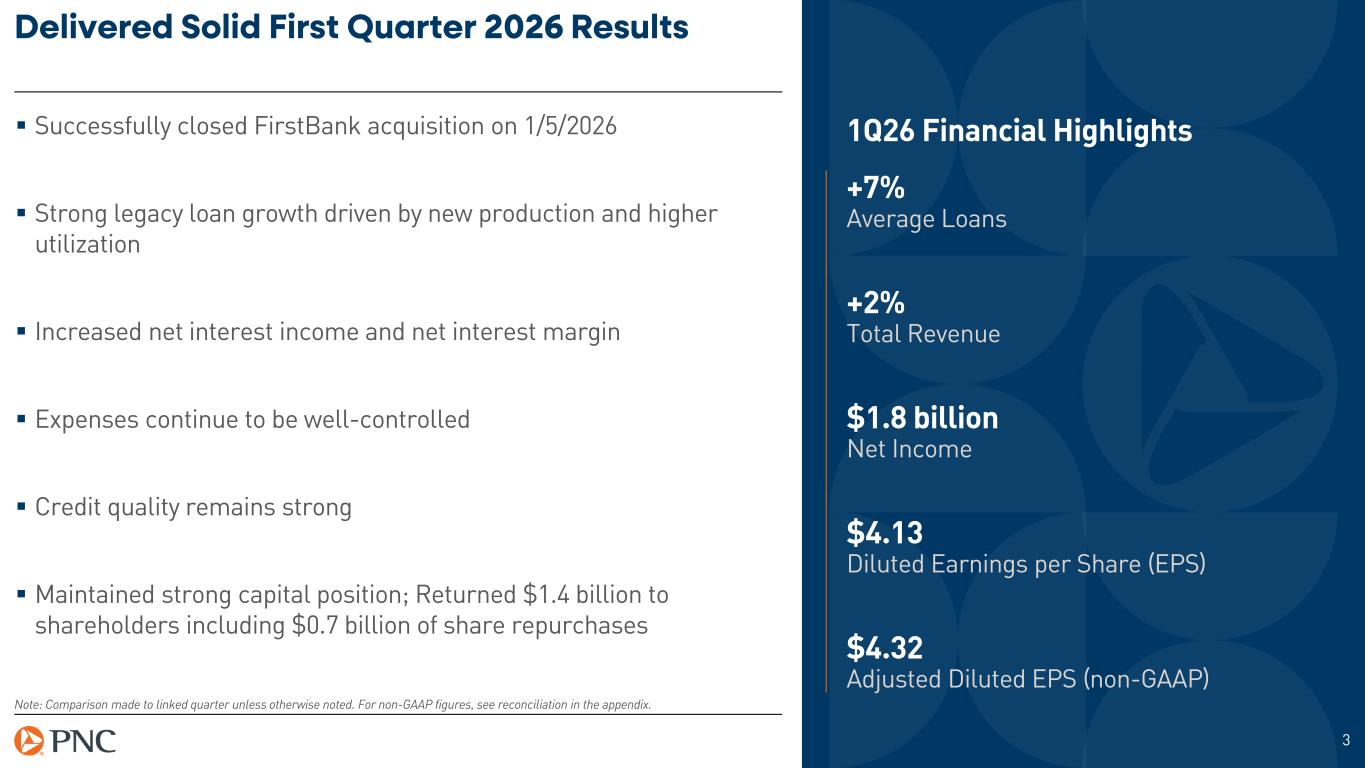
3 Delivered Solid First Quarter 2026 Results Successfully closed FirstBank acquisition on 1/5/2026 Strong legacy loan growth driven by new production and higher utilization Increased net interest income and net interest margin Expenses continue to be well-controlled Credit quality remains strong Maintained strong capital position; Returned $1.4 billion to shareholders including $0.7 billion of share repurchases Note: Comparison made to linked quarter unless otherwise noted. For non-GAAP figures, see reconciliation in the appendix. +7% Average Loans +2% Total Revenue $1.8 billion Net Income $4.32 Adjusted Diluted EPS (non-GAAP) 1Q26 Financial Highlights $4.13 Diluted Earnings per Share (EPS)
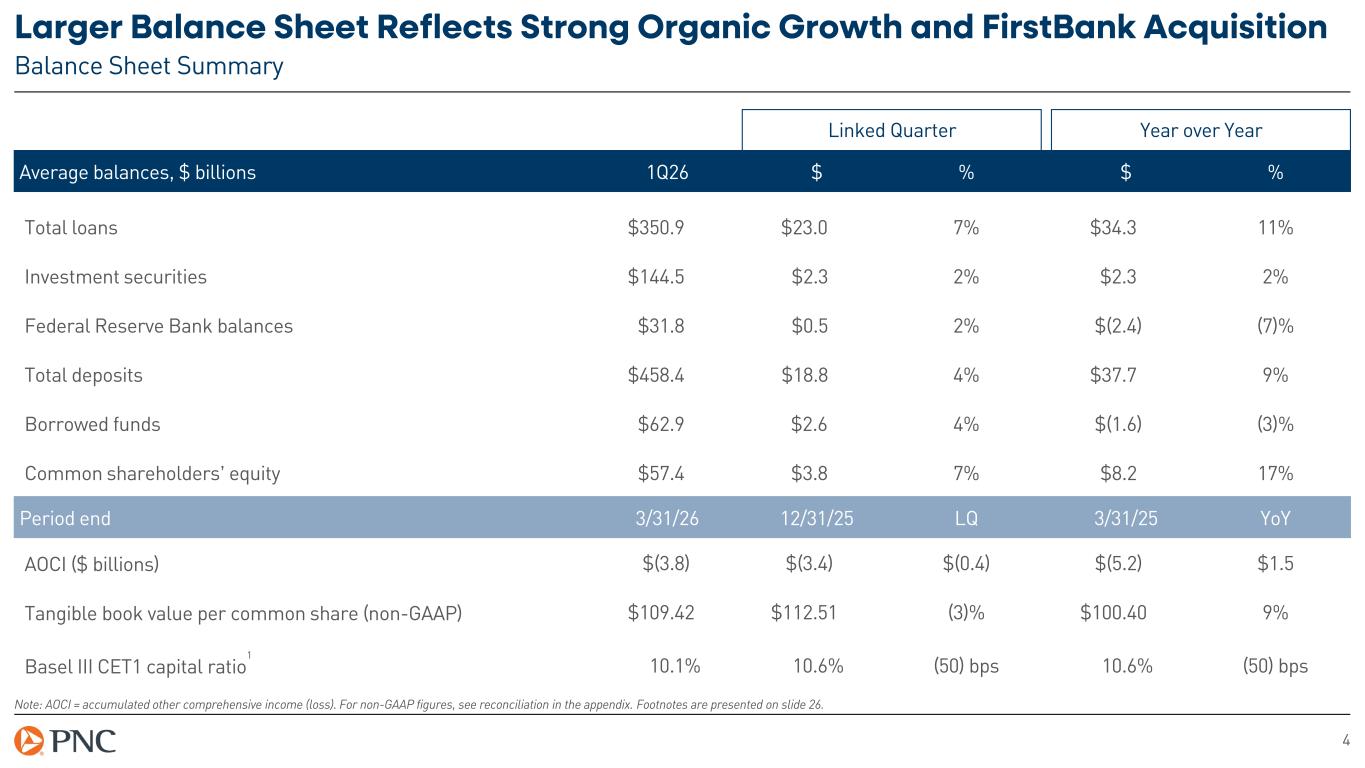
4 Larger Balance Sheet Reflects Strong Organic Growth and FirstBank Acquisition Balance Sheet Summary Linked Quarter Year over Year Average balances, $ billions 1Q26 $ % $ % Total loans $350.9 $23.0 7% $34.3 11% Investment securities $144.5 $2.3 2% $2.3 2% Federal Reserve Bank balances $31.8 $0.5 2% $(2.4) (7)% Total deposits $458.4 $18.8 4% $37.7 9% Borrowed funds $62.9 $2.6 4% $(1.6) (3)% Common shareholders’ equity $57.4 $3.8 7% $8.2 17% Note: AOCI = accumulated other comprehensive income (loss). For non-GAAP figures, see reconciliation in the appendix. Footnotes are presented on slide 26. Period end 3/31/26 12/31/25 LQ 3/31/25 YoY AOCI ($ billions) $(3.8) $(3.4) $(0.4) $(5.2) $1.5 Tangible book value per common share (non-GAAP) $109.42 $112.51 (3)% $100.40 9% Basel III CET1 capital ratio 1 10.1% 10.6% (50) bps 10.6% (50) bps
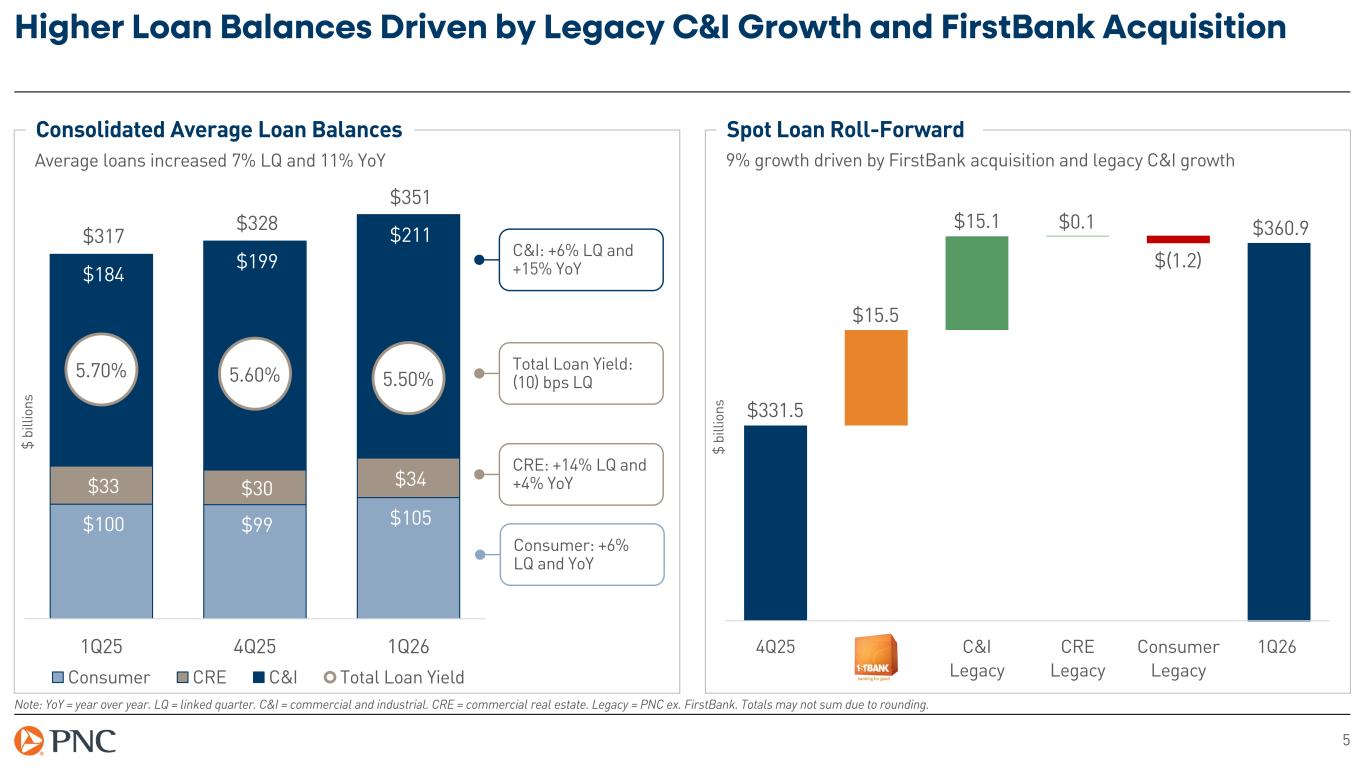
5 Higher Loan Balances Driven by Legacy C&I Growth and FirstBank Acquisition Note: YoY = year over year. LQ = linked quarter. C&I = commercial and industrial. CRE = commercial real estate. Legacy = PNC ex. FirstBank. Totals may not sum due to rounding. Consolidated Average Loan Balances Average loans increased 7% LQ and 11% YoY $ bi lli on s Consumer: +6% LQ and YoY Total Loan Yield: (10) bps LQ C&I: +6% LQ and +15% YoY Spot Loan Roll-Forward 9% growth driven by FirstBank acquisition and legacy C&I growth $ bi lli on s 4Q25 C&I Legacy CRE Legacy Consumer Legacy 1Q26 $331.5 $15.1 $(1.2) $360.9 CRE: +14% LQ and +4% YoY $15.5 $0.1 $100 $99 $105 $33 $30 $34 $184 $199 $211 $317 $328 $351 5.70% 5.60% 5.50% 1Q25 4Q25 1Q26 Consumer CRE C&I Total Loan Yield
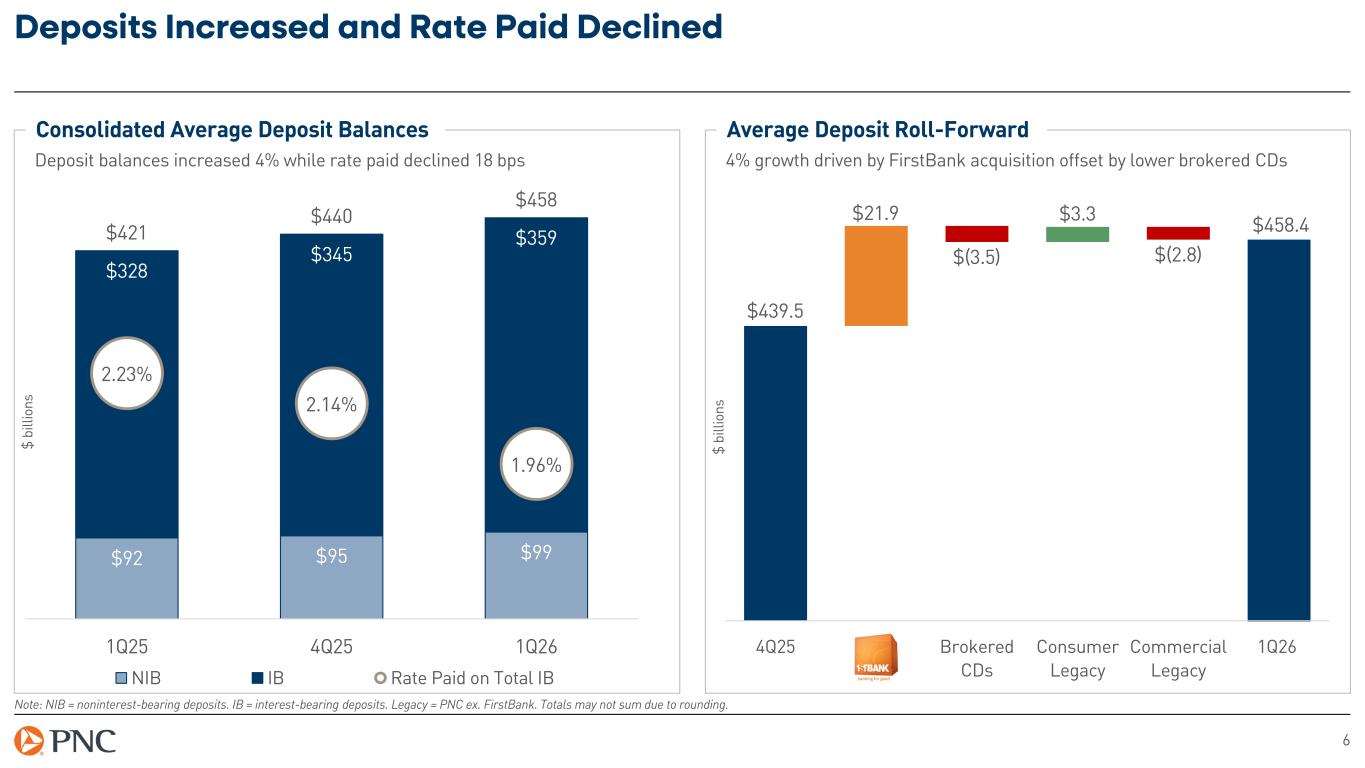
6 Deposits Increased and Rate Paid Declined Note: NIB = noninterest-bearing deposits. IB = interest-bearing deposits. Legacy = PNC ex. FirstBank. Totals may not sum due to rounding. Consolidated Average Deposit Balances $ bi lli on s Deposit balances increased 4% while rate paid declined 18 bps $92 $95 $99 $328 $345 $359$421 $440 $458 2.23% 2.14% 1.96% 1Q25 4Q25 1Q26 NIB IB Rate Paid on Total IB Average Deposit Roll-Forward 4% growth driven by FirstBank acquisition offset by lower brokered CDs $ bi lli on s 4Q25 Brokered CDs Consumer Legacy Commercial Legacy 1Q26 $439.5 $(3.5) $(2.8) $458.4$21.9 $3.3
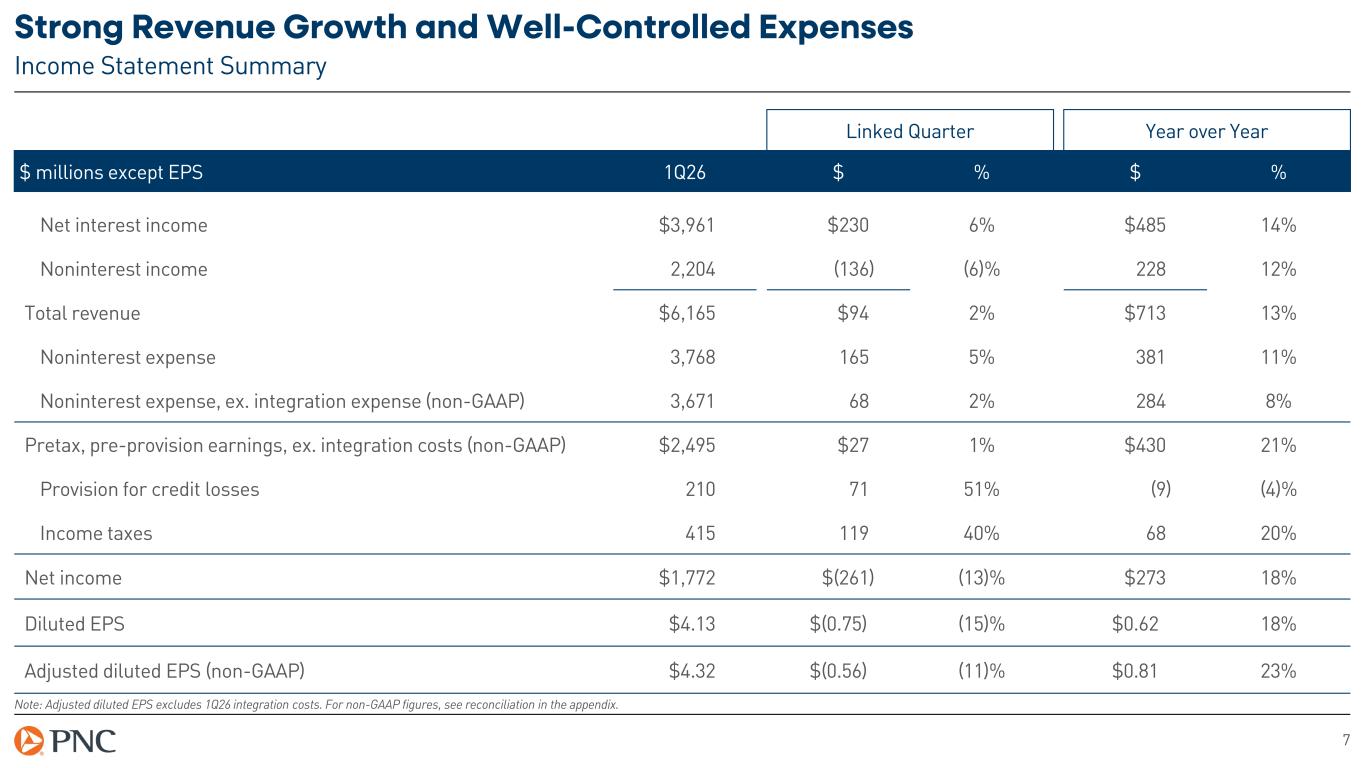
7 Strong Revenue Growth and Well-Controlled Expenses Income Statement Summary Linked Quarter Year over Year $ millions except EPS 1Q26 $ % $ % Net interest income $3,961 $230 6% $485 14% Noninterest income 2,204 (136) (6)% 228 12% Total revenue $6,165 $94 2% $713 13% Noninterest expense 3,768 165 5% 381 11% Noninterest expense, ex. integration expense (non-GAAP) 3,671 68 2% 284 8% Pretax, pre-provision earnings, ex. integration costs (non-GAAP) $2,495 $27 1% $430 21% Provision for credit losses 210 71 51% (9) (4)% Income taxes 415 119 40% 68 20% Net income $1,772 $(261) (13)% $273 18% Diluted EPS $4.13 $(0.75) (15)% $0.62 18% Adjusted diluted EPS (non-GAAP) $4.32 $(0.56) (11)% $0.81 23% Note: Adjusted diluted EPS excludes 1Q26 integration costs. For non-GAAP figures, see reconciliation in the appendix.
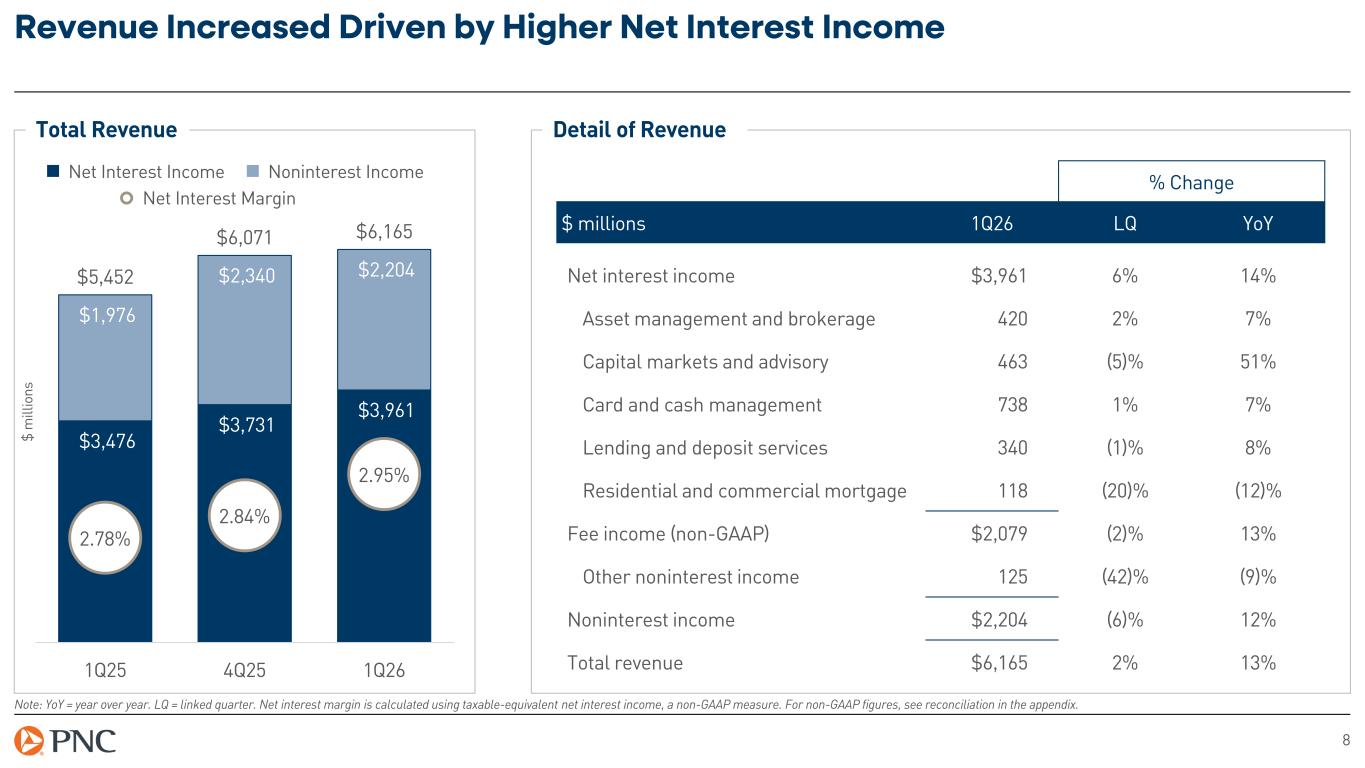
8 Revenue Increased Driven by Higher Net Interest Income Note: YoY = year over year. LQ = linked quarter. Net interest margin is calculated using taxable-equivalent net interest income, a non-GAAP measure. For non-GAAP figures, see reconciliation in the appendix. Total Revenue $3,476 $3,731 $3,961 $1,976 $2,340 $2,204 $5,452 $6,071 $6,165 2.78% 2.84% 2.95% 1Q25 4Q25 1Q26 % Change $ millions 1Q26 LQ YoY Net interest income $3,961 6% 14% Asset management and brokerage 420 2% 7% Capital markets and advisory 463 (5)% 51% Card and cash management 738 1% 7% Lending and deposit services 340 (1)% 8% Residential and commercial mortgage 118 (20)% (12)% Fee income (non-GAAP) $2,079 (2)% 13% Other noninterest income 125 (42)% (9)% Noninterest income $2,204 (6)% 12% Total revenue $6,165 2% 13% Detail of Revenue $ m ill io ns Net Interest Income Noninterest Income Net Interest Margin
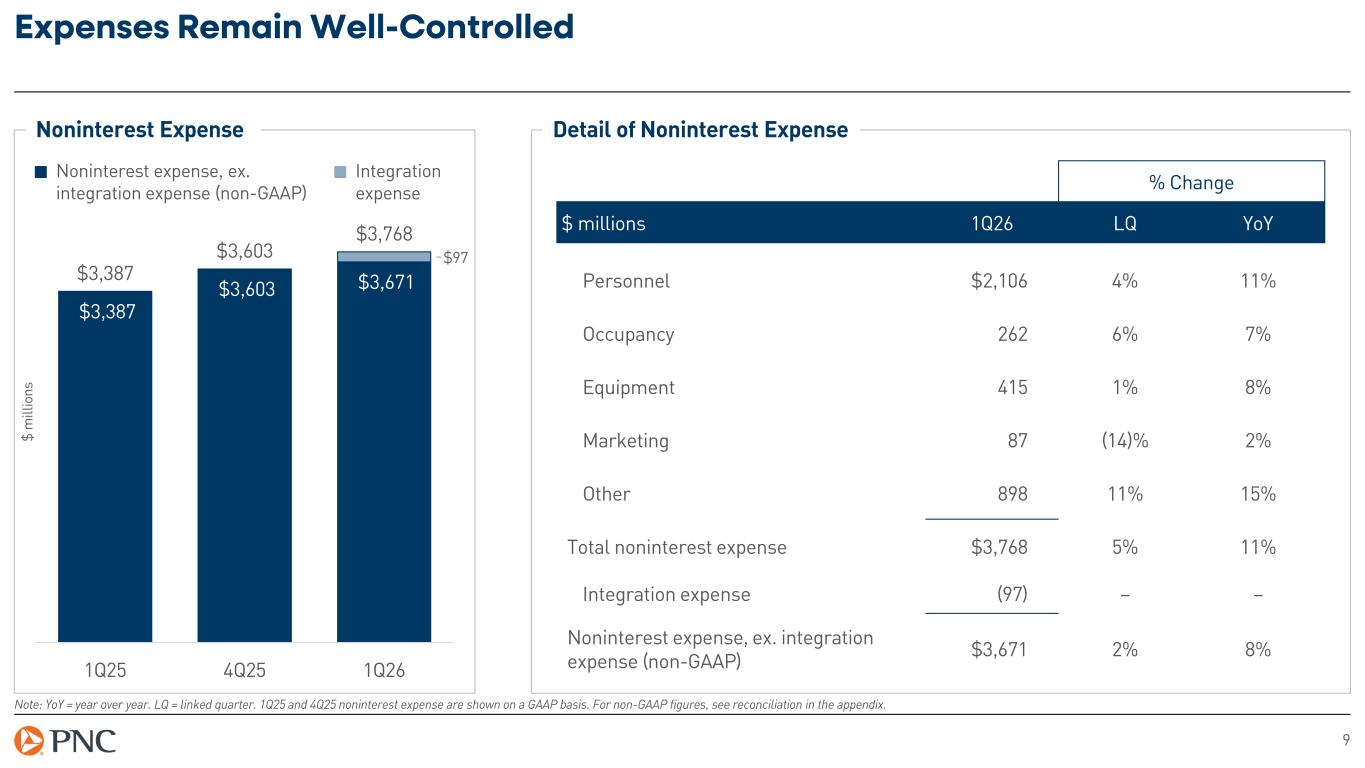
9 Expenses Remain Well-Controlled Note: YoY = year over year. LQ = linked quarter. 1Q25 and 4Q25 noninterest expense are shown on a GAAP basis. For non-GAAP figures, see reconciliation in the appendix. Noninterest Expense % Change $ millions 1Q26 LQ YoY Personnel $2,106 4% 11% Occupancy 262 6% 7% Equipment 415 1% 8% Marketing 87 (14)% 2% Other 898 11% 15% Total noninterest expense $3,768 5% 11% Integration expense (97) – – Noninterest expense, ex. integration expense (non-GAAP) $3,671 2% 8% Detail of Noninterest Expense $ m ill io ns Noninterest expense, ex. integration expense (non-GAAP) Integration expense $3,387 $3,603 $3,671 $3,387 $3,603 $3,768 1Q25 4Q25 1Q26 $97
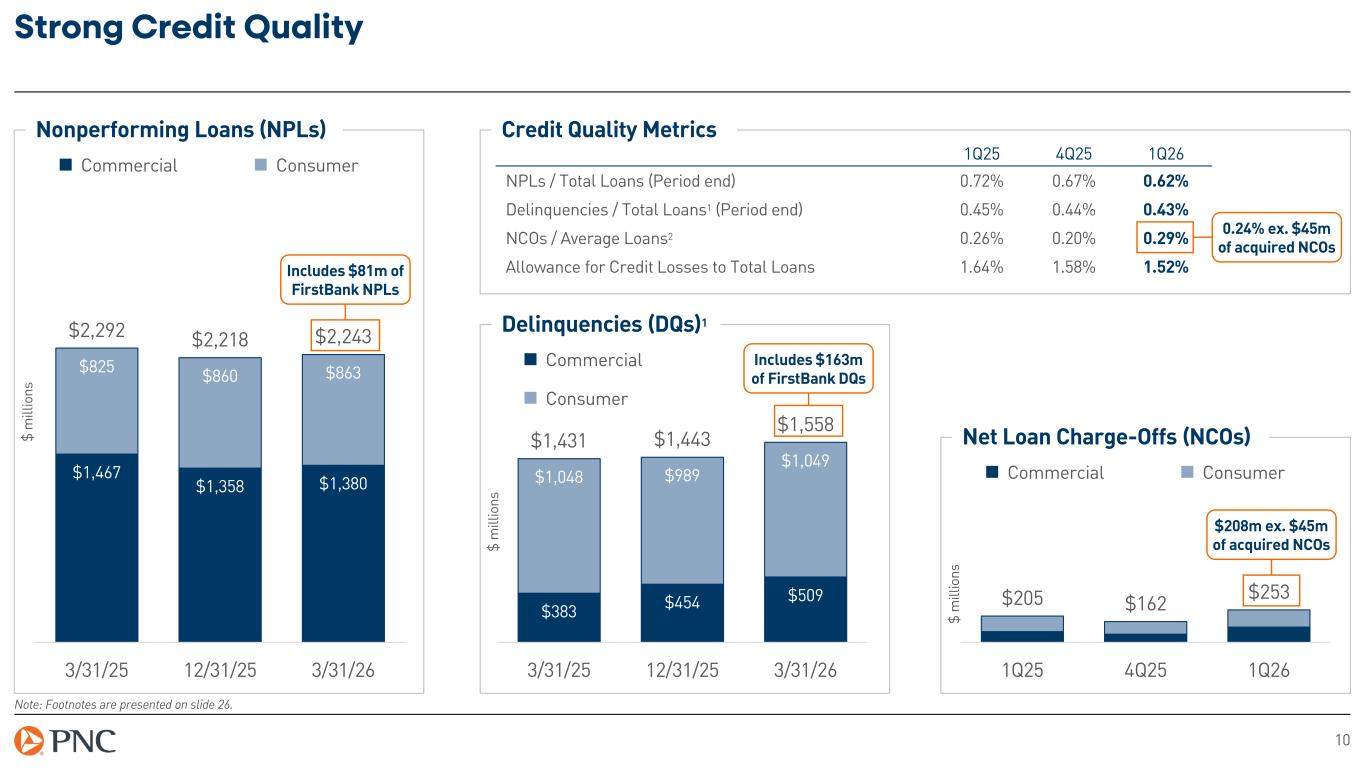
10 Strong Credit Quality Note: Footnotes are presented on slide 26. Nonperforming Loans (NPLs) Net Loan Charge-Offs (NCOs) Credit Quality Metrics $1,467 $1,358 $1,380 $825 $860 $863 $2,292 $2,218 $2,243 3/31/25 12/31/25 3/31/26 $383 $454 $509 $1,048 $989 $1,049 $1,431 $1,443 $1,558 3/31/25 12/31/25 3/31/26 Delinquencies (DQs)1 $ m ill io ns $ m ill io ns $ m ill io ns 1Q25 4Q25 1Q26 NPLs / Total Loans (Period end) 0.72% 0.67% 0.62% Delinquencies / Total Loans1 (Period end) 0.45% 0.44% 0.43% NCOs / Average Loans2 0.26% 0.20% 0.29% Allowance for Credit Losses to Total Loans 1.64% 1.58% 1.52% 0.24% ex. $45m of acquired NCOs $205 $162 $253 1Q25 4Q25 1Q26 Commercial Consumer $208m ex. $45m of acquired NCOs Commercial Consumer Includes $81m of FirstBank NPLs Includes $163m of FirstBank DQs Commercial Consumer
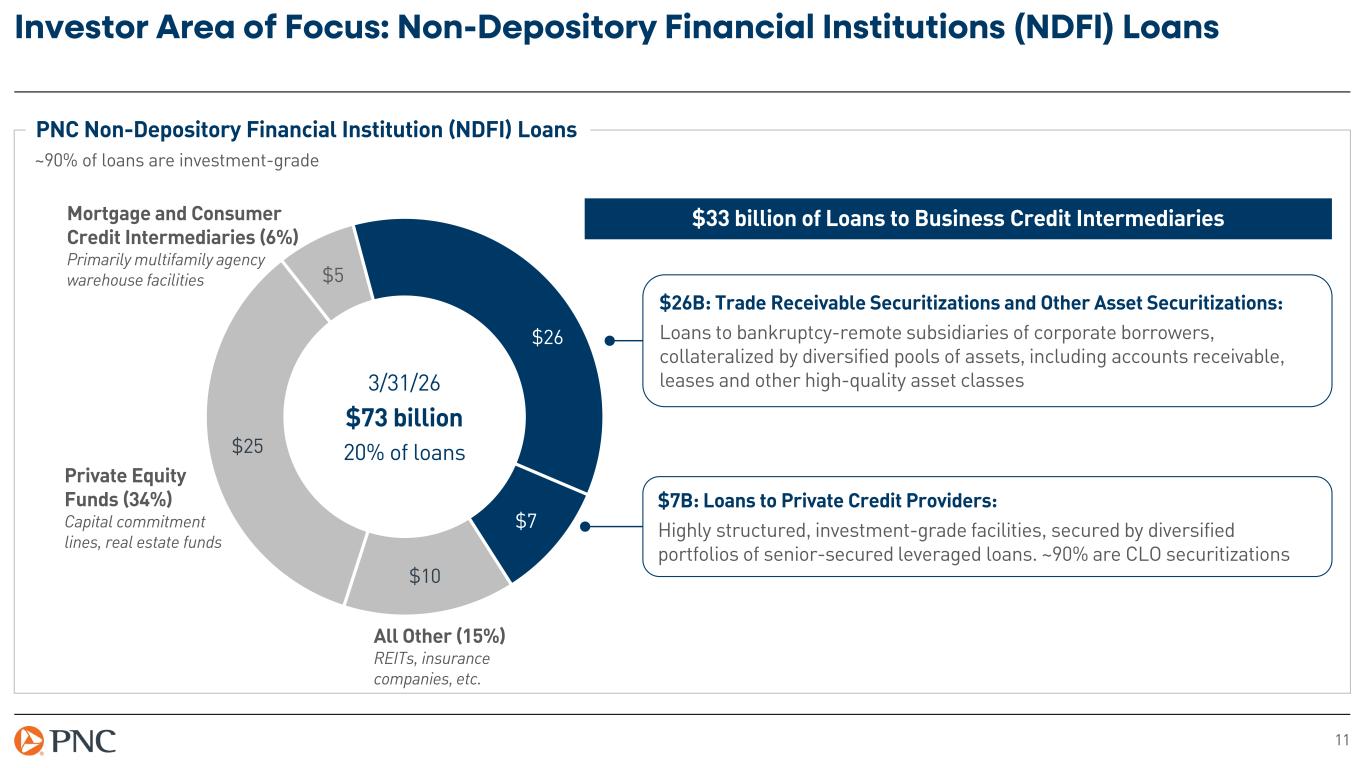
11 Investor Area of Focus: Non-Depository Financial Institutions (NDFI) Loans $26 $7 $10 $25 $5 Private Equity Funds (34%) Capital commitment lines, real estate funds Mortgage and Consumer Credit Intermediaries (6%) Primarily multifamily agency warehouse facilities All Other (15%) REITs, insurance companies, etc. 3/31/26 $73 billion 20% of loans $26B: Trade Receivable Securitizations and Other Asset Securitizations: Loans to bankruptcy-remote subsidiaries of corporate borrowers, collateralized by diversified pools of assets, including accounts receivable, leases and other high-quality asset classes $7B: Loans to Private Credit Providers: Highly structured, investment-grade facilities, secured by diversified portfolios of senior-secured leveraged loans. ~90% are CLO securitizations $33 billion of Loans to Business Credit Intermediaries PNC Non-Depository Financial Institution (NDFI) Loans ~90% of loans are investment-grade
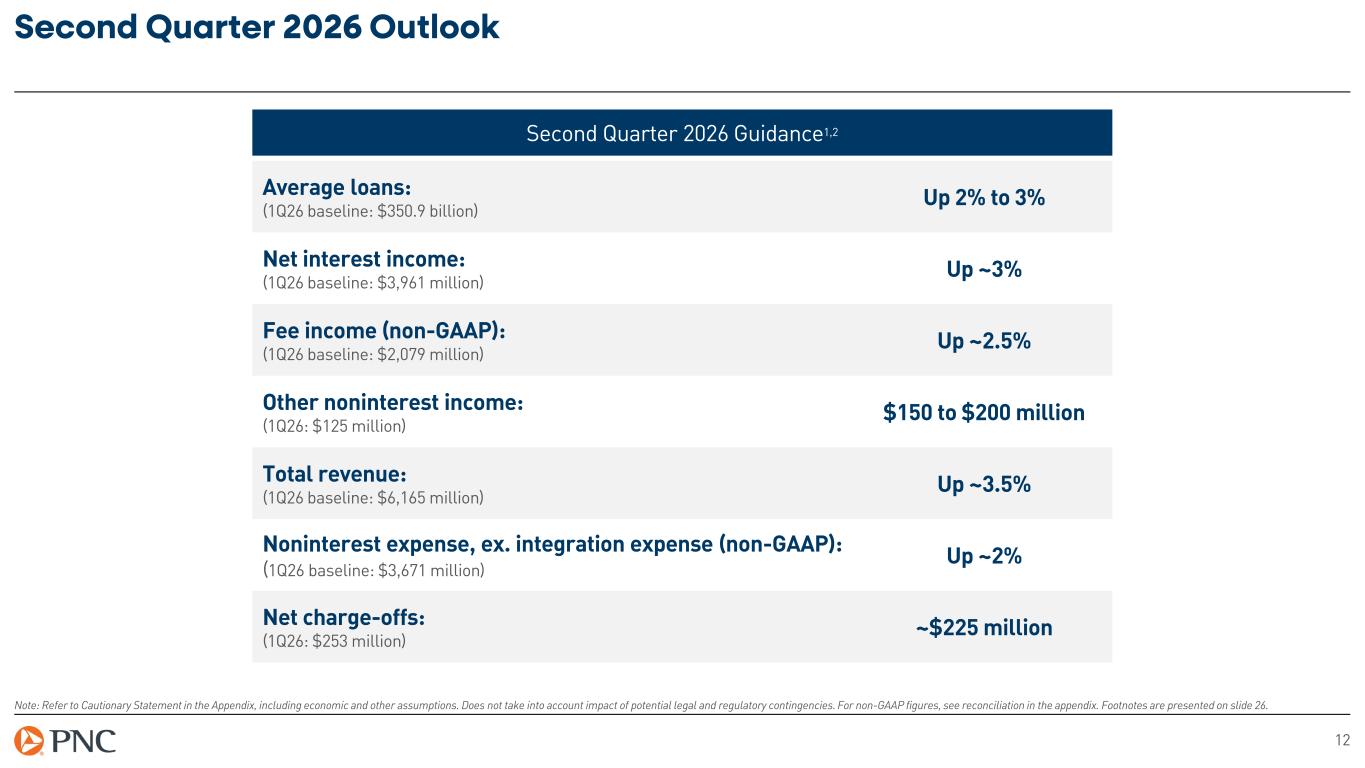
12 Second Quarter 2026 Outlook Note: Refer to Cautionary Statement in the Appendix, including economic and other assumptions. Does not take into account impact of potential legal and regulatory contingencies. For non-GAAP figures, see reconciliation in the appendix. Footnotes are presented on slide 26. Second Quarter 2026 Guidance1,2 Average loans: (1Q26 baseline: $350.9 billion) Up 2% to 3% Net interest income: (1Q26 baseline: $3,961 million) Up ~3% Fee income (non-GAAP): (1Q26 baseline: $2,079 million) Up ~2.5% Other noninterest income: (1Q26: $125 million) $150 to $200 million Total revenue: (1Q26 baseline: $6,165 million) Up ~3.5% Noninterest expense, ex. integration expense (non-GAAP): (1Q26 baseline: $3,671 million) Up ~2% Net charge-offs: (1Q26: $253 million) ~$225 million
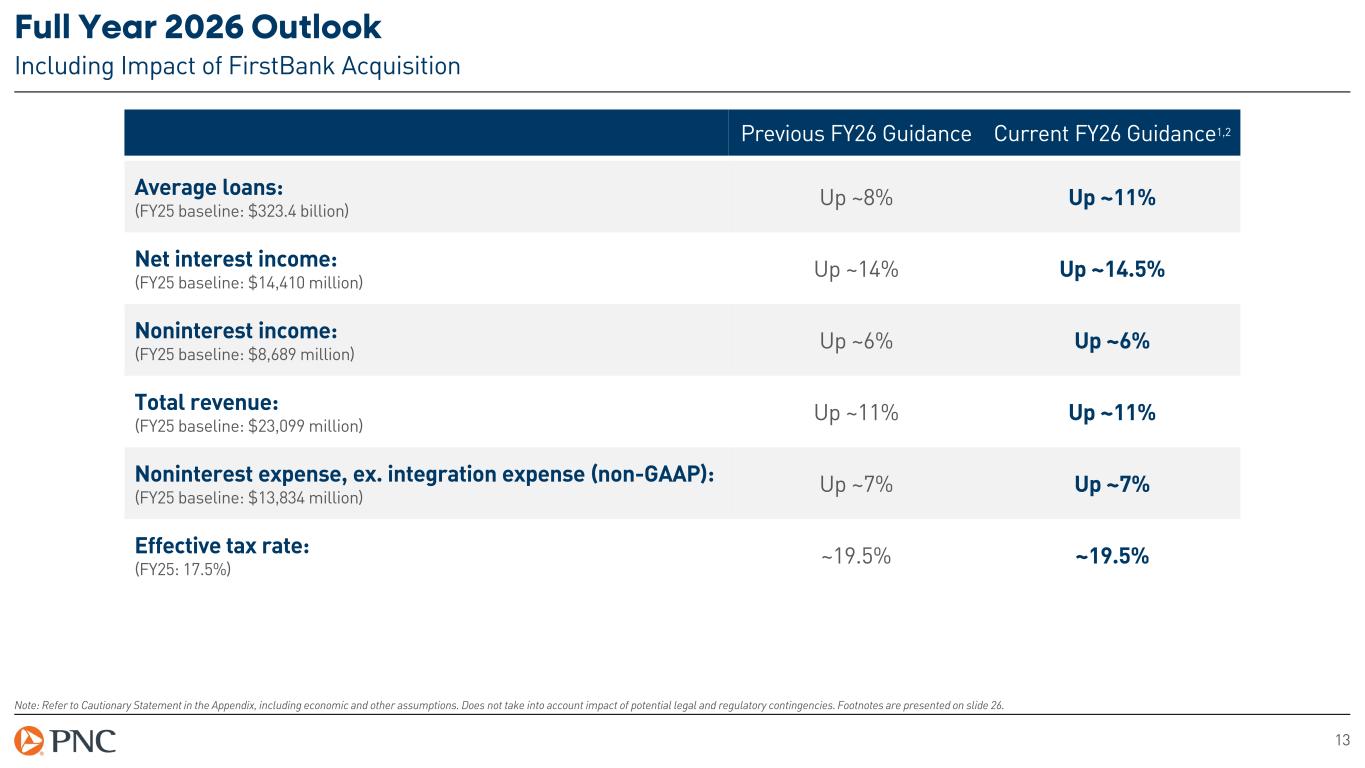
13 Full Year 2026 Outlook Including Impact of FirstBank Acquisition Note: Refer to Cautionary Statement in the Appendix, including economic and other assumptions. Does not take into account impact of potential legal and regulatory contingencies. Footnotes are presented on slide 26. Previous FY26 Guidance Current FY26 Guidance1,2 Average loans: (FY25 baseline: $323.4 billion) Up ~8% Up ~11% Net interest income: (FY25 baseline: $14,410 million) Up ~14% Up ~14.5% Noninterest income: (FY25 baseline: $8,689 million) Up ~6% Up ~6% Total revenue: (FY25 baseline: $23,099 million) Up ~11% Up ~11% Noninterest expense, ex. integration expense (non-GAAP): (FY25 baseline: $13,834 million) Up ~7% Up ~7% Effective tax rate: (FY25: 17.5%) ~19.5% ~19.5%
14 Appendix: Cautionary Statement Regarding Forward-Looking Information We make statements in this presentation, and we may from time to time make other statements, regarding our outlook for financial performance, such as earnings, revenues, expenses, tax rates, capital and liquidity levels and ratios, asset levels, asset quality, financial position, and other matters regarding or affecting us and our future business and operations, including our sustainability strategy, that are forward-looking statements within the meaning of the Private Securities Litigation Reform Act. Forward-looking statements are typically identified by words such as “believe,” “plan,” “expect,” “anticipate,” “see,” “look,” “intend,” “outlook,” “project,” “forecast,” “estimate,” “goal,” “will,” “should” and other similar words and expressions. Forward-looking statements are necessarily subject to numerous assumptions, risks and uncertainties, which change over time. Future events or circumstances may change our outlook and may also affect the nature of the assumptions, risks and uncertainties to which our forward-looking statements are subject. Forward-looking statements speak only as of the date made. We do not assume any duty and do not undertake any obligation to update forward-looking statements. Actual results or future events could differ, possibly materially, from those anticipated in forward-looking statements, as well as from historical performance. As a result, we caution against placing undue reliance on any forward-looking statements. Our forward-looking statements are subject to the following principal risks and uncertainties. Our businesses, financial results and balance sheet values are affected by business and economic conditions, including: − Changes in interest rates and valuations in debt, equity and other financial markets, − Disruptions in the U.S. and global financial markets, − Actions by the Federal Reserve Board, U.S. Treasury and other government agencies, including those that impact money supply, market interest rates and inflation, − Changes in customer behavior due to changing business and economic conditions or legislative or regulatory initiatives, − Changes in customers', suppliers' and other counterparties' performance and creditworthiness, − Impacts of sanctions, tariffs and other trade policies of the U.S. and its global trading partners, − Impacts of changes in federal, state and local governmental policy, including on the regulatory landscape, capital markets, taxes, infrastructure spending and social programs, − Our ability to attract, recruit and retain skilled employees, and − Commodity price volatility.
15 Appendix: Cautionary Statement Regarding Forward-Looking Information Our forward-looking financial statements are subject to the risk that economic and financial market conditions will be substantially different than those we are currently expecting. These statements are based on our views that: − PNC’s baseline forecast remains for continued expansion in 2026, but slower economic growth in 2026 than in 2024 and 2025. The baseline forecast anticipates real GDP growth slowing to around 1.9% in 2026, with continued modest job gains and the unemployment rate moving slightly higher, to around 4.6% at year’s end. CPI inflation will peak at around 3.5% in mid-2026, with core CPI inflation at around 2.6%. An extended conflict with Iran and higher energy prices are significant risks to the outlook, both for inflation and growth, and a reversal in sentiment around AI or a large decline in equity prices would be drags. Weaker labor force growth could lead to weaker long-run growth. − Our baseline forecast is for the Federal Reserve to keep the federal funds rate unchanged throughout 2026 and into 2027, in a range between 3.50% and 3.75%. However, there are two-sided risks to this outlook: (1) if the conflict with Iran persists and inflation proves more persistent than expected the Federal Reserve may raise rates, or (2) if growth falters or recession emerges there could be a deep and prolonged easing in monetary policy. PNC's ability to take certain capital actions, including returning capital to shareholders, is subject to PNC meeting or exceeding minimum capital levels, including a stress capital buffer established by the Federal Reserve Board in connection with the Federal Reserve Board's Comprehensive Capital Analysis and Review (CCAR) process. PNC's regulatory capital ratios in the future will depend on, among other things, PNC's financial performance, the scope and terms of final capital regulations then in effect and management actions affecting the composition of PNC's balance sheet. In addition, PNC's ability to determine, evaluate and forecast regulatory capital ratios, and to take actions (such as capital distributions) based on actual or forecasted capital ratios, will be dependent at least in part on the development, validation and regulatory review of related models and the reliability of and risks resulting from extensive use of such models. Legal and regulatory developments could have an impact on our ability to operate our businesses, financial condition, results of operations, competitive position, reputation, or pursuit of attractive acquisition opportunities. Reputational impacts could affect matters such as business generation and retention, liquidity, funding, and ability to attract and retain employees. These developments could include: − Changes to laws and regulations, including changes affecting oversight of the financial services industry, changes in the enforcement and interpretation of such laws and regulations, and changes in accounting and reporting standards. − Unfavorable resolution of legal proceedings or other claims and regulatory and other governmental investigations or other inquiries resulting in monetary losses, costs, or alterations in our business practices, and potentially causing reputational harm to PNC. − Results of the regulatory examination and supervision process, including our failure to satisfy requirements of agreements with governmental agencies. − Costs associated with obtaining rights in intellectual property claimed by others and of adequacy of our intellectual property protection in general.
16 Appendix: Cautionary Statement Regarding Forward-Looking Information Business and operating results are affected by our ability to identify and effectively manage risks inherent in our businesses, including, where appropriate, through effective use of systems and controls, third-party insurance, derivatives, and capital management techniques, and to meet evolving regulatory capital and liquidity standards. Our reputation and business and operating results may be affected by our ability to appropriately meet or address environmental, social or governance targets, goals, commitments or concerns that may arise. We grow our business in part through acquisitions and new strategic initiatives. Risks and uncertainties include those presented by the nature of the business acquired and strategic initiative, including in some cases those associated with our entry into new businesses or new geographic or other markets and risks resulting from our inexperience in those new areas, as well as risks and uncertainties related to the acquisition transactions themselves, regulatory issues, the integration of the acquired businesses into PNC after closing or any failure to execute strategic or operational plans. Competition can have an impact on customer acquisition, growth and retention and on credit spreads and product pricing, which can affect market share, deposits and revenues. Our ability to anticipate and respond to technological changes can also impact our ability to respond to customer needs and meet competitive demands. Business and operating results can also be affected by widespread manmade, natural and other disasters (including severe weather events), health emergencies, dislocations, geopolitical instabilities or events, terrorist activities, system failures or disruptions, security breaches, cyberattacks, international hostilities, or other extraordinary events beyond PNC's control through impacts on the economy and financial markets generally or on us or our counterparties, customers or third-party vendors and service providers specifically. We provide greater detail regarding these as well as other factors in our most recent Form 10-K and in any subsequent Form 10-Qs, including in the Risk Factors and Risk Management sections and the Legal Proceedings and Commitments Notes of the Notes to Consolidated Financial Statements in those reports, and in our other subsequent SEC filings. Our forward-looking statements may also be subject to other risks and uncertainties, including those we may discuss elsewhere in this news release or in our SEC filings, accessible on the SEC's website at www.sec.gov and on our corporate website at www.pnc.com/secfilings. We have included these web addresses as inactive textual references only. Information on these websites is not part of this document.
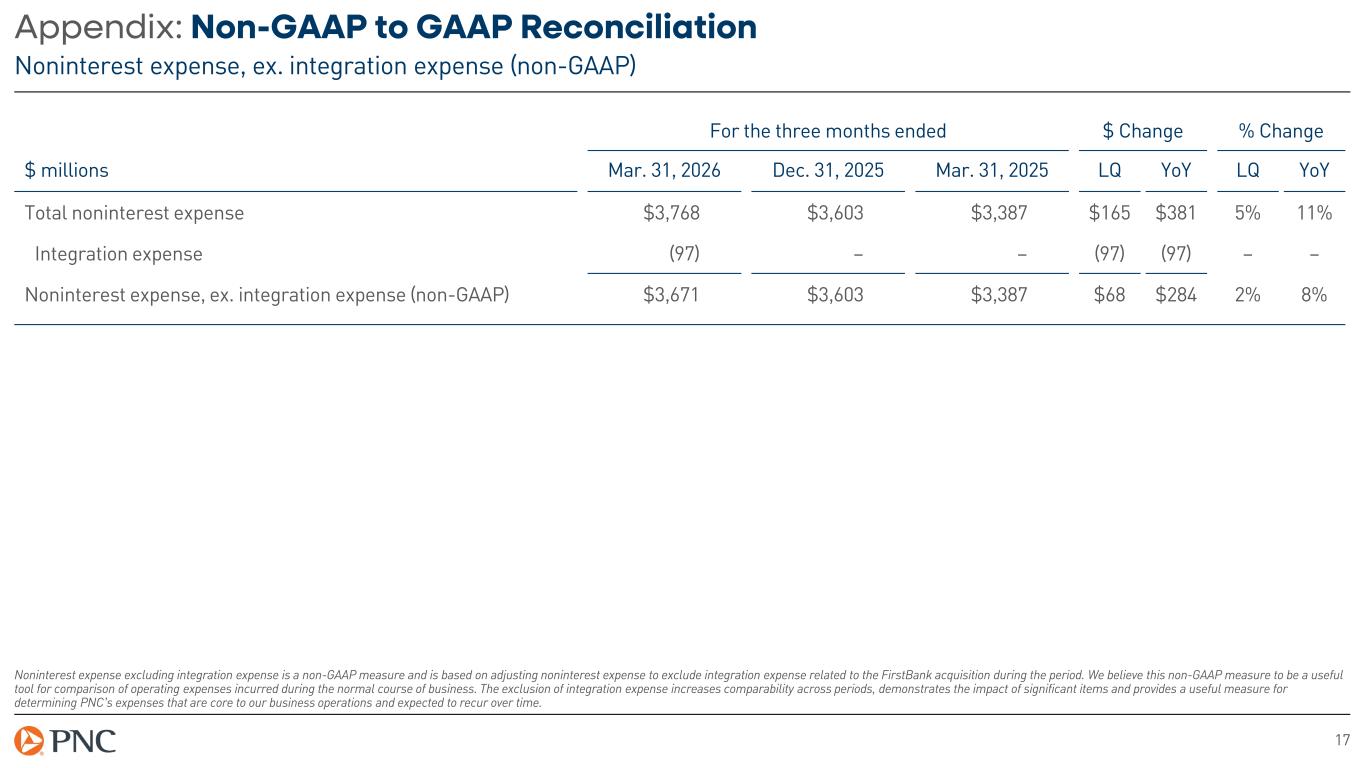
17 Appendix: Non-GAAP to GAAP Reconciliation Noninterest expense, ex. integration expense (non-GAAP) For the three months ended $ Change % Change $ millions Mar. 31, 2026 Dec. 31, 2025 Mar. 31, 2025 LQ YoY LQ YoY Total noninterest expense $3,768 $3,603 $3,387 $165 $381 5% 11% Integration expense (97) – – (97) (97) – – Noninterest expense, ex. integration expense (non-GAAP) $3,671 $3,603 $3,387 $68 $284 2% 8% Noninterest expense excluding integration expense is a non-GAAP measure and is based on adjusting noninterest expense to exclude integration expense related to the FirstBank acquisition during the period. We believe this non-GAAP measure to be a useful tool for comparison of operating expenses incurred during the normal course of business. The exclusion of integration expense increases comparability across periods, demonstrates the impact of significant items and provides a useful measure for determining PNC’s expenses that are core to our business operations and expected to recur over time.
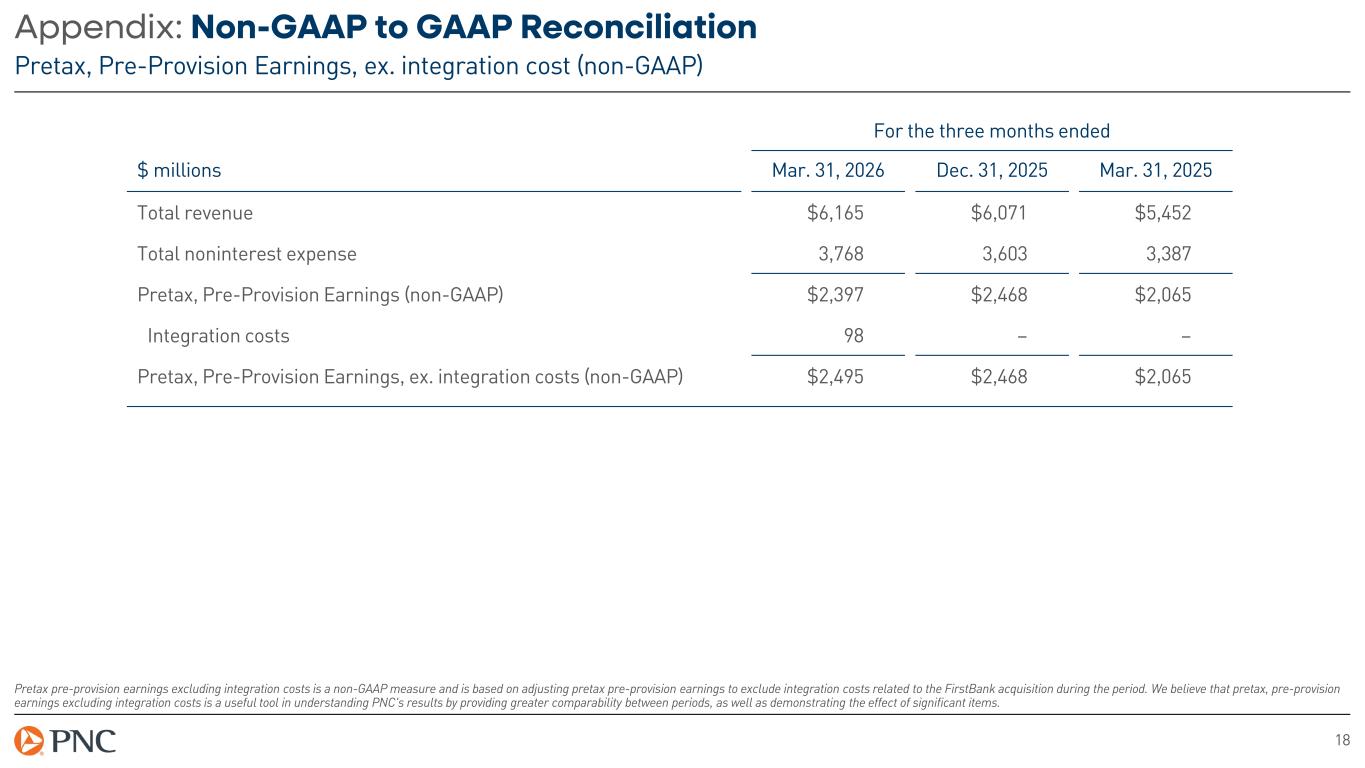
18 Appendix: Non-GAAP to GAAP Reconciliation Pretax, Pre-Provision Earnings, ex. integration cost (non-GAAP) For the three months ended $ millions Mar. 31, 2026 Dec. 31, 2025 Mar. 31, 2025 Total revenue $6,165 $6,071 $5,452 Total noninterest expense 3,768 3,603 3,387 Pretax, Pre-Provision Earnings (non-GAAP) $2,397 $2,468 $2,065 Integration costs 98 – – Pretax, Pre-Provision Earnings, ex. integration costs (non-GAAP) $2,495 $2,468 $2,065 Pretax pre-provision earnings excluding integration costs is a non-GAAP measure and is based on adjusting pretax pre-provision earnings to exclude integration costs related to the FirstBank acquisition during the period. We believe that pretax, pre-provision earnings excluding integration costs is a useful tool in understanding PNC's results by providing greater comparability between periods, as well as demonstrating the effect of significant items.
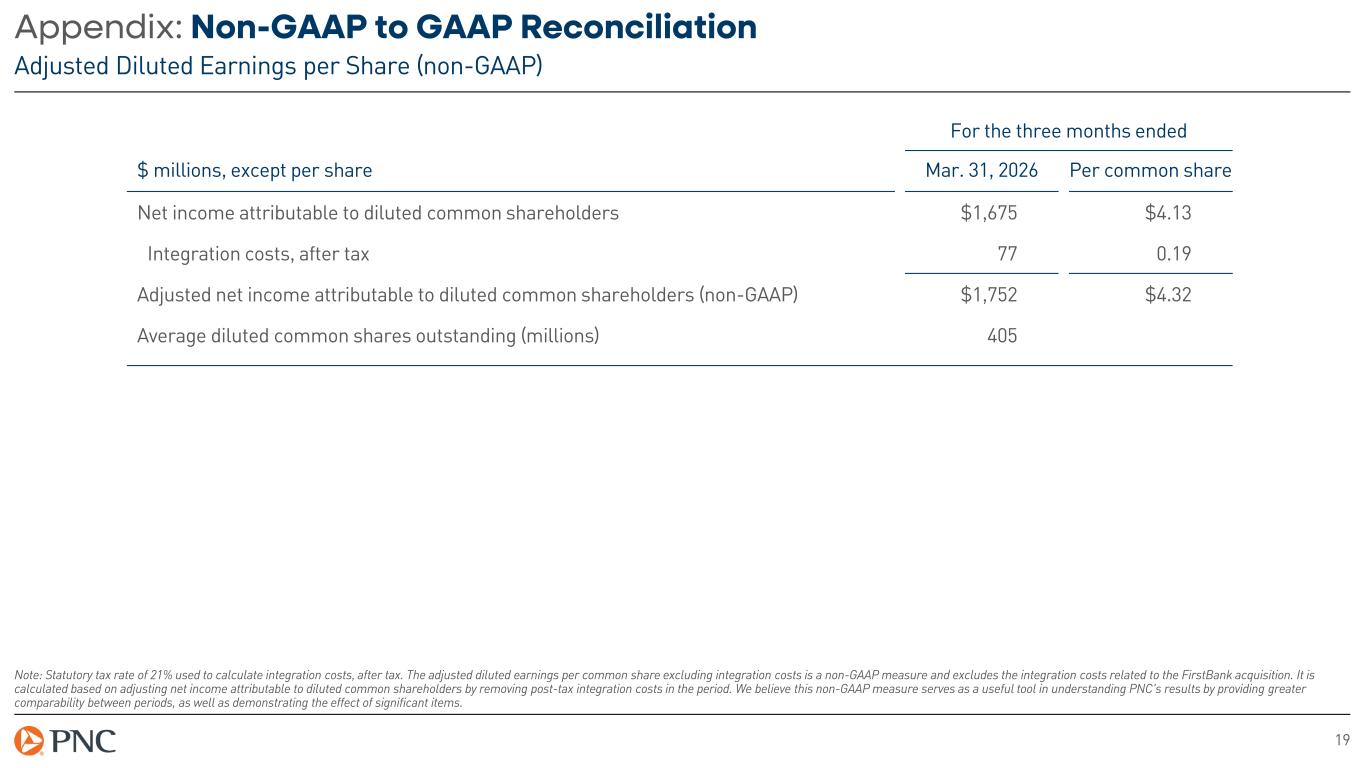
19 Appendix: Non-GAAP to GAAP Reconciliation Adjusted Diluted Earnings per Share (non-GAAP) For the three months ended $ millions, except per share Mar. 31, 2026 Per common share Net income attributable to diluted common shareholders $1,675 $4.13 Integration costs, after tax 77 0.19 Adjusted net income attributable to diluted common shareholders (non-GAAP) $1,752 $4.32 Average diluted common shares outstanding (millions) 405 Note: Statutory tax rate of 21% used to calculate integration costs, after tax. The adjusted diluted earnings per common share excluding integration costs is a non-GAAP measure and excludes the integration costs related to the FirstBank acquisition. It is calculated based on adjusting net income attributable to diluted common shareholders by removing post-tax integration costs in the period. We believe this non-GAAP measure serves as a useful tool in understanding PNC's results by providing greater comparability between periods, as well as demonstrating the effect of significant items.
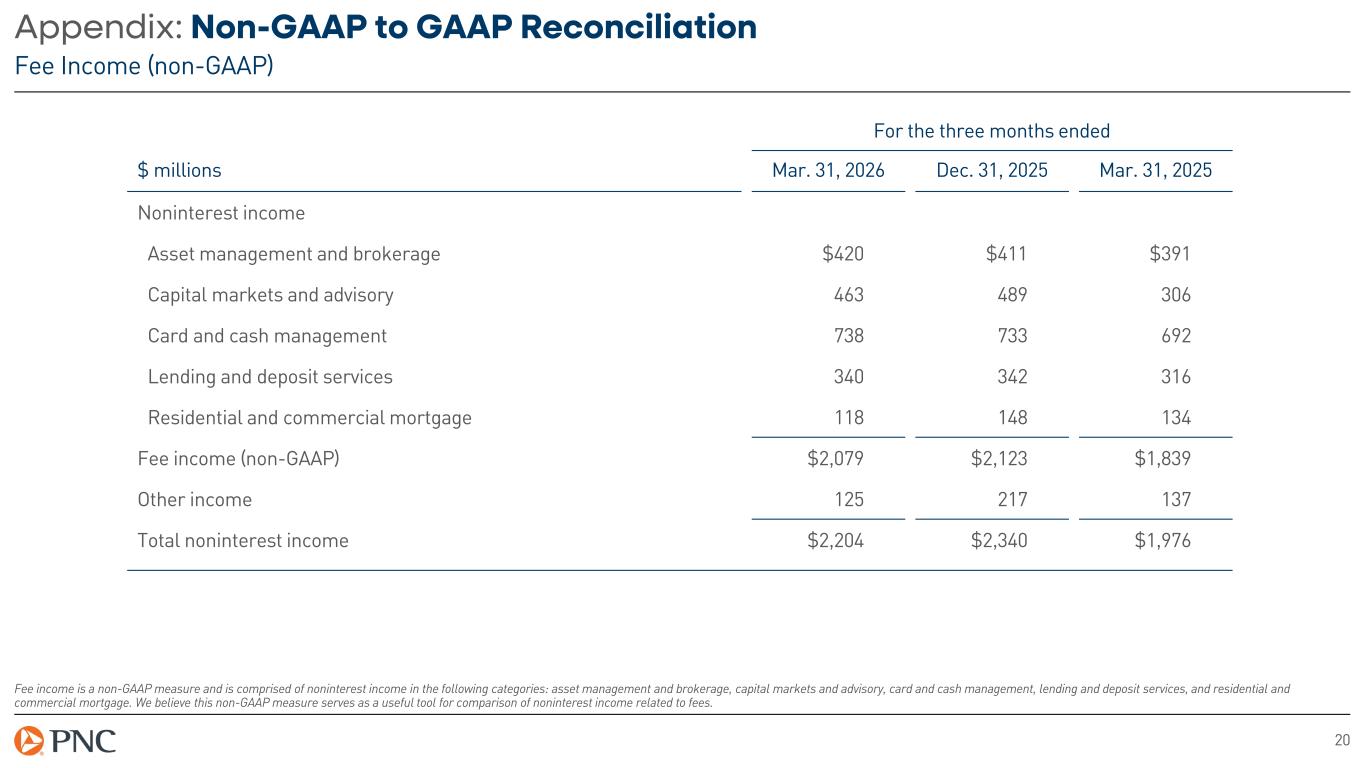
20 Appendix: Non-GAAP to GAAP Reconciliation Fee Income (non-GAAP) For the three months ended $ millions Mar. 31, 2026 Dec. 31, 2025 Mar. 31, 2025 Noninterest income Asset management and brokerage $420 $411 $391 Capital markets and advisory 463 489 306 Card and cash management 738 733 692 Lending and deposit services 340 342 316 Residential and commercial mortgage 118 148 134 Fee income (non-GAAP) $2,079 $2,123 $1,839 Other income 125 217 137 Total noninterest income $2,204 $2,340 $1,976 Fee income is a non-GAAP measure and is comprised of noninterest income in the following categories: asset management and brokerage, capital markets and advisory, card and cash management, lending and deposit services, and residential and commercial mortgage. We believe this non-GAAP measure serves as a useful tool for comparison of noninterest income related to fees.
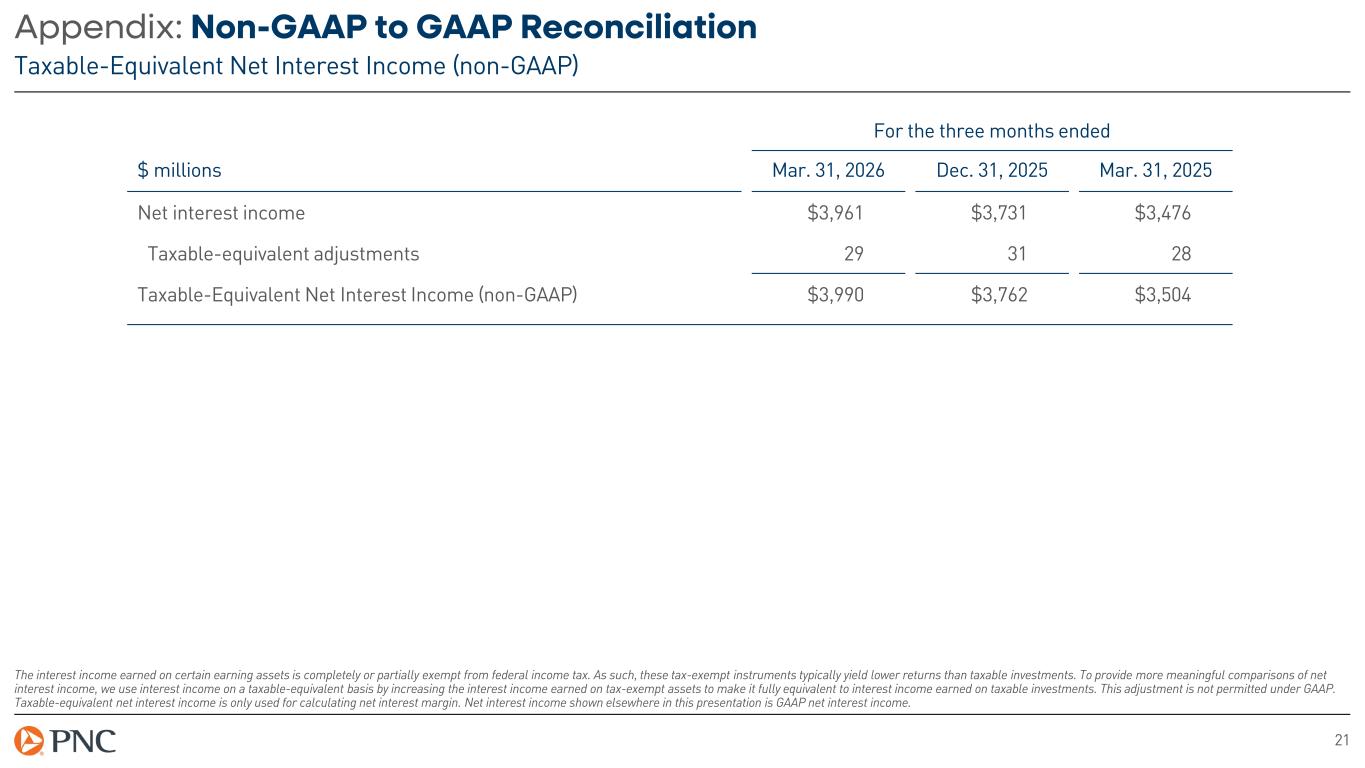
21 Appendix: Non-GAAP to GAAP Reconciliation Taxable-Equivalent Net Interest Income (non-GAAP) The interest income earned on certain earning assets is completely or partially exempt from federal income tax. As such, these tax-exempt instruments typically yield lower returns than taxable investments. To provide more meaningful comparisons of net interest income, we use interest income on a taxable-equivalent basis by increasing the interest income earned on tax-exempt assets to make it fully equivalent to interest income earned on taxable investments. This adjustment is not permitted under GAAP. Taxable-equivalent net interest income is only used for calculating net interest margin. Net interest income shown elsewhere in this presentation is GAAP net interest income. For the three months ended $ millions Mar. 31, 2026 Dec. 31, 2025 Mar. 31, 2025 Net interest income $3,961 $3,731 $3,476 Taxable-equivalent adjustments 29 31 28 Taxable-Equivalent Net Interest Income (non-GAAP) $3,990 $3,762 $3,504
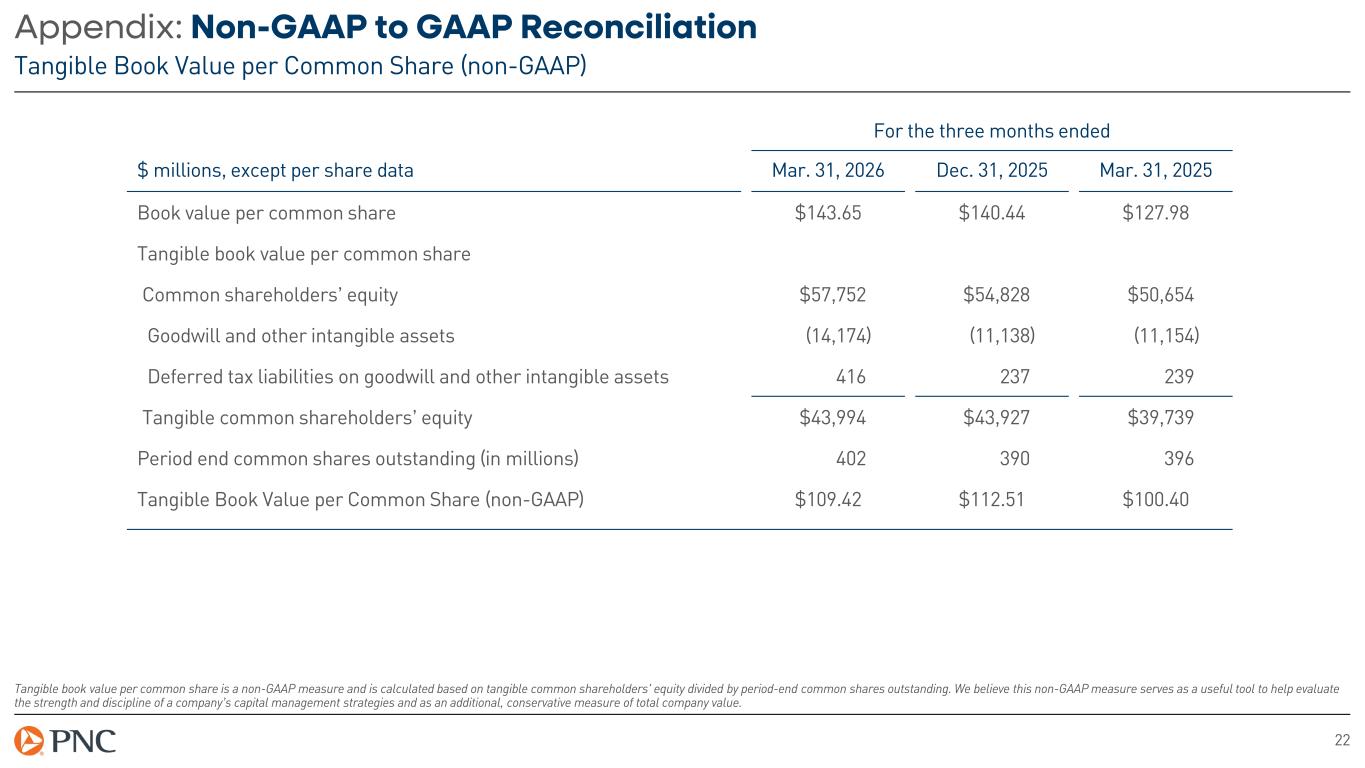
22 Appendix: Non-GAAP to GAAP Reconciliation Tangible Book Value per Common Share (non-GAAP) Tangible book value per common share is a non-GAAP measure and is calculated based on tangible common shareholders' equity divided by period-end common shares outstanding. We believe this non-GAAP measure serves as a useful tool to help evaluate the strength and discipline of a company’s capital management strategies and as an additional, conservative measure of total company value. For the three months ended $ millions, except per share data Mar. 31, 2026 Dec. 31, 2025 Mar. 31, 2025 Book value per common share $143.65 $140.44 $127.98 Tangible book value per common share Common shareholders’ equity $57,752 $54,828 $50,654 Goodwill and other intangible assets (14,174) (11,138) (11,154) Deferred tax liabilities on goodwill and other intangible assets 416 237 239 Tangible common shareholders’ equity $43,994 $43,927 $39,739 Period end common shares outstanding (in millions) 402 390 396 Tangible Book Value per Common Share (non-GAAP) $109.42 $112.51 $100.40
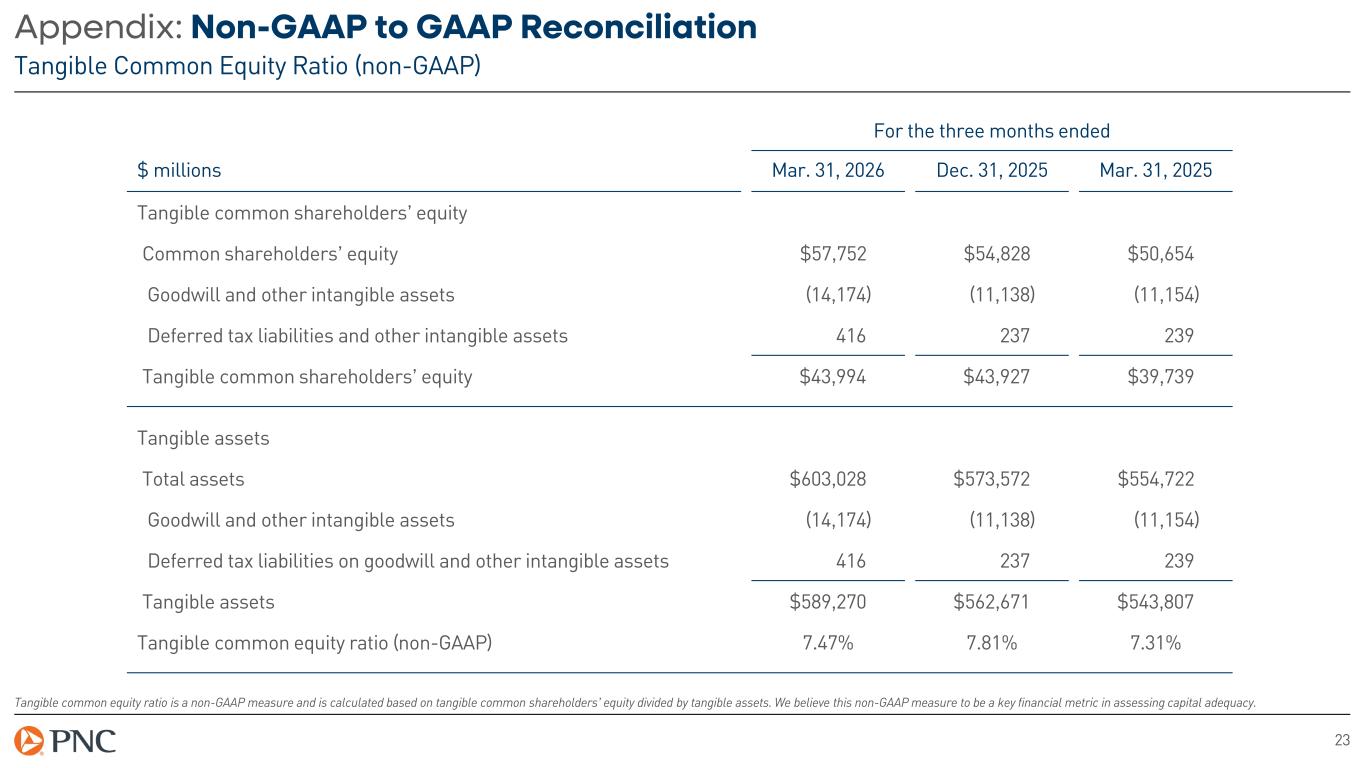
23 Appendix: Non-GAAP to GAAP Reconciliation Tangible Common Equity Ratio (non-GAAP) Tangible common equity ratio is a non-GAAP measure and is calculated based on tangible common shareholders’ equity divided by tangible assets. We believe this non-GAAP measure to be a key financial metric in assessing capital adequacy. For the three months ended $ millions Mar. 31, 2026 Dec. 31, 2025 Mar. 31, 2025 Tangible common shareholders’ equity Common shareholders’ equity $57,752 $54,828 $50,654 Goodwill and other intangible assets (14,174) (11,138) (11,154) Deferred tax liabilities and other intangible assets 416 237 239 Tangible common shareholders’ equity $43,994 $43,927 $39,739 Tangible assets Total assets $603,028 $573,572 $554,722 Goodwill and other intangible assets (14,174) (11,138) (11,154) Deferred tax liabilities on goodwill and other intangible assets 416 237 239 Tangible assets $589,270 $562,671 $543,807 Tangible common equity ratio (non-GAAP) 7.47% 7.81% 7.31%
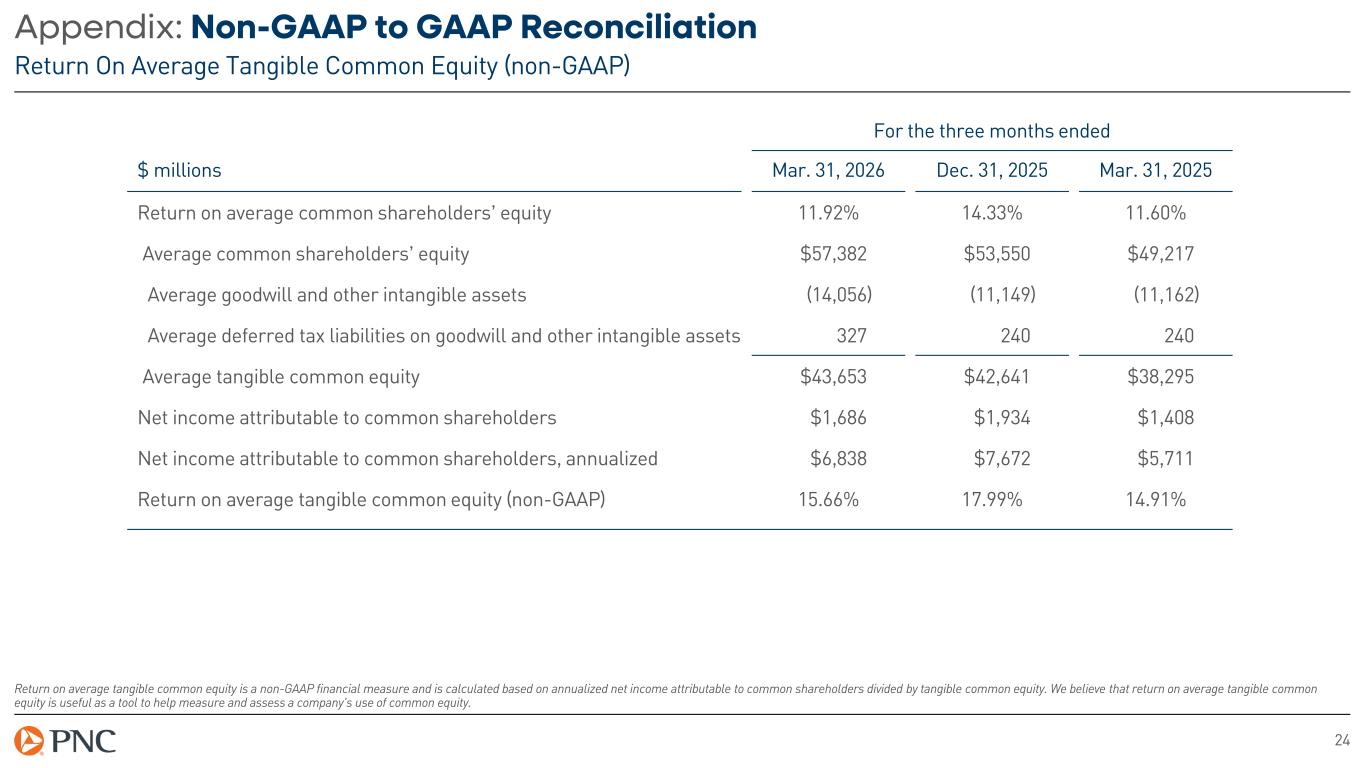
24 Appendix: Non-GAAP to GAAP Reconciliation Return On Average Tangible Common Equity (non-GAAP) Return on average tangible common equity is a non-GAAP financial measure and is calculated based on annualized net income attributable to common shareholders divided by tangible common equity. We believe that return on average tangible common equity is useful as a tool to help measure and assess a company's use of common equity. For the three months ended $ millions Mar. 31, 2026 Dec. 31, 2025 Mar. 31, 2025 Return on average common shareholders’ equity 11.92% 14.33% 11.60% Average common shareholders’ equity $57,382 $53,550 $49,217 Average goodwill and other intangible assets (14,056) (11,149) (11,162) Average deferred tax liabilities on goodwill and other intangible assets 327 240 240 Average tangible common equity $43,653 $42,641 $38,295 Net income attributable to common shareholders $1,686 $1,934 $1,408 Net income attributable to common shareholders, annualized $6,838 $7,672 $5,711 Return on average tangible common equity (non-GAAP) 15.66% 17.99% 14.91%
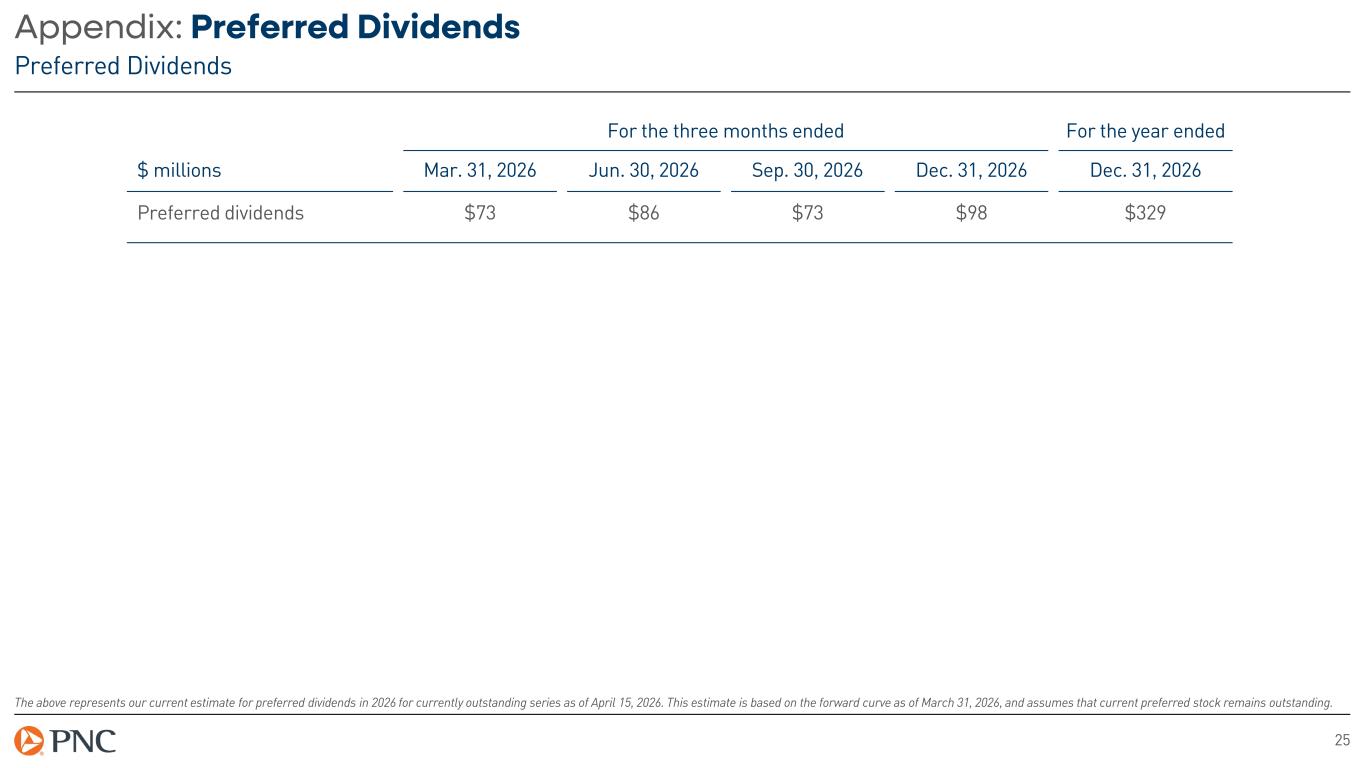
25 Appendix: Preferred Dividends Preferred Dividends The above represents our current estimate for preferred dividends in 2026 for currently outstanding series as of April 15, 2026. This estimate is based on the forward curve as of March 31, 2026, and assumes that current preferred stock remains outstanding. For the three months ended For the year ended $ millions Mar. 31, 2026 Jun. 30, 2026 Sep. 30, 2026 Dec. 31, 2026 Dec. 31, 2026 Preferred dividends $73 $86 $73 $98 $329
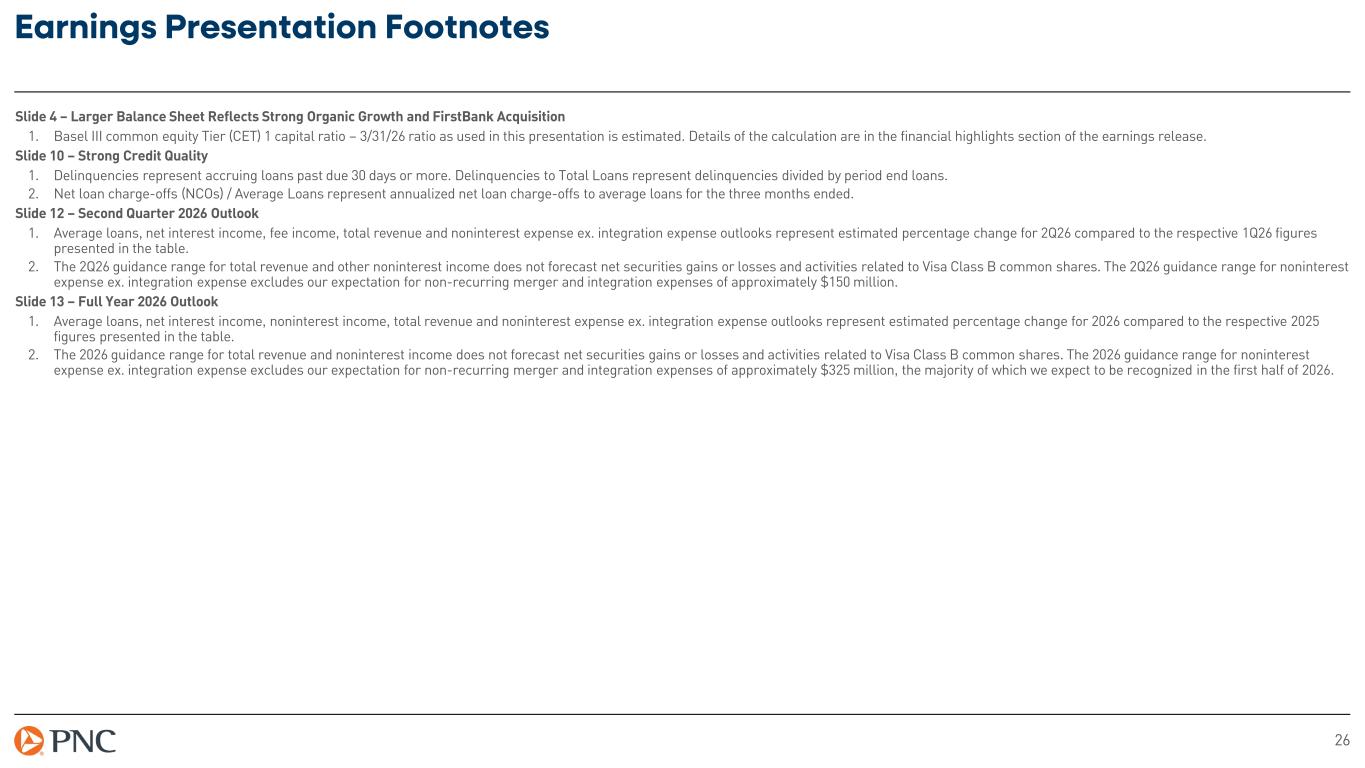
26 Earnings Presentation Footnotes Slide 4 – Larger Balance Sheet Reflects Strong Organic Growth and FirstBank Acquisition 1. Basel III common equity Tier (CET) 1 capital ratio – 3/31/26 ratio as used in this presentation is estimated. Details of the calculation are in the financial highlights section of the earnings release. Slide 10 – Strong Credit Quality 1. Delinquencies represent accruing loans past due 30 days or more. Delinquencies to Total Loans represent delinquencies divided by period end loans. 2. Net loan charge-offs (NCOs) / Average Loans represent annualized net loan charge-offs to average loans for the three months ended. Slide 12 – Second Quarter 2026 Outlook 1. Average loans, net interest income, fee income, total revenue and noninterest expense ex. integration expense outlooks represent estimated percentage change for 2Q26 compared to the respective 1Q26 figures presented in the table. 2. The 2Q26 guidance range for total revenue and other noninterest income does not forecast net securities gains or losses and activities related to Visa Class B common shares. The 2Q26 guidance range for noninterest expense ex. integration expense excludes our expectation for non-recurring merger and integration expenses of approximately $150 million. Slide 13 – Full Year 2026 Outlook 1. Average loans, net interest income, noninterest income, total revenue and noninterest expense ex. integration expense outlooks represent estimated percentage change for 2026 compared to the respective 2025 figures presented in the table. 2. The 2026 guidance range for total revenue and noninterest income does not forecast net securities gains or losses and activities related to Visa Class B common shares. The 2026 guidance range for noninterest expense ex. integration expense excludes our expectation for non-recurring merger and integration expenses of approximately $325 million, the majority of which we expect to be recognized in the first half of 2026.